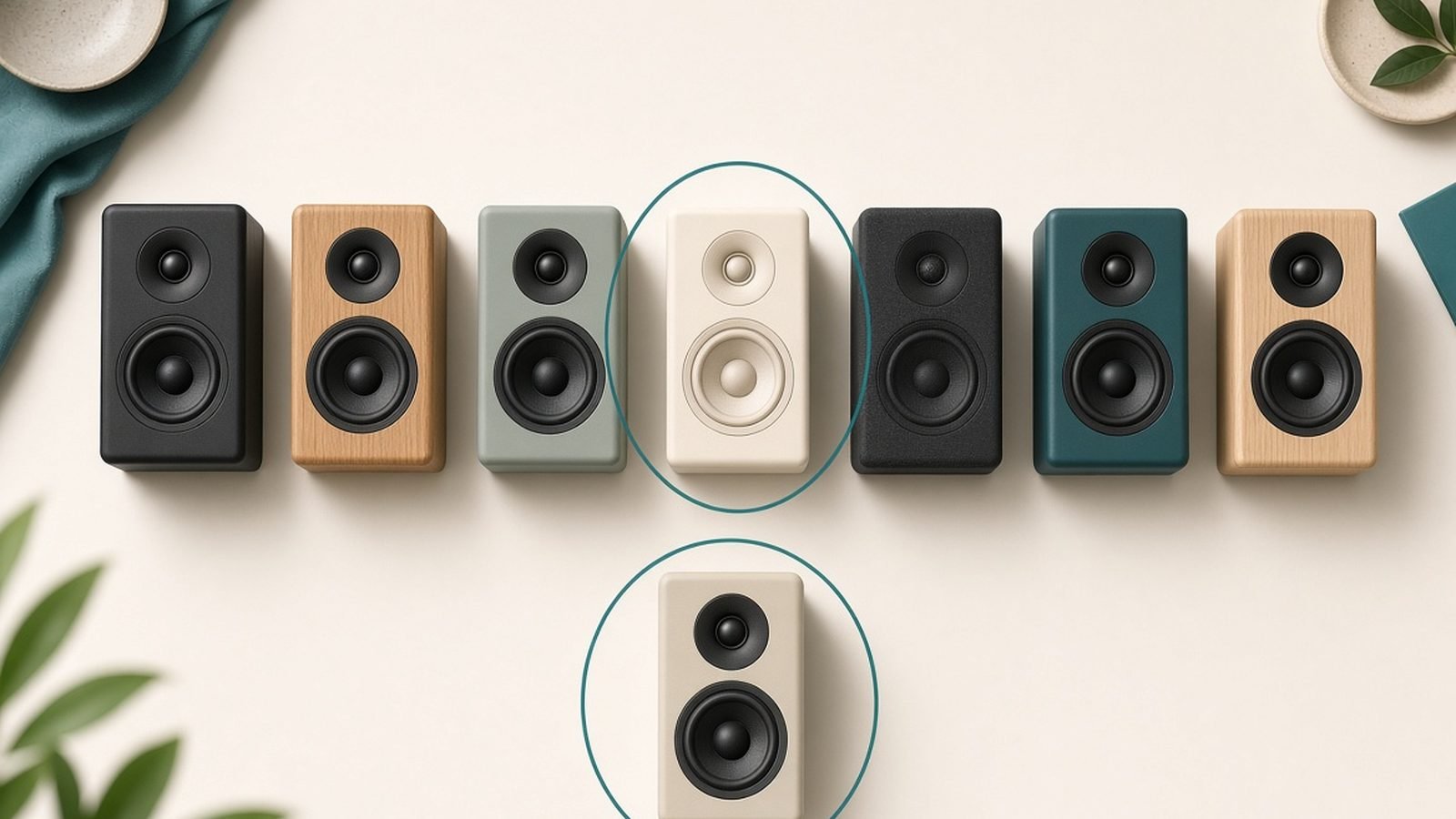
The best bookshelf speakers in 2026 depend on whether you want an all-in-one system or a traditional hi-fi setup — but for most people, the powered KEF LSX II LT is the smartest pick, delivering genuine audiophile sound with the amplifier and streaming built in. If you already own or want a separate amplifier, the passive Q Acoustics 3030i offer the best sound-per-dollar in hi-fi, while the powered Edifier R1280DBs are the budget champion that gets great sound into any room for very little money.
This guide covers five bookshelf speakers worth your money in 2026 — a mix of powered (active) and passive designs — based on our spec research, manufacturer documentation and aggregated owner and reviewer feedback across US and UK retailers. We don’t fabricate measurements; every strength and flaw below is grounded in published specs or recurring owner reports.
Bookshelf speakers serve a different job from headphones and soundbars — room-filling stereo sound for music and desktops. If you’d rather listen privately, our Best Headphones 2026: Over-Ear Picks for Every Budget guide covers over-ears, and Best Wireless Earbuds 2026: Top Picks Compared & Ranked handles portable listening.
Best Bookshelf Speakers 2026 at a Glance
| Pick | Product | Type | Best for | Price (US / UK) |
|---|---|---|---|---|
| Best overall | KEF LSX II LT | Powered | All-in-one hi-fi | around $999 / £899 |
| Best value hi-fi | Q Acoustics 3030i | Passive | Amp owners | around $449 / £329 |
| Best budget powered | Edifier R1280DBs | Powered | Easy setup, low cost | around $149 / £129 |
| Best premium passive | KEF LS50 Meta | Passive | Serious listeners | around $1,599 / £1,199 |
| Best desktop powered | Kanto YU4 | Powered | Desks and small rooms | around $399 / £369 |
Prices vary with finish and frequent sales, especially on the passive pairs. Treat these as guidance and check current pricing before you buy. Remember that passive speakers also need an amplifier, which adds to the total.
How We Picked
Bookshelf speakers split into two camps — powered (amplifier built in) and passive (separate amp needed) — and we judged both on the same core criteria:
- Sound quality for the price. Tonal balance, imaging, bass extension and how they scale with better sources.
- What’s in the box. Powered speakers include amplification and often streaming; passive speakers need extra kit, which changes the real cost.
- Room fit and connectivity. How forgiving they are on a desk versus a large room, and what you can actually plug in — streaming, HDMI, optical, analog.
- Build, features and value. Cabinet quality, included extras, and how often each pair sells below list.
Conclusions come from published specs, manufacturer documentation and aggregated owner and reviewer feedback across both markets — never invented test numbers. Recurring issues in owner reports make the write-up.
Best Overall: KEF LSX II LT
Around $999 / £899 · Powered (active) · Wi-Fi streaming, Bluetooth, HDMI ARC, optical · Uni-Q driver · app control
The KEF LSX II LT is the pick for most people because it collapses an entire hi-fi system into two speakers. Inside each cabinet is amplification, streaming and KEF’s acclaimed Uni-Q driver array — the same coaxial design philosophy that makes KEF’s pricier speakers image so precisely, with the tweeter sitting in the center of the midrange cone. The result is a genuinely audiophile presentation: detailed, spacious and remarkably coherent for the size, with a soundstage that belies the compact cabinets.
The convenience is the other half of the story. You get Wi-Fi streaming (AirPlay, Chromecast and the major services), Bluetooth, HDMI ARC for a TV, and optical and analog inputs, all managed through KEF’s app. There’s no separate amplifier or streamer to buy and no rack of boxes — just two speakers and a power lead. For a clean, modern setup that still satisfies a critical ear, nothing else here is as complete.
The trade-offs are price and bass. At around $999 / £899 it’s a real investment, and like most compact speakers it benefits from a subwoofer if you want deep low end for films or electronic music. The “LT” trims a couple of features from the full LSX II (there’s no USB-C or dedicated sub output on some configurations, so check the spec), but the core sound and streaming remain. For all-in-one hi-fi in a small footprint, this is the one to beat.
Pros:
- Audiophile Uni-Q sound with precise imaging in a compact size
- Complete all-in-one system — amp and streaming built in
- Extensive connectivity including HDMI ARC and Wi-Fi
- Clean, modern setup with excellent app control
Cons:
- Expensive for its size
- Needs a subwoofer for deep bass
- “LT” trims a few features from the full LSX II
Who it’s for: People who want genuine hi-fi sound and modern streaming convenience without assembling a separate amplifier, streamer and cabling.
Best Value Hi-Fi: Q Acoustics 3030i
Around $449 / £329 · Passive · Requires amplifier · 5-inch woofer · ported cabinet
The Q Acoustics 3030i are the enthusiast’s value pick and a long-standing critical darling. These are passive speakers — you supply the amplifier — but that separation is exactly why they punch so far above their price. Q Acoustics put the budget into the drivers and cabinet rather than built-in electronics, and the payoff is a warm, refined, room-filling sound with surprisingly full bass from the larger 5-inch woofer, easily besting most powered speakers near this price.
They’re forgiving to live with, too. The cabinet is well-damped, the sound is smooth rather than fatiguing, and they pair happily with affordable stereo amplifiers or AV receivers. For anyone building a first proper hi-fi system, or upgrading from a soundbar to real stereo, this is the classic recommendation that rewards you every time you improve the amp or source feeding them.
The catch is hidden cost and setup. You’ll need an amplifier — budget at least $150–$300 / £120–£250 for a decent one — plus speaker cable and stands or a solid shelf. That makes the true cost higher than the sticker suggests. But for pure sound-per-dollar in a traditional system, nothing here beats them.
Pros:
- Outstanding sound quality for the price
- Warm, refined, room-filling presentation with full bass
- Easy to drive; pairs well with affordable amps
- Rewards future upgrades to amp and source
Cons:
- Needs a separate amplifier and cable — higher true cost
- More setup than a powered pair
- No built-in streaming or Bluetooth
Who it’s for: Buyers who own or want a separate amplifier and want the best possible sound-per-dollar in a traditional hi-fi setup.
Best Budget Powered: Edifier R1280DBs
Around $149 / £129 · Powered (active) · Bluetooth, optical, coaxial, dual RCA, sub output · included remote
The Edifier R1280DBs are the budget champion and the easiest way to get genuinely good stereo sound into any room. They’re powered, so the amplifier is built in — plug them into the wall, connect a source, and you’re done. Despite the low price, they deliver a clear, pleasant, notably better sound than any soundbar or smart speaker near this money, with a warmth that suits everything from podcasts to background music to casual critical listening.
Connectivity is the standout for the price: Bluetooth for phones, optical and coaxial for TVs, dual RCA analog inputs, and a subwoofer output if you want to add low end later. There’s a remote and simple bass and treble controls on the cabinet. For a bedroom, home office, or a first stereo system on a tight budget, these overdeliver at every turn.
The trade-offs are what you’d expect at the price. Bass is decent but not deep, the drivers don’t scale to the refinement of the pricier picks, and the build is plain particleboard. They won’t satisfy a demanding audiophile in a large room. But as a cheap, complete, sound-good-anywhere pair, nothing here matches the value.
Pros:
- Excellent sound for a very low price
- Amp built in — plug-and-play simplicity
- Broad connectivity including optical, Bluetooth and sub out
- Remote and onboard tone controls included
Cons:
- Limited bass depth and ultimate refinement
- Plain particleboard build
- Underpowered for large rooms
Who it’s for: Anyone who wants real stereo sound in a bedroom, office or first system for as little money as possible, with zero extra kit to buy.
Best Premium Passive: KEF LS50 Meta
Around $1,599 / £1,199 · Passive · Requires amplifier · Uni-Q driver with Metamaterial Absorption Technology
The KEF LS50 Meta are the serious listener’s pick and one of the most acclaimed bookshelf speakers of the era. They’re passive, demanding a quality amplifier, but they reward it with a level of detail, imaging and neutrality that most speakers at any price can’t touch. The Uni-Q driver, enhanced with KEF’s Metamaterial Absorption Technology that soaks up unwanted rear sound from the tweeter, produces an exceptionally clean, holographic soundstage that seems to detach from the speakers entirely.
These are speakers you sit down and listen to. Feed them good recordings and a capable amp and they disappear, leaving only the music positioned precisely in space. For a dedicated two-channel setup or high-end desktop, they hit the sweet spot where hi-fi performance and real-world price still meet.
The costs are significant and honest. At around $1,599 / £1,199 they’re the priciest pick here, and because they demand a good amplifier the total system cost climbs well beyond the speakers alone. They also want stands and a subwoofer for deep bass. But if you want reference-grade sound from a compact pair, these are the benchmark.
Pros:
- Reference-grade detail, imaging and neutrality
- Metamaterial tech delivers an exceptionally clean soundstage
- Compact footprint for the performance
- A genuine end-game speaker for many listeners
Cons:
- Expensive, and demands a quality amplifier
- High total system cost; wants stands and space
- Benefits from a subwoofer for deep bass
Who it’s for: Committed listeners building a dedicated hi-fi or premium desktop who want reference sound and already have — or will buy — a capable amplifier.
Best Desktop Powered: Kanto YU4
Around $399 / £369 · Powered (active) · Bluetooth, optical, dual RCA, phono, sub output · included remote
The Kanto YU4 are the best bookshelf speakers for a desk or small room, purpose-built for near-field listening. They’re powered, with the amplifier inside, and they’re sized and voiced to sound their best a few feet from your ears rather than across a large lounge. The sound is clear, punchy and detailed, with better bass than the Edifier, making them a big step up for a computer setup, turntable corner or compact living space.
The feature set is genuinely useful. A built-in phono preamp lets you connect a turntable directly without extra boxes — a real convenience for vinyl on a desk. You also get Bluetooth, optical, dual RCA inputs, a subwoofer output, a remote and a range of desk-friendly finishes. For the money, it’s a complete, tidy, great-sounding desktop system.
The trade-offs are scale and value positioning. They can’t fill a large room the way the KEF or a strong passive setup can, and at around $399 / £369 they sit above the budget Edifier, so they only make sense if you value the extra sound quality, phono stage and finish. For a desk or small room, though, they’re the sweet spot.
Pros:
- Excellent near-field sound tuned for desks and small rooms
- Built-in phono preamp for direct turntable connection
- Strong connectivity and attractive finishes
- Complete powered system with remote
Cons:
- Not built to fill a large room
- Pricier than budget powered rivals
- Bass still benefits from an added subwoofer
Who it’s for: Desktop listeners, vinyl dabblers and small-room owners who want a tidy, powered system with a phono input and better sound than budget pairs.
How to Choose
Bookshelf speakers come down to a few key decisions.
Powered or passive? Powered speakers (KEF LSX II LT, Edifier, Kanto) include the amplifier and often streaming — simpler and complete in the box. Passive speakers (Q Acoustics, KEF LS50 Meta) need a separate amp and cable, which adds cost but lets you upgrade each part over time and often extracts more sound-per-dollar. Beginners lean powered; enthusiasts building a system lean passive.
Match the speaker to the room. Near-field on a desk favors the Kanto YU4 or Edifier; a small-to-medium living room suits the KEF LSX II LT or Q Acoustics 3030i; a dedicated listening space justifies the LS50 Meta. Bigger rooms need more capable speakers and amplification.
Budget for the whole system. With passive picks, add the amplifier, cable and stands. A $449 / £329 passive pair can cost $700+ / £550+ once you factor in a decent amp — still excellent value, but plan for it.
Consider a subwoofer. Every compact speaker here trades deep bass for size. If you love films or electronic music, budget for a sub, which most of these pairs support via a dedicated output.
FAQ
What are the best bookshelf speakers in 2026?
For most people, the powered KEF LSX II LT is the best all-in-one, delivering hi-fi sound with amplification and streaming built in. The passive Q Acoustics 3030i offer the best sound-per-dollar for amp owners, the Edifier R1280DBs are the budget champion, the KEF LS50 Meta are the premium passive pick, and the Kanto YU4 are best for desks.
Are powered or passive bookshelf speakers better?
Neither is universally better. Powered (active) speakers include the amplifier and often streaming, making them simpler and tidier — ideal for beginners and minimalists. Passive speakers need a separate amp but let you upgrade components over time and often deliver more sound-per-dollar. Choose powered for convenience, passive for flexibility and system-building.
Do I need an amplifier for bookshelf speakers?
Only for passive speakers, like the Q Acoustics 3030i and KEF LS50 Meta — they require a separate stereo amplifier or AV receiver plus speaker cable. Powered speakers such as the KEF LSX II LT, Edifier R1280DBs and Kanto YU4 have the amplifier built in, so you just add a source. Factor the amp into your budget for passive pairs.
What are the best bookshelf speakers for a small room or desk?
The Kanto YU4 are purpose-built for desks and small rooms, with near-field tuning and a built-in phono preamp for turntables. The Edifier R1280DBs are the budget option, and the compact KEF LSX II LT suits a small living space. All three are powered, so no separate amplifier is needed.
Do bookshelf speakers need a subwoofer?
Not necessarily, but they benefit from one if you want deep bass for films or electronic music, since compact cabinets trade low-end extension for size. Every pick here has a subwoofer output or supports adding one. For casual music and general listening, most people find these speakers full enough on their own.
Zen Tech Hub may earn a commission from links on this page, at no extra cost to you.