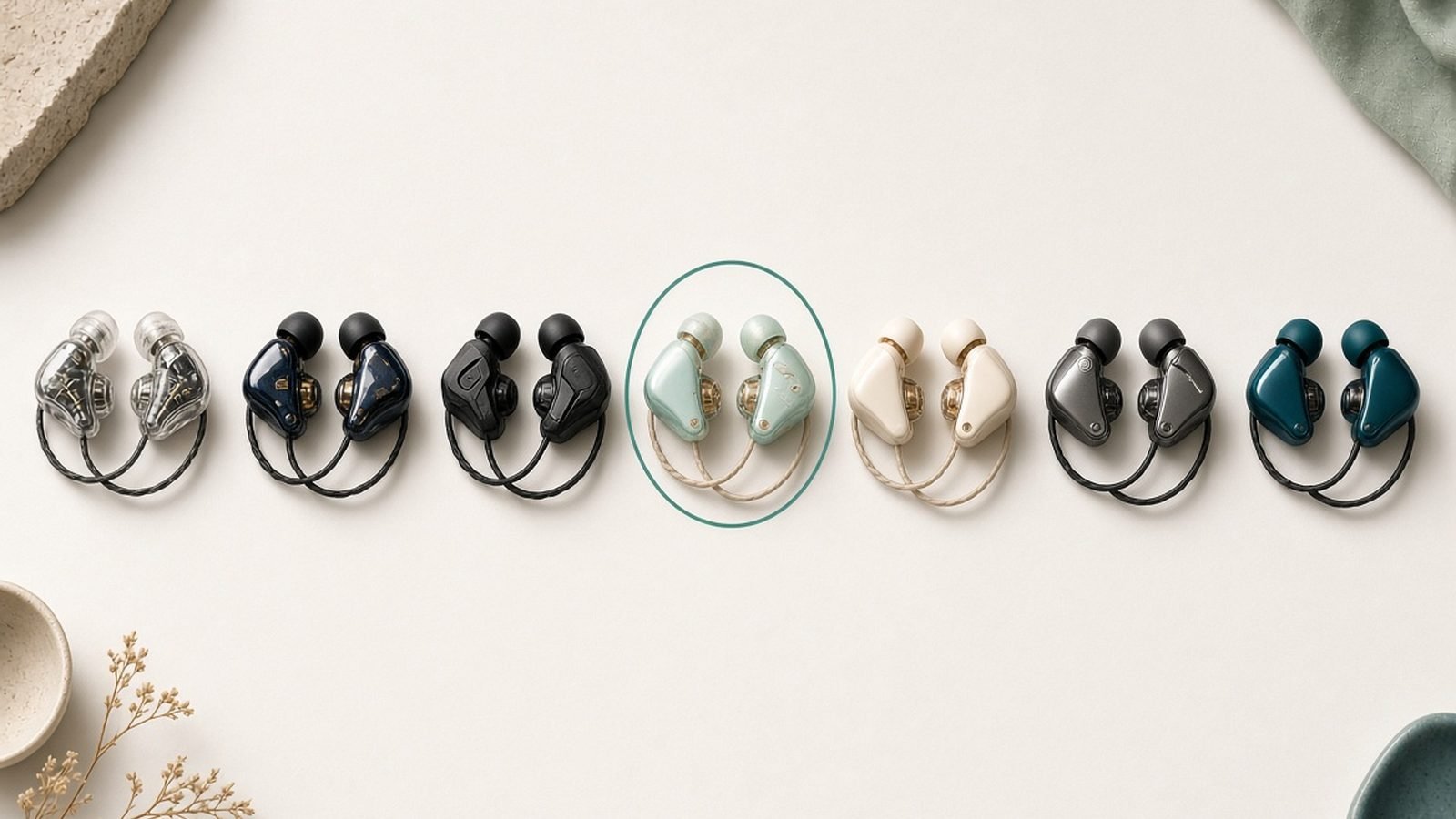
Here’s the uncomfortable truth the wireless earbud industry would rather you didn’t hear: the best IEMs under $100 sound better than almost every Bluetooth earbud on the market, including sets costing $250+. Not “better for the money” — better, full stop. A $25 wired in-ear monitor from a Chinese brand you’ve never heard of will out-resolve AirPods Pro, and a $55 one will embarrass most flagship wireless sets.
This guide covers the five budget IEMs actually worth your money in 2026, from a $20 starter set to a $100 isolation monster, plus the one $9 accessory most phone owners will need. If you’re graduating from AirPods and want to hear what your music has been hiding, start here. (Need wireless convenience instead? Our best budget earbuds guide covers the Bluetooth side of the ledger.)
Why Wired IEMs Destroy Bluetooth Earbuds for Sound-Per-Dollar
The IEM vs earbuds difference comes down to where the money goes. A $150 wireless earbud has to pay for Bluetooth chips, batteries, microphones, ANC processors, charging cases and app development — often leaving less than $20 of the build budget for the parts that make sound. A $50 wired IEM spends nearly everything on drivers, tuning and acoustics.
Wired also sidesteps Bluetooth’s compression bottleneck entirely. Even good codecs like LDAC are lossy, and the standard AAC/SBC most people actually get is worse — we’ve broken down exactly what you lose in Bluetooth Codecs Explained: AAC vs aptX vs LDAC vs LC3.
The result: audiophile earbuds on a budget are not a compromise category anymore. The Chinese hi-fi (“ChiFi”) boom of the last five years drove a brutal race to the top in tuning quality, and the picks below are the survivors. If you genuinely need wireless for the gym or commute, keep a pair — our Best Wireless Earbuds Under $100 (£80) in 2026: Ranked guide has you covered — but for desk listening, these win by a landslide.
Best Budget IEMs 2026: Top Picks at a Glance
| Pick | Model | Price | Drivers | Best For |
|---|---|---|---|---|
| Best overall | Truthear ZERO:RED | ~$55 / £50 | 2x dynamic | Almost everyone |
| Best under $25 | 7Hz Salnotes Zero 2 | ~$25 / £23 | 1x dynamic | First-time buyers |
| Cheapest good IEM | Truthear GATe | ~$20 / £18 | 1x dynamic | Absolute beginners |
| Best technical performer | Truthear Hexa | ~$80 / £70 | 1DD + 3BA | Detail lovers |
| Best vocals & isolation | Etymotic ER2XR | ~$100 / £90 | 1x dynamic | Commuters, vocal fans |
| Essential add-on | Apple USB-C to 3.5mm | ~$9 / £9 | — | Phones without a jack |
The Best IEMs Under $100: Full Reviews
Best Under $25: 7Hz Salnotes Zero 2
Price: around $25 / £23
The original Salnotes Zero was the set that convinced thousands of skeptics that a sub-$25 IEM could be genuinely well tuned. The Zero 2 keeps that near-neutral foundation and adds a healthy bass shelf — roughly 3dB more low-end warmth — which makes it an easier first listen for anyone coming from consumer earbuds.
In our research across hundreds of owner reports and published frequency measurements, the Zero 2’s tuning holds up against sets three times its price: controlled treble with no harsh spikes, clear mids, and bass that adds punch without smearing into the vocals. Its single 10mm dynamic driver won’t win technicality contests — stage is intimate, and busy metal or orchestral tracks can congest slightly — but nothing under $30 clearly beats it.
The compromises are all outside the shell. The included cable is thin and springy, the eartips are basic, and there’s no case. All fixable later for a few dollars, and none of it affects the sound.
Pros
- Class-leading tuning for the price; fun but controlled bass
- Lightweight, comfortable shells that suit most ears
- Detachable 2-pin cable — upgradeable, unlike fixed-cable buds
Cons
- Basic cable and accessories
- Average detail retrieval and soundstage vs $50+ sets
- No case or foam tips included
Who it’s for: anyone spending $25 or less who wants to hear what the IEM hype is about. It’s the default answer in the “7Hz Salnotes Zero 2 vs Truthear GATe” debate if you want a touch more bass and a slightly more relaxed treble.
Check price: 7Hz Salnotes Zero 2
Best Under $30 Alternative: Truthear GATe
Price: around $20 / £18
At $20, the Truthear GATe is the cheapest IEM we’re comfortable recommending to anyone, which makes it one of the best IEMs for beginners full stop. It’s a single dynamic driver in a light resin shell, tuned close to the Harman-style curve that Truthear built its reputation on: warm-neutral, vocal-forward, nothing offensive anywhere in the range.
Based on aggregated owner feedback, the GATe’s standout trait is comfort — the shells are small and rounded, and it disappears in ears that find chunkier ChiFi sets fatiguing. Tuning-wise it’s slightly leaner in the bass than the Zero 2 and a touch smoother up top, which suits acoustic music, podcasts and long listening sessions.
Manage expectations on raw performance: resolution, imaging precision and dynamic punch are all “fine for $20” rather than remarkable. Fast, layered tracks will sound flatter here than on the ZERO:RED or Hexa. That’s the deal at this price, and it’s still a spectacular deal.
Pros
- Absurd tuning quality for around $20 / £18
- Small, genuinely comfortable shells — great for small ears
- Smooth, fatigue-free treble for long sessions
Cons
- Limited technical performance vs $50+ sets
- Bass lacks the physicality bass lovers want
- Accessories are as basic as the price suggests
Who it’s for: absolute beginners, kids, backup pairs, or anyone who wants to test the wired waters for the price of two takeout coffees and a sandwich.
Best Overall: Truthear ZERO:RED
Price: around $55 / £50
If this guide had one answer, it would be the ZERO:RED. Any honest Truthear Zero Red review lands in the same place: this is one of the best-tuned IEMs ever made at any price, and it happens to cost about $55. Co-designed with reviewer Crinacle, it uses two dynamic drivers — a dedicated 7.8mm woofer and a 10mm driver — to deliver neutral-with-sub-bass tuning that measures almost eerily close to modern preference targets.
What that means in plain English: bass that digs deep and hits hard without ever bleeding into vocals, mids that sound correct on every genre, and treble with detail but no sizzle. In our research, it’s the set most often cited by owners as “the moment I got it” — the upgrade where the difference from mainstream earbuds stops being subtle. Detail and separation are a clear step up from the $20-25 class too.
Two real caveats. The shells are on the larger side, so smaller ears should pay attention to fit reports. And the dual-driver design is relatively power-hungry for an IEM — it’ll play from any phone, but it wakes up properly with a dongle DAC (see below). There’s also an optional 10-ohm impedance adapter in the box that adds even more sub-bass, a genuinely fun party trick.
Pros
- Benchmark tuning: deep, clean bass with genuinely neutral mids and treble
- Noticeable technical step up from sub-$30 sets
- Included impedance adapter offers a second, bassier tuning
Cons
- Large-ish shells won’t suit every ear
- Less sensitive than most IEMs — benefits from a dongle DAC
- Understated looks, modest accessories
Who it’s for: almost everyone. If you have $55 and functioning ears, buy this. It’s the “graduate from AirPods” pick — the set that makes the whole hobby make sense.
Check price: Truthear ZERO:RED
Best Technical Performer: Truthear Hexa
Price: around $80 / £70
The Hexa is where budget IEMs start sounding expensive. It pairs one dynamic driver for bass with three balanced armature drivers handling mids and treble, and that hybrid setup buys you the things cheap single-driver sets can’t do: sharper imaging, cleaner instrument separation, and micro-detail that survives busy mixes.
Its tuning has become a reference point in the hobby — so neutral and spike-free that reviewers routinely use it as the sub-$100 benchmark. Based on hundreds of owner reports, it’s the pick for classical, jazz, acoustic and anyone who listens into recordings rather than just along with them. Vocals in particular are rendered with a precision the Zero 2 and GATe can’t touch.
The flip side of all that politeness: bass quantity is honest rather than fun. If you love hip-hop, EDM or anything that lives in the low end, the ZERO:RED is the better $55 — and the better choice, period. Like the RED, the Hexa also appreciates a little extra power from a dongle.
Pros
- Best detail retrieval and imaging under $100
- Reference-grade neutral tuning with smooth treble
- Comfortable, well-built metal-and-resin shells
Cons
- Bass is polite — bassheads will be left wanting
- Needs a bit of power to sound its best
- Stock cable is famously mediocre
Who it’s for: detail-obsessed listeners and neutral-tuning fans who’d rather hear everything in the mix than feel the kick drum in their chest.
Best for Vocals and Isolation: Etymotic ER2XR
Price: around $100 / £90
Etymotic has been making in-ear monitors since before “ChiFi” existed, and the ER2XR is its accessible classic. The pitch is unique: a deep-insertion design that seats the eartip much further into your ear canal than any other set here. The payoff is passive noise isolation in the 35-42dB range — better than most active noise cancelling — and a midrange focus that makes vocals sound almost surgically clear.
The XR (“extended response”) tuning adds a modest bass lift over Etymotic’s famously flat house sound, so it’s warm enough for modern music while keeping that laser-etched vocal presentation. In our research, ER2XR owners are among the most loyal in the hobby: for voices, strings and detail at low volumes on a loud train, nothing under $100 competes.
The dealbreaker is the fit, and it genuinely divides people. The deep insertion with triple-flange tips feels invasive for the first week, and a minority never adjust. Soundstage is also intimate — everything happens inside your head, precisely, rather than around it.
Pros
- Best-in-class passive isolation — ANC-beating, with zero battery
- Gorgeous, focused vocal and midrange reproduction
- Coherent single dynamic driver, easy to drive
Cons
- Deep-insertion fit is polarising; some people never get used to it
- Narrow soundstage
- Fixed accessories ecosystem; standard eartips don’t apply
Who it’s for: commuters and frequent flyers who want silence without ANC, and anyone whose library is built on voices — singer-songwriter, podcasts, classical, jazz.
Do You Need a Dongle DAC for IEMs?
Short answer: you need a headphone output, and your phone probably doesn’t have one. Do you need a DAC for IEMs beyond that? Usually not an expensive one.
Every IEM here runs happily from a laptop’s 3.5mm jack or a basic dongle. For phones without a headphone jack — so, nearly all of them in 2026 — the Apple USB-C to 3.5mm adapter at around $9 / £9 is the answer. It measures far better than its price suggests and works with Android as well as iPhone. That’s the whole recommendation: don’t let anyone upsell you a $100 dongle to drive a $55 IEM.
Check price: Apple USB-C to 3.5mm adapter
One nuance: the ZERO:RED and Hexa are less sensitive than average, so on the Apple dongle you’ll be running volume higher than you’re used to. That’s fine — it has headroom. If you later want more power and a blacker background, a $50-70 dongle from the likes of Moondrop or Fiio is a sensible endgame, not a requirement.
Eartips, Cables and Fit: Getting the Most From Cheap IEMs
Fit is half the sound of any IEM. A broken seal kills bass instantly, which is behind most “these sound thin” complaints in owner reviews. Spend five minutes trying every included tip size, and consider $10-15 aftermarket tips (Spinfit, Final E, or foams) — it’s the highest-value upgrade in audio. Wax build-up does the same over time — our guide to cleaning earbuds safely applies just as well to IEMs.
Cables matter for comfort and durability, not sound. All the ChiFi picks here use detachable 2-pin cables, so a fraying stock cable is a $10 replacement, not a dead IEM. Ignore anyone selling “audible” $200 cable upgrades.
Two habits worth building: wear the cable over your ears (it’s designed that way, and kills cable noise), and insert tips with a slight twist for a proper seal. That’s it — no burn-in rituals required.
How Budget IEM Tuning Is Measured (The 60-Second Version)
You’ll see “Harman target” everywhere in this hobby. It refers to research from Harman International that measured what frequency response most listeners actually prefer: roughly neutral mids and treble with a moderate bass boost. Reviewers measure IEMs on standardised ear-simulator rigs and compare the resulting frequency-response graph to that target.
It’s why $20 sets can now compete with $200 ones: good tuning is knowledge, not expensive hardware, and ChiFi brands iterate on public measurements at ruthless speed. Graphs don’t capture everything — fit, driver quality and technicalities still separate the Hexa from the GATe — but they’re why “cheap” no longer means “bad.” Every pick in this guide tracks close to modern preference targets, by design.
Which Should You Buy?
- Just curious, minimal spend: Truthear GATe (~$20 / £18) or 7Hz Salnotes Zero 2 (~$25 / £23). Pick the Zero 2 if you want more bass.
- One correct answer: Truthear ZERO:RED (~$55 / £50), plus the $9 Apple dongle if your phone lacks a jack. This combo is the best $65 in audio.
- Detail above all: Truthear Hexa (~$80 / £70).
- Silence on the commute, vocals first: Etymotic ER2XR (~$100 / £90).
Whatever you pick from the best IEMs under $100, budget $10 for eartips before you budget anything else. For more of our audio coverage — including whether the latest AirPods justify their price against these sets (AirPods Pro 3 Long-Term Review: 9 Months Later (2026)) — head to our hub at Audio.
FAQ
What’s the difference between IEMs and earbuds?
IEMs (in-ear monitors) seal inside your ear canal with silicone or foam tips, which improves bass response, detail and noise isolation. “Earbuds” traditionally rest loosely in the outer ear, though the term now covers wireless sets too. Practically, wired IEMs deliver far better sound per dollar because no budget is spent on batteries, Bluetooth or ANC hardware.
Are the best wired earbuds under £100 really better than AirPods?
For pure sound quality, yes — comfortably. A ~£50 Truthear ZERO:RED resolves more detail and produces cleaner, deeper bass than AirPods Pro, based on widespread measurement data and owner comparisons. What you give up is convenience: no ANC, no mic controls on most sets, and a cable. Many listeners keep both for different situations.
Do you need a DAC or amp for budget IEMs?
Not a dedicated one. Every IEM in this guide runs from a laptop jack or a $9 / £9 Apple USB-C dongle. The Truthear ZERO:RED and Hexa are harder to drive than average, so you’ll use more volume, but the Apple dongle still has enough headroom. Expensive DACs are a luxury here, not a requirement.
Which are the best IEMs for beginners?
The Truthear GATe at around $20 / £18 if you want the cheapest safe entry, or the 7Hz Salnotes Zero 2 at ~$25 / £23 for a bit more bass. If your budget stretches to ~$55 / £50, skip straight to the Truthear ZERO:RED — it’s the set beginners least often outgrow.
7Hz Salnotes Zero 2 vs Truthear GATe — which should I get?
They’re closer than their fanbases admit. The Zero 2 has slightly more bass punch and a marginally more energetic presentation; the GATe is smoother, leaner and comes in smaller, comfier shells. Choose the Zero 2 for pop, hip-hop and electronic music; choose the GATe for small ears, long sessions and vocal-centric listening.
Can I use these IEMs for phone calls?
Mostly no — that’s the honest trade-off. The ChiFi picks here ship with microphone-free cables (some sellers offer a mic cable variant for a couple of dollars more). If calls are a daily requirement, keep wireless earbuds for meetings and use IEMs for actual listening. Your ears and your colleagues will both be better served.
Zen Tech Hub may earn a commission from links on this page, at no extra cost to you.