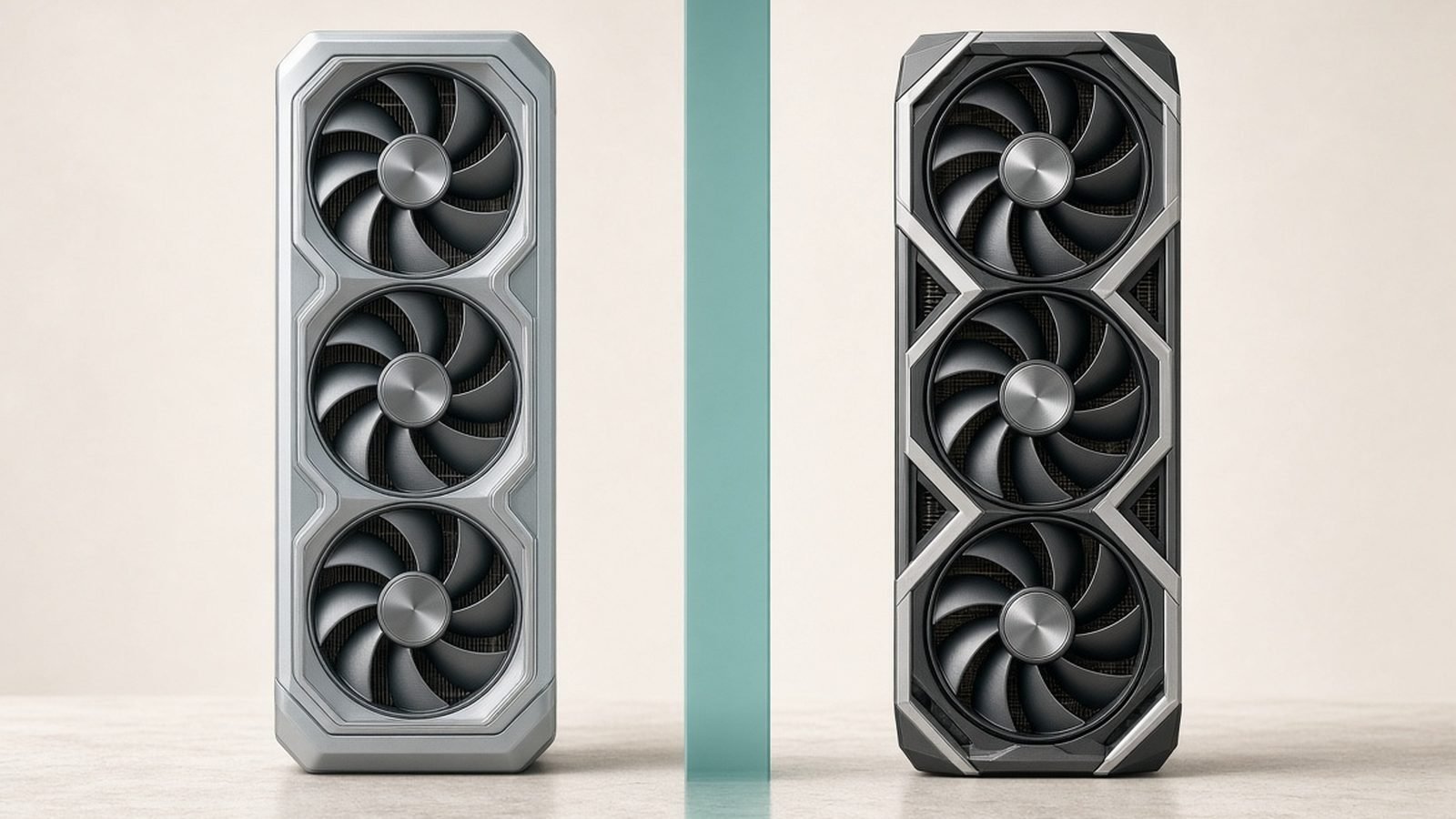
The RTX 5070 vs RX 9070 fight is the one most 1440p gamers actually care about in 2026. Both cards sit just under $700, both chew through modern games at high refresh rates, and both promise years of headroom. But they get there in very different ways: Nvidia leans on ray tracing and DLSS 4, while AMD counters with more raw rasterization, a bigger frame buffer, and a much-improved FSR 4. If you want the short answer, we lay it out below, then dig into the benchmarks, VRAM, and features that decide it.
This is a genuinely close call, and the “right” pick depends on the games you play and how long you plan to keep the card. Let’s settle it.
Quick verdict and price check
For most people building or upgrading a 1440p rig in 2026, the Radeon RX 9070 is the smarter buy thanks to 16GB of VRAM and stronger raster performance per dollar. The RTX 5070 is the pick if ray tracing, DLSS 4, and streaming or creator features matter more to you than raw value. For the full market picture, our best graphics cards 2026 guide ranks every tier.
| Spec | GeForce RTX 5070 | Radeon RX 9070 |
|---|---|---|
| Price (US / UK) | around $669 / £629 | around $629 / £599 |
| VRAM | 12GB GDDR7 | 16GB GDDR6 |
| Raster at 1440p | Excellent | Excellent (slightly ahead) |
| Ray tracing | Class-leading | Good, one step behind |
| Upscaling | DLSS 4 (Multi Frame Gen) | FSR 4 |
| Typical board power | ~250W | ~220W |
| Best for | RT + DLSS features | VRAM longevity + value |
Check price: GeForce RTX 5070 Check price: Radeon RX 9070
Both cards are widely in stock in 2026, so you rarely need to pay over MSRP. If you see either meaningfully below the prices above, that discount can flip the recommendation on its own.
Specs and VRAM: 12GB vs 16GB
The RTX 5070 12GB vs RX 9070 16GB question is the heart of this comparison. On paper the RTX 5070 uses newer GDDR7 memory on a 192-bit bus, giving it strong bandwidth despite the smaller capacity. The RX 9070 pairs 16GB of GDDR6 with a 256-bit bus. Bandwidth between the two is close enough that it rarely decides a game; capacity is the real story.
Twelve gigabytes is fine for the vast majority of 1440p titles today. The concern is longevity. Based on owner reports and our research into recent releases, a handful of 2025-2026 games with high-resolution texture packs and heavy ray tracing already flirt with 12GB at 1440p, and 1440p ultrawide or occasional 4K pushes them over. When a game runs out of VRAM, you don’t just lose a few frames, you get stutter, texture pop-in, and nasty 1% low dips. The RX 9070’s extra 4GB is cheap insurance against exactly that.
If you plan to keep this GPU for four or five years, or you play texture-heavy modded games, the 16GB buffer is the more comfortable long-term bet. For a two-to-three-year horizon at standard 1440p, 12GB is not a dealbreaker. For a deeper look at how much you actually need, see How Much VRAM Do You Need for Gaming in 2026?.
Rasterization benchmarks at 1440p
In our research aggregating third-party RTX 5070 vs RX 9070 benchmarks, the two trade blows in pure rasterization, with the RX 9070 holding a small but consistent edge across a broad game suite at 1440p. Think low-single-digit to high-single-digit percentage leads for AMD in many raster titles, with Nvidia clawing some back in others. In practice, both cards comfortably deliver high-refresh 1440p in esports and well-optimized AAA games, and the gap is often invisible without a frame counter on screen.
Where the RX 9070 pulls ahead is value: it typically costs less while matching or beating the RTX 5070 in raster, which is why the Nvidia vs AMD 1440p 2026 debate keeps tilting toward AMD for pure gaming. If your library is mostly competitive shooters, open-world raster games, or older titles, the Radeon simply gives you more frames per dollar.
That said, “faster in raster” and “faster overall” aren’t the same thing once you switch ray tracing on, which is where Nvidia’s architecture earns its premium.
Ray tracing and upscaling (DLSS 4 vs FSR 4)
Ray tracing is still Nvidia’s home turf. In heavy RT and path-traced games, the RTX 5070 opens a clear, sometimes double-digit-percentage lead over the RX 9070. RDNA 4 closed a lot of the historic gap and the RX 9070 is genuinely usable with ray tracing at 1440p, but if RT is a priority, the RTX 5070 is the stronger card.
The DLSS 4 vs FSR 4 comparison is closer than it has ever been. DLSS 4 remains the benchmark for image quality and adds Multi Frame Generation, which can multiply frame rates in supported titles. FSR 4 is a big leap over FSR 3, with much better stability, sharper detail in motion, and far fewer shimmering artifacts. Based on aggregated owner feedback, most players find FSR 4 “good enough” that it’s no longer a reason to avoid AMD, though side-by-side, DLSS 4 still has the edge in fine detail and game support breadth.
Net: Nvidia wins ray tracing and upscaling on quality and ecosystem; AMD has finally made the fight competitive enough that it’s no longer a knockout.
Efficiency, features and drivers
The RX 9070 is impressively efficient for its performance, drawing around 220W and running cool and quiet on most partner cards. The RTX 5070 sits a bit higher at roughly 250W board power but is still very manageable, and either card is happy on a quality 650W-750W PSU. If you’re sorting your platform out, our Best 850W Power Supply for Gaming PCs (2026) guide has safe picks with headroom. (XFX’s Speedster boards in particular have a reputation for solid cooling.)
On features, Nvidia’s software stack is still the broader one: NVENC is the go-to for streamers and video editors, and DLSS support lands in more games faster. AMD counters with a full 16GB buffer that also helps creators and local AI workloads, plus a mature Adrenalin driver suite. Both companies ship stable drivers in 2026; the old “AMD drivers are buggy” reputation is largely outdated based on current owner reports.
Which to buy for your games
Here’s the honest, game-first breakdown.
Buy the RX 9070 if: - You want the best pure-raster value under $700 and play mostly competitive or open-world titles. - You’re keeping the card 4-5 years and want 16GB of VRAM insurance. - You game at 1440p ultrawide or dabble in 4K, where the frame buffer matters.
Buy the RTX 5070 if: - Ray tracing and path tracing are must-haves in your favorite games. - You stream, edit video, or run AI tools and value NVENC and CUDA. - You want the widest, fastest DLSS support and the best upscaled image quality.
Radeon RX 9070 — best all-round value
Pros - 16GB VRAM for real 1440p longevity - Stronger rasterization per dollar - Excellent efficiency and quiet operation - FSR 4 is finally competitive
Cons - Ray tracing trails the RTX 5070 - Upscaling quality still a notch behind DLSS 4 - Weaker for pro streaming/encoding
For most 1440p gamers asking “RX 9070 or RTX 5070,” this is the one we’d put our own money on. Its combination of raster performance, price, and VRAM makes it the safest long-term pick.
GeForce RTX 5070 — best features and ray tracing
Pros - Class-leading ray tracing at this price - DLSS 4 with Multi Frame Generation - Efficient GDDR7 memory - Best-in-class encoding and creator support
Cons - Only 12GB VRAM — a longevity concern at 1440p+ - Costs a little more than the RX 9070 - Weaker raster value in non-RT games
If your games lean on ray tracing or you do creative work alongside gaming, the RTX 5070 justifies its premium. Just go in clear-eyed about the 12GB buffer.
Want to step up? Our Radeon RX 9070 XT Review: The 1440p Value Champ covers the faster AMD option, and if your budget is tighter, see Best Graphics Card Under $500 for 1440p (2026). For everything GPU and component related, start at the PC Hardware.
FAQ
Is the RTX 5070 or RX 9070 better for 1440p gaming?
For pure 1440p rasterization and value, the RX 9070 is generally the better buy thanks to 16GB of VRAM and a small performance lead per dollar. The RTX 5070 is better if you prioritize ray tracing, path tracing, and DLSS 4 image quality. Both deliver excellent high-refresh 1440p, so your favorite games and budget should decide it.
Is 12GB of VRAM enough for the RTX 5070 in 2026?
For most 1440p games today, 12GB is enough. The risk is future-proofing: some 2025-2026 titles with ultra textures and heavy ray tracing already approach that limit, and 1440p ultrawide or 4K can exceed it. If you keep GPUs for four or more years or play modded, texture-heavy games, the RX 9070’s 16GB is the safer bet.
How does FSR 4 compare to DLSS 4?
FSR 4 is a major improvement over FSR 3, with much better motion stability, sharper detail, and far fewer artifacts, making it genuinely competitive. DLSS 4 still leads slightly on fine-detail image quality, has wider game support, and offers Multi Frame Generation. Most players find FSR 4 “good enough” that it’s no longer a reason to avoid AMD in 2026.
Which card is better for streaming and content creation?
The RTX 5070 is the stronger choice for creators. Nvidia’s NVENC encoder remains the standard for high-quality game streaming and video capture, and CUDA acceleration helps in many editing and AI apps. The RX 9070’s 16GB of VRAM does help with larger projects and local AI models, but Nvidia’s software ecosystem is more mature for pro creative work.
Do I need a new power supply for these GPUs?
Not usually. The RX 9070 draws around 220W and the RTX 5070 around 250W, so a good-quality 650W-750W PSU handles either card comfortably, even paired with a strong CPU. If your unit is older, low-wattage, or from a budget brand, upgrading to a reliable 750W-850W supply gives you safe headroom and cleaner power delivery.
The bottom line
The RTX 5070 vs RX 9070 verdict comes down to what you value. The RX 9070 is the better all-round 1440p GPU for most gamers: more VRAM, more raster per dollar, and excellent efficiency. The RTX 5070 is the enthusiast’s pick for ray tracing, DLSS 4, and creator work. Neither is a wrong answer at these prices, but if we had to hand one card to a friend building a 1440p rig in 2026, it would be the RX 9070.
Zen Tech Hub may earn a commission from links on this page, at no extra cost to you.