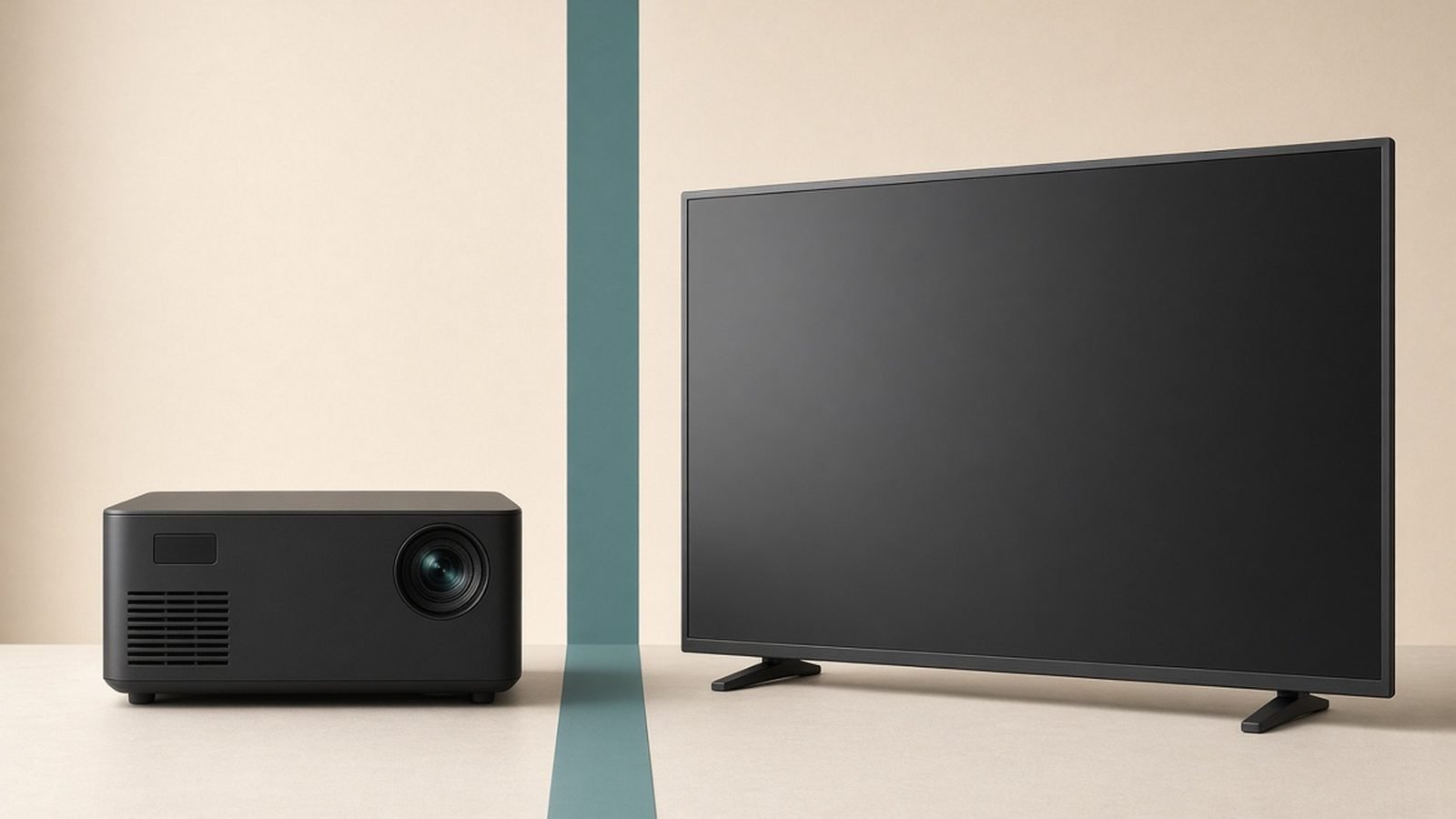
Choosing a projector is mostly a question about your room. Brightness has to be weighed against how dark you can really make the space, an ultra-short-throw design removes the need for a ceiling mount altogether, and the light source matters for running costs — LED and laser last far longer than the old lamp models and never need a bulb replacement. On those criteria the BenQ HT2060 comes first for a typical dim-to-dark home cinema, the Epson Home Cinema LS11000 is the choice where the budget stretches to true 4K on a big wall, and the Hisense PX3-PRO is the one for replacing a television with something that sits inches from the wall.
Below are our picks across budget, 4K, ultra-short-throw and portable categories, with dual US/UK pricing. Analysis is based on published specs, manufacturer documentation and aggregated owner feedback, not our own lab measurements — and each pick names who it is for and the trade-off involved.
Best projector 2026 at a glance
| Pick | Projector | Best for | Price (US / UK) |
|---|---|---|---|
| Best overall | BenQ HT2060 | Accurate 1080p home cinema | $999 / £949 |
| Best 4K | Epson Home Cinema LS11000 | True 4K laser picture | $3,499 / £3,299 |
| Best budget | BenQ TH585P | Movies + gaming on a budget | $599 / £549 |
| Best ultra-short-throw | Hisense PX3-PRO | TV replacement, no ceiling mount | $2,499 / £2,299 |
| Best portable | XGIMI Halo+ | Backyard and travel movie nights | $749 / £699 |
| Best for gaming | BenQ TH585P | Low input lag on a big screen | $599 / £549 |
How we picked
Projectors live or die on the match between the room and the machine, so we weighed brightness (measured in lumens or ANSI lumens) against the reality that most people cannot fully darken a living room. We prioritised accurate colour, sensible input lag for gamers, quiet operation, and light-source longevity — laser and LED sources last far longer than old lamp models and never need a costly bulb replacement.
None of this rests on our own benchmarks. We draw on manufacturer specs, projector documentation and the weight of aggregated owner and reviewer feedback, and we call out the compromises plainly. A projector is a room-dependent purchase, so the buyer’s framework at the end matters as much as any single pick.
Best overall: BenQ HT2060
1080p DLP, LED light source, ~2,300 lumens, low input lag — around $999 / £949.
The HT2060 is the projector we would recommend to most people building a first proper home cinema. It uses an LED light source rather than a lamp, so there is no bulb to replace and colour stays consistent for the life of the unit. BenQ’s colour tuning is the star: out of the box it delivers accurate, natural images that make films look right rather than over-saturated. Vertical lens shift makes placement forgiving in real rooms.
It is 1080p rather than 4K, which keeps the price sane and, on a big screen from a normal viewing distance, still looks excellent. Low input lag and a 16ms fast mode make it a genuinely good gaming projector too. The honest limits: it wants a dim-to-dark room to look its best, and 4K purists will notice the resolution on very large screens up close.
Pros:
- Excellent, accurate colour out of the box
- Long-life LED source, no lamp changes
- Low input lag for gaming
- Forgiving placement with lens shift
Cons:
- 1080p, not 4K
- Needs a dim room for best results
- Modest brightness for daytime viewing
Who it’s for: First-time home cinema buyers who value accurate colour and low running costs over a 4K spec sheet, and who can control room light.
Best 4K: Epson Home Cinema LS11000
4K PRO-UHD, laser light source, ~2,500 lumens, wide colour — around $3,499 / £3,299.
If picture quality is the priority and the budget allows, the LS11000 is the enthusiast’s projector. Its laser light source delivers strong, stable brightness and a claimed 20,000-hour lifespan, while Epson’s PRO-UHD pixel-shifting and 3-chip design produce a detailed, film-accurate 4K image with no rainbow artefacts. Motorised lens controls with memory positions make it easy to switch between a 16:9 and a wide 2.35:1 screen.
This is a serious home-theatre machine, so treat it accordingly: it belongs in a dedicated or well-controlled room, it is large, and the price is firmly in premium territory. Given a dark room and a quality screen, it produces images that rival far more expensive projectors.
Pros:
- Detailed, film-accurate 4K image
- Long-life laser source
- Motorised lens with position memory
- Wide colour gamut for HDR
Cons:
- Expensive
- Large and needs proper installation
- Best in a dedicated dark room
Who it’s for: Enthusiasts building a dedicated home theatre who want reference-grade 4K and will control the room to suit it.
Best budget: BenQ TH585P
1080p DLP, lamp source, ~3,500 lumens, 16ms low latency — around $599 / £549.
The TH585P is the value pick that gets a big-screen picture into your home without draining your wallet. Its higher lamp brightness handles a little ambient light better than dimmer LED units, and its low input lag makes it a favourite for console and PC gaming on a 100-inch-plus screen. For sport, gaming and casual movie nights it is hard to beat at the price.
The compromises are the usual budget ones: it uses a traditional lamp that will eventually need replacing, colour accuracy is good rather than reference-grade, and it is 1080p. But as a first projector or a fun games-room screen, it delivers the core big-picture thrill cheaply.
Pros:
- Low price for a big-screen experience
- Bright enough for some ambient light
- Excellent 16ms input lag for gaming
Cons:
- Lamp will need eventual replacement
- 1080p resolution
- Colour is good, not reference-grade
Who it’s for: Budget buyers and gamers who want the biggest possible screen for the money and can accept lamp-based running costs.
Best ultra-short-throw: Hisense PX3-PRO
4K DLP, tri-chroma laser, ~3,000 lumens, sits ~inches from the wall — around $2,499 / £2,299.
An ultra-short-throw (UST) laser projector is the closest thing to a giant TV without buying an 100-inch panel. The PX3-PRO sits on a cabinet just inches from the wall and throws a 100-to-130-inch 4K image, so there is no ceiling mount and no beam for people to walk through. Its triple-laser light source produces vivid, wide-gamut colour, and paired with an ambient-light-rejecting (ALR) screen it holds up impressively in rooms with some daylight.
The catches are specific to UST. It demands a very flat wall or, ideally, a dedicated ALR screen to look its best, alignment can be fiddly during setup, and triple-laser projectors can show faint speckle to sensitive eyes. Get the screen and placement right and it is a genuine living-room TV alternative.
Pros:
- Giant 4K image with no ceiling mount
- Vivid triple-laser colour
- Usable in rooms with some ambient light (with an ALR screen)
Cons:
- Needs a flat wall or ALR screen for best results
- Setup and alignment can be finicky
- Possible laser speckle for some viewers
Who it’s for: Buyers who want a big-screen TV replacement in a normal living room without a ceiling mount, and who will pair it with a proper UST screen.
Best portable: XGIMI Halo+
1080p DLP, LED, battery-powered, Android TV built in — around $749 / £699.
The Halo+ is the go-anywhere projector for backyards, camping and spare-room movie nights. It runs on an internal battery for a couple of hours, has Android TV and Harman Kardon speakers built in, and uses smart auto-keystone and autofocus so you can set it down and get a watchable image in seconds. For a self-contained, grab-and-go cinema it is the most polished option.
Portability sets the limits. Brightness is modest, so it wants darkness or nightfall to shine, battery life covers one film rather than a marathon, and it is 1080p. As a fixed home-theatre projector it is outclassed, but for flexibility and convenience it is excellent.
Pros:
- Battery-powered and genuinely portable
- Fast auto-keystone and autofocus
- Built-in Android TV and decent speakers
Cons:
- Modest brightness, needs darkness
- Battery lasts about one movie
- 1080p only
Who it’s for: Anyone who values flexibility over ultimate picture — backyard films, travel, and rooms where a permanent install is not possible.
How to choose a projector
Match brightness to your room. Lumens matter most against ambient light. A fully dark room is happy with 2,000-2,500 lumens; a living room with daytime light wants a brighter unit or a UST paired with an ALR screen. Do not expect any projector to beat a bright TV in full daylight.
Resolution vs screen size. 1080p looks great up to roughly 100 inches from a normal seating distance and saves money. Go 4K if you want a very large screen or sit close and want maximum detail.
Light source. Laser and LED sources last 20,000-30,000 hours and never need a bulb, keeping running costs near zero. Lamp projectors are cheaper up front but you will pay for replacement bulbs over time.
Throw distance. A standard long-throw projector needs distance from the screen (often ceiling-mounted). An ultra-short-throw sits inches from the wall — ideal if you cannot mount to the ceiling. Measure your room first.
Gaming input lag. If you game, look for a low-latency mode around 16ms or better. Not every home-cinema projector prioritises this, so check the spec.
If you are still torn between a projector and a big panel, our Best TVs 2026: OLED, Mini-LED & Budget Picks Compared guide covers where a TV wins, and OLED vs QLED 2026: Which TV Tech Is Better? explains the panel tech behind the brightest sets.
FAQ
Is a projector better than a TV for home cinema?
For sheer screen size and a cinematic feel, a projector wins — you get a 100-inch-plus image for far less than a same-size TV. A TV wins on brightness, daytime viewing, simplicity and built-in smarts. If you can control room light and crave scale, a projector is worth it; otherwise a big TV from our Best TVs 2026: OLED, Mini-LED & Budget Picks Compared roundup is easier to live with.
How many lumens do I need for a projector?
For a fully dark room, 2,000-2,500 lumens is plenty. For a living room with some ambient light, aim higher or choose an ultra-short-throw laser with an ambient-light-rejecting screen. Brightness is the single most room-dependent spec, so match it to how dark you can make the space.
Are laser projectors worth it over lamp models?
For most buyers, yes. Laser (and LED) light sources last 20,000 hours or more, keep colour consistent, and never need a costly bulb replacement. They cost more up front but save money and hassle over the life of the projector. Lamp models still make sense on a tight budget.
What is an ultra-short-throw projector?
A UST projector sits just inches from the wall and throws a large image upward, so it needs no ceiling mount and no clear beam path. Paired with an ALR screen it works as a genuine big-screen TV replacement in a normal living room. The trade-off is that it needs a very flat surface and careful alignment.
Can I use a projector for gaming?
Yes, and some are excellent for it. Look for a low-latency gaming mode around 16ms — models like the BenQ TH585P are built with this in mind. You get a huge screen for console and PC gaming, though you will still want a reasonably dark room for the best contrast.
Do I need a special screen for a projector?
A dedicated screen improves any projector, and a UST model really wants an ambient-light-rejecting screen to look its best. A clean, flat white wall works in a pinch for a dark room, but a proper screen boosts brightness, contrast and uniformity noticeably.
Zen Tech Hub may earn a commission from links on this page, at no extra cost to you.