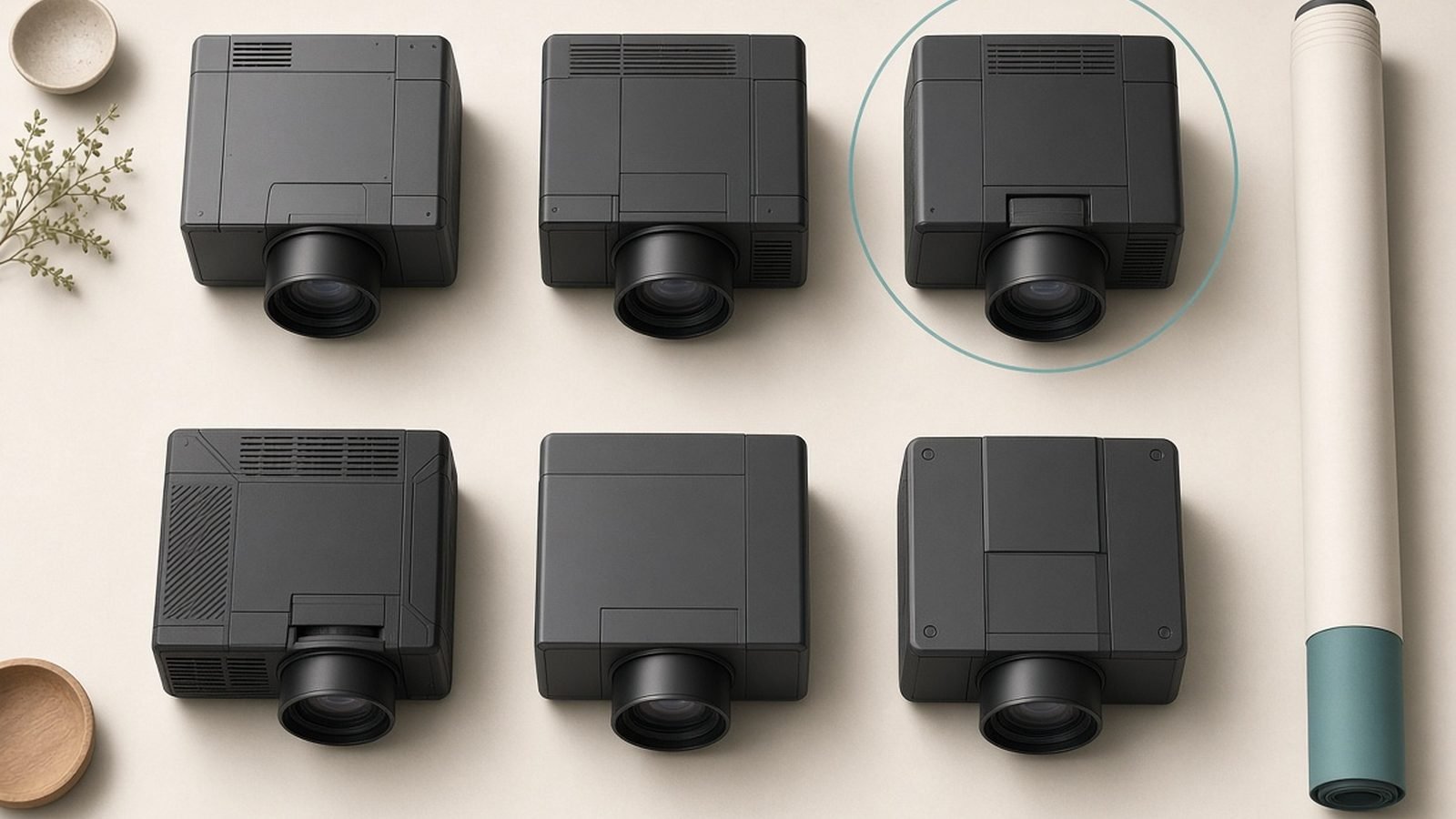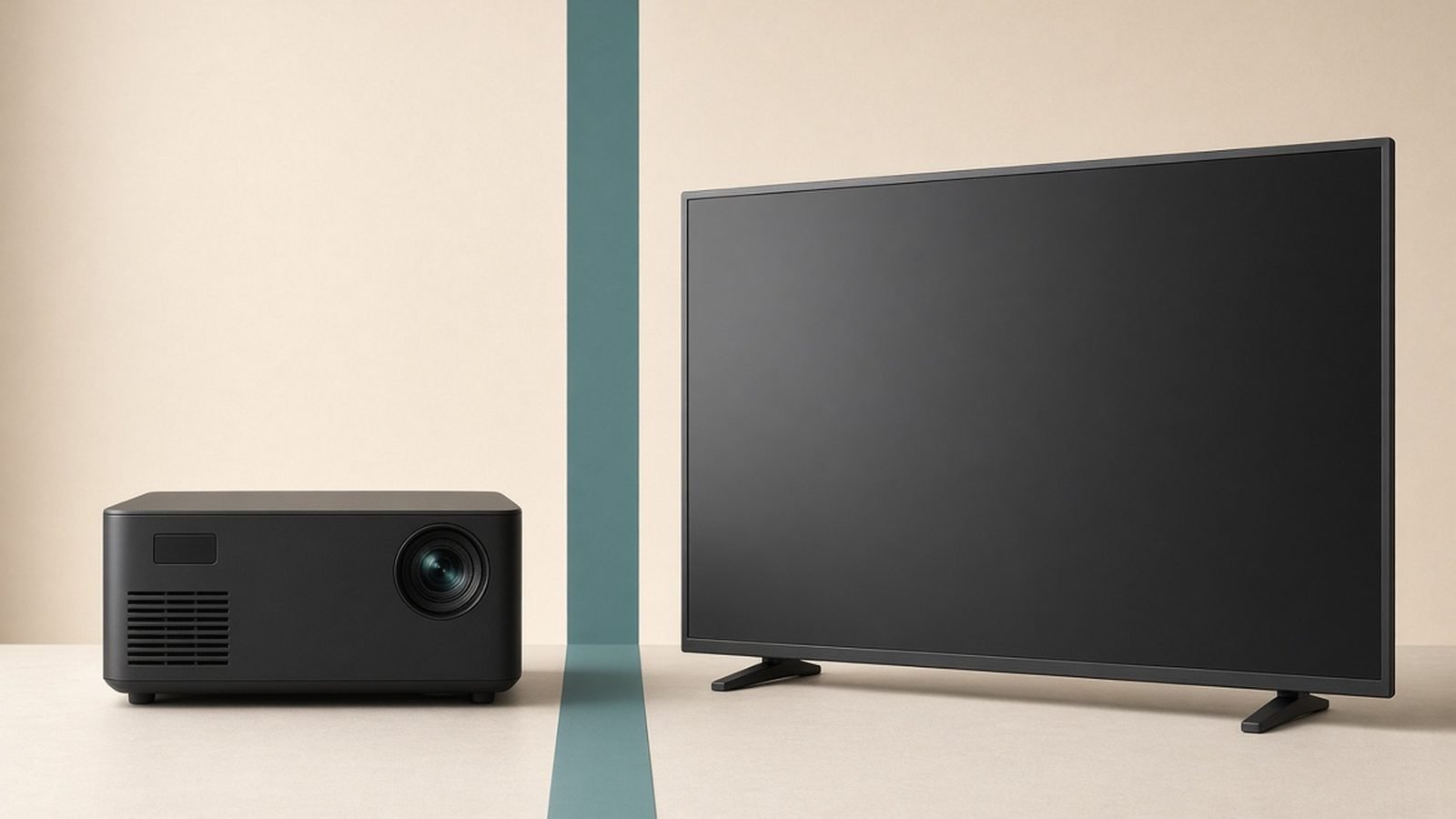
The old rule was simple: if you wanted a screen bigger than 85 inches, you bought a projector. That rule is broken. In the projector vs TV for home theater debate, 2026 is the year giant flat panels crashed the party — you can now buy a 98-inch TV for well under $1,500, a price that used to get you a mid-range projector and a screen.
So the honest answer to “is a projector better than a TV” is: it depends entirely on your room and how big you actually want to go. Below we break down cost, picture quality, light control and real-world use, then give you specific picks for each scenario.
Quick answer: it comes down to light control and size
Two variables decide this for almost everyone.
Light control. A projector reflects light off a screen, so ambient light washes it out. If your room has big windows and you watch during the day, a TV wins on brightness every time. If you can dim the room — or you mostly watch at night — a projector becomes viable.
Size. TVs are now excellent up to roughly 98–100 inches. Beyond that, you’re into projector territory, where a 120- or 150-inch image costs a fraction of what an equivalent panel would (if one even existed).
If you want a huge cinema wall and can control the light, a projector still wins. If you want a bright, no-fuss screen that works at noon, get the TV. Everything else is nuance.
Cost per inch in 2026: the math has changed (98” TVs under $1,500)
For years, projector vs TV cost per inch was a rout — projectors were dramatically cheaper at large sizes. That gap has narrowed at the 90–100 inch range and reversed below it.
Samsung’s 98-inch DU9000 has been discounted to around $1,397 / £1,799 — a giant flat panel that now undercuts most premium projectors while delivering full daytime brightness. Two years ago that same screen size was $8,000-plus. That single price drop is the strongest counter-argument to buying a projector at all.
Where projectors still win the cost-per-inch fight is beyond 100 inches. A quality ultra-short-throw (UST) projector throws a 120–150 inch image, and no affordable TV touches that scale. If your dream is a wall-sized picture, the projector math still works. If 98 inches is genuinely big enough for your room, the TV is now the value play.
| Factor | Projector | Large TV (85–98”) |
|---|---|---|
| Best screen size | 100–150”+ | Up to ~98–100” |
| Cost per inch (100”+) | Lower | Higher / limited |
| Daytime brightness | Weak–moderate | Excellent |
| Black levels / contrast | Room-dependent | Excellent (OLED/mini-LED) |
| Setup effort | High | Plug and play |
| Built-in sound | Basic | Basic–good |
| Lifespan | ~20,000+ hrs (laser) | ~7–10 yrs typical |
Picture quality: brightness, contrast, HDR reality check
This is where the UST projector vs OLED TV comparison gets brutal for projectors.
A high-end OLED or mini-LED TV produces 1,500–4,000 nits of peak brightness and near-perfect blacks. A projector — even a $3,500 triple-laser UST — puts out roughly 3,000 lumens spread across a 100-plus inch screen, which translates to far lower on-screen brightness. HDR on a projector is real but compressed; you don’t get the searing highlights or inky OLED blacks that make HDR pop.
The projector’s trump card is scale and a softer, more “cinematic” look that many people prefer for movies. On a properly dimmed 120-inch screen, a good projector is genuinely immersive in a way no TV replicates. But side by side in a lit room, the TV looks obviously punchier.
Based on owner reports and our spec research, the pattern is consistent: projector buyers love the size and film feel; the ones who regret it almost always underestimated how much ambient light hurts the image.
Room requirements and daytime viewing
Ask yourself one question: can I control the light in this room?
For a dedicated basement or blackout-curtained den, a projector shines. For a typical living room with windows — the “projector or tv for living room” question most people are really asking — a TV is the safer bet. UST projectors paired with an ambient-light-rejecting (ALR) screen close some of that gap and can look great in moderate daylight, but a bright TV still beats them when the sun is streaming in.
Projectors also demand more setup: throw distance, screen mounting, focus and geometry alignment. A TV you unbox and turn on. If you want the projector route done right, our guide on How to Set Up a Projector: Distance, Screen & Settings walks through placement and screens.
Gaming, sport and everyday TV use
For fast-paced gaming and live sport, projector vs tv brightness matters again — and so does input lag and motion.
Modern gaming TVs offer 120–165Hz, sub-10ms input lag, VRR and HDMI 2.1. Projectors have caught up impressively (several now do 4K/120 or 1080p/240), but you still watch in a darkened room, which is fine for a movie and less fine for a Saturday of football with friends and the curtains open.
For everyday TV — news, kids’ cartoons, casual streaming during the day — the TV is simply more livable. You don’t want to dim the room every time you watch something. Many home-theater enthusiasts land on the obvious compromise: a good TV for daily use and a projector for movie nights, if budget and space allow.
Sound, streaming and convenience
Both projectors and TVs ship with built-in speakers you’ll want to upgrade. UST projectors often include surprisingly capable Dolby Atmos speaker systems, while most TVs need a soundbar to do a big screen justice. Either way, budget for audio.
Streaming is a wash — Google TV, Tizen and the usual apps are baked into both categories now. Convenience, though, favors the TV: no lamp/laser warm-up, no screen to mount, no re-alignment if something gets bumped. A projector is a project; a TV is an appliance.
Best projector and TV picks for each scenario
Hisense PX3-Pro UST projector — best TV-replacement projector
The strongest case for going projector without a dedicated room. This triple-laser UST sits inches from the wall and throws an 80–150 inch Dolby Vision image, with genuinely usable brightness on an ALR screen.
Pros: Huge image, no ceiling mount, bright for a UST, great HDR color. Cons: Needs an ALR screen to look its best; still not a daytime TV. Around $3,499 / £2,499. Best for: people who want cinema scale in a normal room.
Check price: Hisense PX3-Pro UST projector
Samsung 98-inch DU9000 — the counter-argument in one product
The reason this article exists. A giant flat panel that undercuts premium projectors, delivers full daytime brightness and just works. If 98 inches is big enough, this is the smart-money buy for the projector vs 98 inch tv shopper.
Pros: Bright at any time of day, plug-and-play, no screen or setup. Cons: 98” is the ceiling; contrast trails OLED/mini-LED flagships. Around $1,397 / £1,799. Best for: bright living rooms that want max size without projector fuss.
Check price: Samsung 98-inch DU9000
BenQ GP520 — best budget big-screen route
For occasional movie nights without a big outlay. A compact, portable projector that gets you a large image cheaply — great as a second screen or a low-commitment way to test the projector life.
Pros: Affordable, portable, easy to set up. Cons: Lower brightness and contrast; not a primary-screen replacement. Around $999 / £949. Best for: casual big-screen nights on a budget.
Epson LS9000 — best for a genuine cinema build
A long-throw laser projector for people building a dedicated, light-controlled home cinema. This is where “home cinema projector worth it” becomes an emphatic yes: on a big screen in a dark room, it’s spectacular.
Pros: Excellent contrast and motion, superb film-like image, long laser life. Cons: Needs a dedicated room and a proper screen; ceiling mount required. Around $3,999 / £2,999. Best for: dedicated home-cinema rooms.
Spec/scenario table
| Your situation | Best choice | Pick |
|---|---|---|
| Bright living room, want it huge | Large TV | Samsung 98” DU9000 |
| Normal room, want 120”+ cinema | UST projector | Hisense PX3-Pro |
| Dedicated dark cinema room | Long-throw laser | Epson LS9000 |
| Occasional movie nights, tight budget | Budget projector | BenQ GP520 |
| Daytime sport and gaming | Large TV | Samsung 98” DU9000 |
The verdict
If you can control the light and crave a wall-sized image, a projector still wins on immersion and cost-per-inch above 100 inches — the Hisense PX3-Pro and Epson LS9000 are the picks. But for most people in most living rooms in 2026, the collapse in giant-TV prices flips the answer: a 98-inch TV like the Samsung DU9000 is brighter, simpler and cheaper than a comparable projector setup. Buy the projector for the cinema; buy the TV for real life.
FAQ
Is a projector better than a TV for home theater? Only in the right room. In a dark, dedicated space a projector delivers a bigger, more cinematic image for less money per inch above 100 inches. In a normal, light-filled living room, a bright TV looks better and is far less hassle. Light control is the deciding factor, not price alone.
Is a projector cheaper than a 98-inch TV now? Not necessarily. With 98-inch TVs like the Samsung DU9000 selling around $1,397 / £1,799, a quality UST projector plus an ALR screen often costs more. Projectors only win on cost per inch once you go beyond 100 inches, where no affordable TV competes.
How much brightness do I need for a projector in daylight? For any daytime viewing you want a bright projector (3,000+ lumens) paired with an ambient-light-rejecting screen. Even then it won’t match a TV in direct sunlight. If your room can’t be dimmed at all, buy a TV — see our Best TVs for Bright Rooms 2026: Anti-Glare & High Nits guide.
Can I use a projector as my only screen? You can, and a good UST like the Hisense PX3-Pro makes it realistic. But most owners end up wanting a TV for daytime and casual viewing. If you go projector-only, prioritize brightness, an ALR screen and a room you can darken for the best results.
For more on sizing and rooms, see What Size TV Should You Buy? Distance Chart (2026), Best Projectors Under $1,000 in 2026: 4K on a Budget and the TVs & Displays hub.
Zen Tech Hub may earn a commission from links on this page, at no extra cost to you.