This Hisense U8QG review cuts to the point: no TV near this price throws light the way it does. Hisense quotes headline numbers north of 5,000 nits, and while marketing figures are always generous, independent measurements from reviewers we track put real-world highlights comfortably above 3,000 nits — genuinely flagship territory for well under a grand. If you have a bright living room and a tight budget, the U8QG is the mini-LED to beat in 2026. It is also, in classic Hisense fashion, a little rough around the edges.
Verdict: absurd brightness-per-dollar with rough edges
The 65-inch U8QG landed at around $899 in the US when this review was written (Hisense’s US site shows no price, so that figure has not been re-read) and, on 10 October 2026, £1,099 on Amazon UK, where it’s sold as the U8Q. For that, you get eye-searing HDR, deep contrast from a high-count mini-LED backlight, and a 165Hz gaming panel that shames sets costing twice as much.
The trade-offs are real. Aggressive auto-brightness limiting (ABL) can make full-white scenes dim noticeably, some units show mild backlight blooming and banding, and Google TV serves up more ads than anyone wants. None of that erases the value — but you should walk in knowing the compromises.
Pros - Class-leading brightness and contrast for the money - 165Hz native panel with VRR — excellent for gaming - Strong out-of-box color and Dolby Vision support - Genuinely aggressive pricing in both the US and UK
Cons - Aggressive ABL dims bright full-screen content - Occasional blooming, banding and firmware quirks - Google TV interface is ad-heavy - No analogue/composite inputs at all
Check price: Hisense U8QG (65-inch)
Hisense U8QG price and sizes (US/UK naming differences)
Here’s a quick reference for how the range shakes out, plus its two main rivals, with each figure dated to the day it was read.
| Model | Size covered | Approx. US price | Approx. UK price | Panel |
|---|---|---|---|---|
| Hisense U8QG (UK: U8Q) | 65-inch | $899 (July 2026 check) | £1,099 Amazon UK, 10 Oct 2026 (55in £899) | 165Hz mini-LED QLED |
| TCL QM8K (UK: C8K) | 65-inch | Unavailable at TCL US on 10 Oct 2026 ($2,499.99 list; QM8L $1,199.99 / QM9K $999.99 in stock, not assessed) | No C8K listing found (Amazon UK 10 Oct, Currys 9 Oct); C8L £1,899 at Currys | 144Hz mini-LED QLED |
| Sony Bravia 7 | 65-inch | $1,499 (July 2026 check) | £1,699.15 as an Amazon Renewed listing only, 10 Oct 2026 (2026 Bravia 7 II £1,899) | 120Hz mini-LED |
One naming note that trips people up: in the US it’s the U8QG, but a Hisense U8Q UK review will point you to the same TV badged simply U8Q. Sizes run from 55 inches up to a wall-swallowing 100-inch model, with the 65-inch being the sweet spot for price and panel quality. Note that smaller and larger sizes in Hisense ranges sometimes use different panels, so a hisense u8qg 65 inch review won’t perfectly predict the 55 or 85.
Price and stock, 10 October 2026: Hisense’s US product page carries no price and a Newegg search on 9 October returned only replacement remotes, so the $899 in the title and above is the July 2026 check, not a current reading. In the UK, Amazon listed the 65-inch U8QTUK at £1,099 (delivery from 28 October) and the 55-inch at £899 on 10 October, and a Currys search on 9 October returned no 65-inch U8Q at all, only the 55-inch at £899 — so the July £1,199 is replaced by the Amazon figure. The rival picture moved more: TCL’s own US store feed listed the QM8K as unavailable in every size on 10 October (the 65-inch at a $2,499.99 list), with the 2026 QM8L at $1,199.99 and the QM9K at $999.99 in stock; neither successor has been assessed here. No C8K appeared in an Amazon UK search that day (TCL’s UK mini-LEDs listed were the C6K at £649 and the 2026 C7L at £1,199) or at Currys on 9 October, where the C8L was £1,899. For the Sony, Amazon UK listed the 2026 Bravia 7 II at £1,899 and the original Bravia 7 only as a renewed set at £1,699.15; Sony US could not be read. The U8 remains the step-up pick in our Best Budget TVs 2026: Great Picture for Less guide, which was re-priced the same day.
Design and connections (no analogue ports, USB-C video)
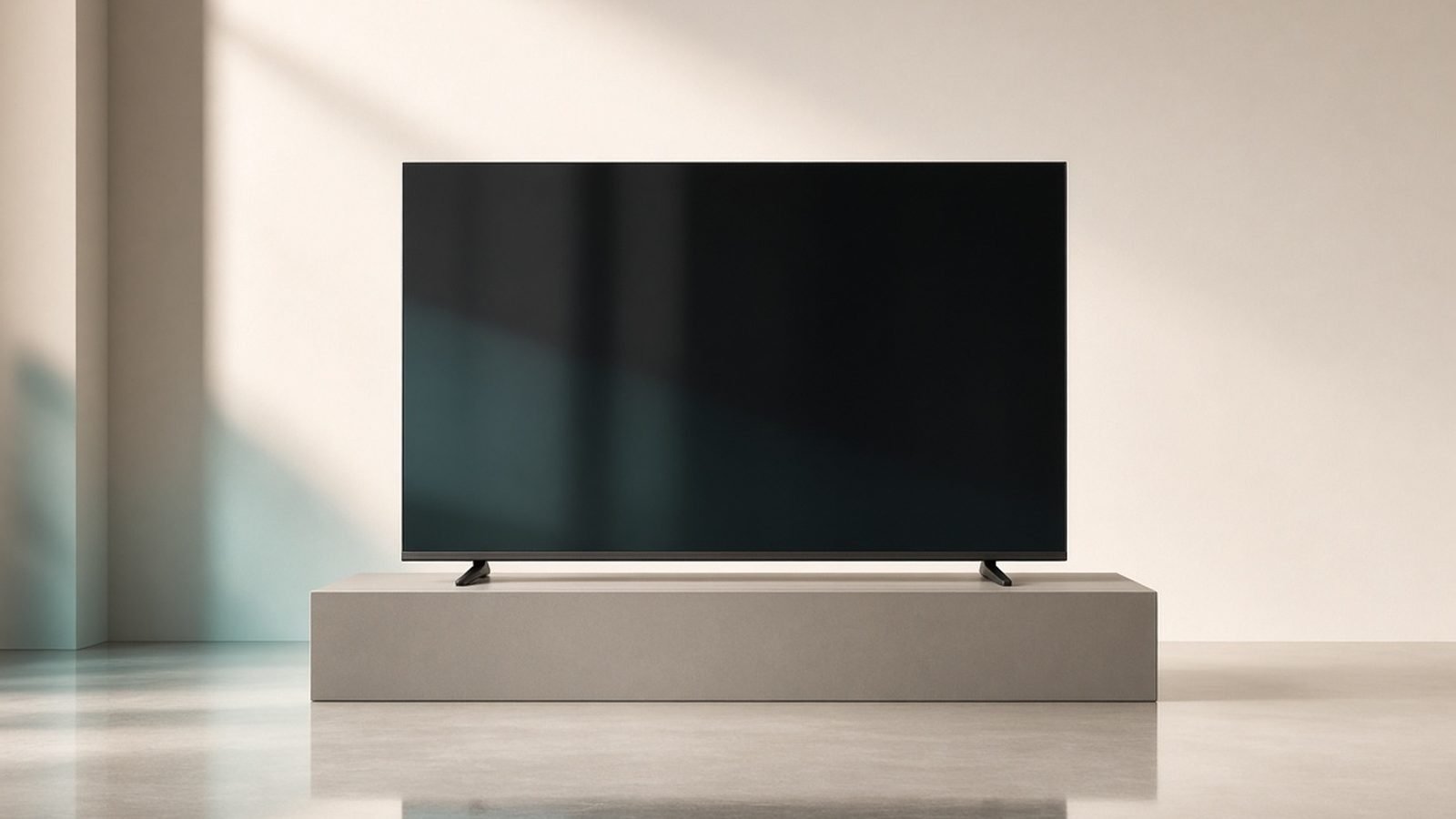
The U8QG looks the part — a slim metal-trimmed bezel, a sturdy center pedestal stand, and a chunky rear housing the multi-channel speaker system. It is not a “gap-free wall mount” set; the backlight depth means it stands off the wall.
Connectivity is modern to a fault. You get two full HDMI 2.1 ports (4K/165Hz capable), eARC, USB including a USB-C port that carries video, plus Wi-Fi and Ethernet. What you don’t get is any analogue input — no composite, no component. If you were hoping to plug in a retro console or old camcorder directly, you’ll need an external converter.
Picture quality: 3,000+ nit mini-LED in practice
Brightness is the headline, and it earns it. Based on aggregated measurements from reviewers we trust, the hisense u8qg brightness figures land among the best of any LED TV at this price — small HDR highlights punch hard, and even sustained bright scenes stay vivid. In a sunlit room, this thing simply refuses to look washed out.
Contrast is excellent too. The high zone-count local dimming produces inky blacks with strong shadow detail, and the QLED color layer delivers a wide, saturated gamut that makes HDR movies pop. Out-of-box accuracy in Filmmaker mode is good enough that most owners won’t need calibration — though dialing in settings always helps. See our Best TV Picture Settings 2026: Calibrate Any Brand guide for the tweaks that matter most.
The catch is the flip side of that brightness. To protect the panel and manage power, the ABL system pulls back luminance on large bright fields — a snowy hockey rink or a bright web page can visibly dim. It’s the single most-discussed quirk in owner feedback, and it’s the price of a backlight pushed this hard.
Hisense U8QG gaming: 165Hz, VRR and input lag
For gamers, this is where the U8QG separates from the pack. The native 165Hz panel supports VRR (including AMD FreeSync and G-Sync compatibility) and covers the full 4K/120Hz+ HDMI 2.1 feature set for PS5, Xbox Series X and high-refresh PC.
Based on owner reports and published measurements, input lag in Game Mode is low enough for competitive play, and the Game Bar overlay makes it easy to confirm refresh rate and VRR status on the fly. Between the low lag, the high refresh ceiling and the sheer brightness for HDR games, hisense u8qg gaming is arguably the strongest value proposition in the whole set. If your main use is a bright room plus a console, also skim our Best TVs for Bright Rooms 2026: Anti-Glare & High Nits roundup.
Google TV experience and bloat
The software is Google TV, and your mileage will vary. On the plus side: a huge app catalog, Chromecast built in, hands-free voice, and a genuinely useful content-aggregation home screen. Performance on the U8QG’s chipset is snappy enough day to day.
On the minus side: ads. The home screen pushes sponsored rows and banners, and that has become the most common software complaint in owner reviews. You can mute some of it in settings, but you can’t kill it entirely. If a clean, ad-free interface is a dealbreaker, budget for an external streamer and treat the built-in OS as a backup.
Quirks and problems owners report
Most competitor reviews stop at “great value” — but if you’re searching hisense u8qg problems, here’s the honest rundown from aggregated owner feedback and forums:
ABL dimming: The most-reported behavior. Full-screen bright content dims to manage power and heat. It’s largely by-design, not a defect, but it’s noticeable.
Blooming and banding: A minority of units show slight halos around bright objects on dark backgrounds, and occasional banding in smooth gradients. Filmmaker mode and disabling some processing can reduce it.
Firmware hiccups: Early firmware on Hisense sets has historically shipped with bugs — audio dropouts, VRR flicker, or app crashes — usually addressed by updates. Check for a firmware update on day one.
Local-dimming shimmer: In very dark scenes with moving subtitles or credits, the dimming algorithm can pump slightly. Adjusting the local dimming setting helps.
None of these are universal, and many owners report a flawless experience. But they’re common enough to plan around, and they’re why we’d buy from a retailer with an easy return window.
Hisense U8QG vs TCL QM8K and Sony Bravia 7
The natural cross-shop, and the query we see most, is hisense u8qg vs u8n — the short version is that the U8QG is brighter, faster (165Hz vs 144Hz) and a clear generational step up, so if the price gap is small, take the QG.
Against current rivals: the TCL QM8K (around $1,098 / £1,099 at its July 2026 prices, sold as the C8K in the UK) was the U8QG’s closest competitor. In our research, the QM8K offers slightly more refined local dimming — less blooming, better control of bright-scene dimming — but it cost roughly $200 more in the US at those prices and tops out at 144Hz. Update, 10 October 2026: TCL’s US store listed the QM8K as unavailable in every size, with the QM8L ($1,199.99) and QM9K ($999.99) in its place, and no C8K was found on Amazon UK or at Currys — the comparison below now describes a set you may struggle to buy new. For a head-to-head breakdown, see our Hisense U8QG vs TCL QM8K: 2026 Mini-LED Battle comparison.
Check price: TCL QM8K (65-inch)
The Sony Bravia 7 plays a different game. It’s dimmer and only 120Hz, but Sony’s processing, upscaling and motion handling remain a cut above — the picture just looks more “finished.” You pay heavily for it, though, at around $1,499 (July 2026 check; on 10 October 2026 Amazon UK listed the 2026 Bravia 7 II at £1,899 and the original only as a renewed set at £1,699.15). It’s the pick for movie purists; the U8QG is the pick for value, brightness and gaming.
Is the Hisense U8QG worth it? Should you buy it?
So, is the hisense u8qg worth it? For most people in a bright room who want maximum HDR impact and gaming performance per dollar — absolutely. Nothing near $899 (or, on Amazon UK on 10 October 2026, £1,099) matches its brightness-and-refresh combo, and the picture punches well above its price.
It’s not the right pick if you watch in a pitch-dark room and obsess over perfect dark-scene uniformity (an OLED suits you better), or if you can’t stand an ad-supported OS and refuse to add a streamer. And if brightness isn’t your priority, a well-chosen step-down set may save you money — see Best 55-Inch TVs Under $500 in 2026 (Mini-LED for Less).
For everyone else, this is the easy value champion of 2026. Buy the 65-inch, update the firmware, drop it into Filmmaker mode, and enjoy flagship brightness for mid-range money.
Check price: Hisense U8QG (65-inch)
For more picks and buying advice, visit our TVs & Displays.
FAQ
How bright is the Hisense U8QG really? Hisense advertises figures above 5,000 nits, which is a peak-window marketing number. Based on independent measurements we track, real-world HDR highlights land comfortably above 3,000 nits — still class-leading for the price. Just note that auto-brightness limiting pulls back luminance on large full-white scenes, so sustained bright content looks dimmer than those peak figures suggest.
What’s the difference between the U8QG and the older U8N? The U8QG is the newer generation. It’s brighter, uses a faster 165Hz panel (versus 144Hz on the U8N), and generally improves color and processing. If the price difference is small, the U8QG is the better buy; if the U8N is heavily discounted, it remains a strong value.
Is the Hisense U8QG good for gaming? Yes — it’s one of the best value gaming TVs available. It has two HDMI 2.1 ports, a native 165Hz panel, VRR with FreeSync and G-Sync compatibility, and low input lag in Game Mode. Combined with its brightness for HDR titles, it’s an outstanding match for a PS5, Xbox Series X or high-refresh PC.
What are the most common Hisense U8QG problems? The top owner complaints are aggressive ABL dimming on bright full-screen scenes, occasional blooming or banding on a minority of units, ad-heavy Google TV software, and early-firmware bugs that updates usually fix. Most are manageable with settings tweaks, and many owners report no issues at all — but buy somewhere with an easy return policy.
Is it called the U8QG in the UK? No. In the UK and Europe the same TV is sold as the Hisense U8Q (without the trailing “G”). Specs and panel are effectively identical to the US U8QG, so a U8Q UK review and a US U8QG review describe the same television. On 10 October 2026 Amazon UK listed the 65-inch U8Q at £1,099 and the 55-inch at £899.
Zen Tech Hub may earn a commission from links on this page, at no extra cost to you.