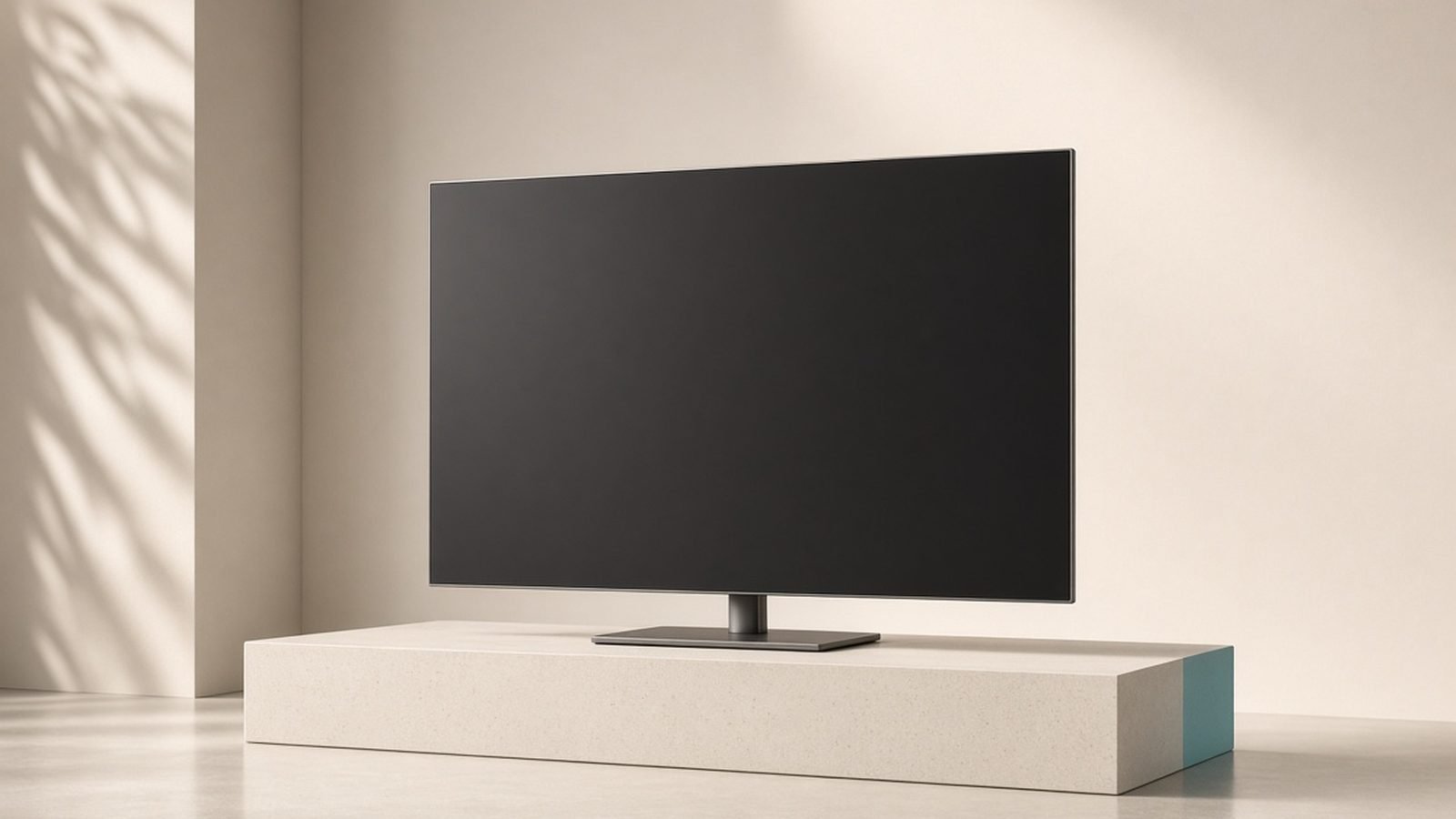
Finding the best TV for bright rooms is a different job from finding the best TV overall. In a dark home theatre, contrast and black levels win. In a south-facing living room at 2pm — or a glass-walled UK conservatory — the enemy is reflection. A brilliant panel is worthless if all you can see is a window and your own face bounced back at you.
This guide names the best TV for daytime viewing in four categories: a glare-free OLED, a high-nit value pick, a premium matte LCD, and a motion-and-brightness all-rounder — each judged on how it handles a bright room specifically, not just its dark-room scores.
Why most TVs struggle in bright rooms
There are two separate problems, and cheap marketing conflates them. The first is peak brightness — how hard the panel can push light to punch through ambient glare and keep HDR highlights looking like highlights. The second is reflection handling — what the screen coating does with the light that lands on it.
You need both. A 3,000-nit mini-LED with a glossy screen still throws a mirror-sharp reflection of your window back at you. A matte OLED that only hits 250 nits full-screen looks washed out and grey by lunchtime. The brightest TV of 2026 on a spec sheet is not automatically the best TV for a sunny room.
Coatings fall into two camps. Glossy screens preserve contrast and saturation but reflect light as a concentrated mirror image. A matte screen TV diffuses that same light across the whole panel, so you get no sharp reflections — at the cost of slightly raised black levels in a dark room. For daytime use, diffusion usually wins. For the deeper backlight explainer, see OLED vs Mini-LED TVs: Which Should You Buy in 2026?.
How we evaluate glare handling
We are an editorial team, not a measurement lab. This guide is built from manufacturer specifications, professional review measurements from outlets we trust, and aggregated owner feedback across retailer reviews and AV forums. We do not run our own bench tests, and we never invent numbers. For a bright-room verdict we weighted four things:
Full-screen (sustained) brightness, not just tiny-window peaks — where many OLEDs quietly fall down.
Reflection handling — matte versus glossy, and how diffuse the coating looks in owner photos taken near windows.
Anti-glare coating quality. Cheap matte layers wash out blacks badly; the good ones barely cost you contrast.
Value at real street prices, because sticker prices in this bracket move monthly.
To dial in the picture afterwards, our Best TV Picture Settings 2026: Calibrate Any Brand guide has a dedicated daytime section.
Quick comparison: best TVs for bright rooms 2026
| TV | Panel / coating | Bright-room strength | Approx. US price | Approx. UK price | Best for |
|---|---|---|---|---|---|
| Samsung S95F OLED (65”) | QD-OLED, matte glare-free | Zero sharp reflections + high full-screen nits | ~$2,299 | ~£2,299 | Best overall bright-room TV |
| Hisense U8QG (65”) | Mini-LED, semi-gloss | 3,000+ nit brute force for the money | ~$899 | ~£1,199 (U8Q) | Best value |
| Samsung QN90F Neo QLED (65”) | Mini-LED, matte | Matte LCD with wide viewing angles | ~$1,799 | ~£1,999 | Best premium LCD |
| Sony Bravia 9 (65”) | Mini-LED, semi-gloss | Best dimming + motion for mixed rooms | ~$2,499 | ~£2,699 | Best motion + brightness |
Prices are a July 2026 snapshot and move often — treat them as a guide, not a guarantee.
Best overall: Samsung S95F (glare-free OLED)
For years the advice was blunt: do not buy an OLED for a bright room. The Samsung S95F breaks that rule. Its glare-free matte QD-OLED coating is the standout feature — in owner photos taken directly in front of windows, reflections dissolve into a faint even haze instead of a sharp mirror image. This is the panel that makes OLED in a bright room genuinely viable.
Crucially, the S95F pairs that matte layer with unusually high full-screen brightness for an OLED. QD-OLED holds colour saturation as it brightens, so daytime HDR still looks vivid rather than pastel. If your priority is perfect blacks and daytime usability in one set, nothing else here matches it.
The trade-offs are real. There is no Dolby Vision support (Samsung backs HDR10+ instead), and the price sits at the top of the market. In a pitch-black room, a glossy OLED will still show marginally deeper blacks — the matte coating trades a sliver of inky contrast for glare immunity. Note too that Samsung’s 2026 successor, the S95H, is now appearing at retail; the S95F remains the value sweet spot as stock clears.
Pros - Genuinely glare-free matte coating — best reflection handling of any OLED - High, colour-rich full-screen brightness for daytime HDR - Perfect per-pixel blacks once the sun goes down - Excellent gaming: 4x HDMI 2.1, 165Hz, low input lag
Cons - No Dolby Vision - Premium, flagship pricing - Matte coating slightly lifts black depth in a fully dark room
Who it’s for: anyone who refuses to compromise between OLED contrast at night and real usability in a sunny room, and has the budget for it. The definitive Samsung S95F glare-free pick.
Check price: Samsung S95F OLED (65-inch)
Best value: Hisense U8QG mini-LED
The Hisense U8QG answers the bright-room problem with sheer force. Its mini-LED backlight pushes past 3,000 nits in professional measurements — enough to bulldoze glare that leaves a mid-range OLED looking flat. You get that firepower for roughly a third of flagship OLED money, which is why it is our best-value anti-glare TV for 2026 despite a semi-gloss rather than fully matte coating.
The logic is simple: if a screen is bright enough, it overpowers ambient reflection by brute strength rather than diffusion. In a sunny room the U8QG stays watchable when dimmer sets surrender. It is also a strong gaming panel with a 165Hz mode and Dolby Vision that the Samsungs lack.
It is not flawless. Based on owner reports, the aggressive local dimming can pump or crush shadow detail in mixed scenes, and the Google TV interface carries ad-heavy bloat. The semi-gloss finish also means a lamp directly behind you can still throw a visible reflection — brightness masks it rather than eliminating it.
Pros - 3,000+ nit peak brightness — one of the brightest TVs of 2026 - Outstanding value versus flagship OLED and Neo QLED - Dolby Vision and HDR10+ support, strong for gaming - Very good full-screen brightness for all-day viewing
Cons - Dimming can be overzealous in mixed content - Google TV home screen is cluttered with ads - Semi-gloss coating still shows some direct reflections
Who it’s for: the value hunter who wants raw daytime punch and Dolby Vision without spending flagship money. Read our full Hisense U8QG Review: Flagship Brightness for $899 and the Hisense U8QG vs TCL QM8K: 2026 Mini-LED Battle head-to-head before buying.
Check price: Hisense U8QG (65-inch)
Best premium LCD: Samsung QN90F Neo QLED
If you want a matte screen but prefer LCD’s sustained brightness and zero burn-in worry, the Samsung QN90F Neo QLED is the pick. It combines a bright mini-LED backlight with Samsung’s matte anti-reflective coating and — unusually for an LCD — wide viewing angles, so the picture holds up for people sitting off to the side of a large, window-lit room.
That matte coating is the reason it makes this list over cheaper rivals. It diffuses reflections the way the S95F does, but on a panel that can hold high brightness across the whole screen indefinitely, which suits all-day viewing and bright sport.
The catch is value. The QN90F costs meaningfully more than the Hisense U8QG or a TCL QM8K for broadly similar brightness, and like other Samsung flagships it omits Dolby Vision. You are paying for the matte coating, the wide angles and Samsung’s polish rather than a decisive picture-quality lead.
Pros - Matte anti-reflective coating kills sharp reflections - Wide viewing angles — rare and valuable for LCD - High, stable full-screen brightness with no burn-in risk - Slick Tizen platform and strong gaming features
Cons - Pricey next to Hisense and TCL for similar punch - No Dolby Vision - Local dimming blooming visible in the hardest scenes
Who it’s for: buyers who specifically want a matte screen TV in LCD form — no burn-in anxiety, wide seating, bright all day — and will pay extra for it.
Check price: Samsung QN90F Neo QLED (65-inch)
Best motion + brightness: Sony Bravia 9
The Sony Bravia 9 is the connoisseur’s bright-room mini-LED. Its standout traits are best-in-class local dimming and Sony’s processing, which together deliver the cleanest image here — with superb motion handling for daytime sport and film alike. For a room that swings from bright afternoons to dark movie nights, this is the most versatile performer.
Brightness is not a weakness: the Bravia 9 pushes high peak nits and controls its backlight with more finesse than any rival, so highlights stay bright without the blooming that troubles cheaper mini-LEDs. In our research it is the best mixed bright/dark set on the list.
But value is its problem. It costs more than the Hisense U8QG for brightness in the same ballpark, and its semi-gloss coating relies on nits rather than a matte layer to fight glare. If daytime is your only concern, you are paying for dark-room finesse you may not use.
Pros - Best-in-class local dimming and backlight control - Superb motion handling and Sony processing - High peak brightness for daytime HDR - The most versatile bright-and-dark all-rounder here
Cons - Poor value versus Hisense for pure brightness - Semi-gloss coating, not matte - Among the most expensive picks in this guide
Who it’s for: the buyer whose room is bright by day and dark by night, who wants one TV that nails both and cares about processing and motion above sticker price.
Check price: Sony Bravia 9 (65-inch)
Matte vs glossy screens: the real trade-offs
This is the decision under every pick above. A matte screen (S95F, QN90F) spreads incoming light across the panel, so you never see a sharp reflection — ideal for a room with windows on multiple walls. The cost is slightly raised black levels in a dark room. A glossy or semi-gloss screen (U8QG, Bravia 9) keeps blacks inkier and colours more saturated, but relies on raw brightness to overpower reflections — brilliant at 3,000 nits, poor at 500.
The rule of thumb: matte for the brightest, most reflective rooms and UK conservatories; glossy-plus-high-nits if your lighting is controllable and you also watch a lot in the dark.
Placement and settings tips for sunny rooms
You can win half this battle without spending more. A few things that consistently help, based on owner reports and our research:
Avoid facing the TV straight at a window. A 90-degree wall placement, so windows sit to the side, cuts direct reflection more than any coating can.
Use a bright/vivid picture mode by day. Standard or Dynamic modes raise backlight and colour to fight ambient light; save Filmmaker Mode for the evening.
Turn the light sensor on if your set has one, so it ramps brightness automatically as the sun moves.
Manage the room. Sheer blinds or a curtain on the worst-offending window beat any anti-glare tech, and cost far less.
UK conservatory note: a glass-roofed conservatory or south-facing lounge is the hardest test — light from above, behind and the sides. Here a matte panel like the S95F or QN90F is worth the premium, because there is no single window angle to place around.
Verdict: which bright-room TV should you buy?
For most people who want one TV that beats glare and still looks stunning at night, the Samsung S95F is the best TV for bright rooms in 2026 — its glare-free matte QD-OLED does something no other OLED manages. If that price is too steep, the Hisense U8QG delivers the raw daytime brightness to overpower most rooms at a third of the cost.
Choose the Samsung QN90F if you want a bright matte LCD with wide seating and no burn-in worry, and the Sony Bravia 9 if your room is bright by day, dark by night, and you want the most polished all-rounder. Still deciding on the broader category? Start at our TVs & Displays.
FAQ
Can you use an OLED in a bright room? Yes — but be selective. Older glossy OLEDs mirror windows and lack the full-screen brightness to fight glare. A matte, glare-free QD-OLED like the Samsung S95F changes the equation: it diffuses reflections and sustains high brightness, making it the first OLED we would confidently recommend for a genuinely sunny room.
Is a matte or glossy screen better for a bright room? Matte is usually better for bright, multi-window rooms because it eliminates sharp reflections entirely. Glossy screens keep deeper blacks and richer colour but rely on high brightness to overpower glare. If your lighting is controllable and you also watch in the dark, high-nit glossy works; if windows surround you, choose matte.
What is the brightest TV for a sunny room in 2026? Among mainstream sets, the Hisense U8QG mini-LED is one of the brightest, pushing past 3,000 nits in professional measurements. Raw brightness helps overpower ambient light, but pair it with sensible placement — reflection handling and screen angle matter just as much as peak nits.
What is the best TV for a UK conservatory? A conservatory floods the screen with light from every direction, so a matte, anti-glare panel is worth the premium. The Samsung S95F (glare-free OLED) or the matte-coated Samsung QN90F Neo QLED handle this best, because there is no single window angle you can simply position the TV to avoid.
Do I need Dolby Vision for daytime viewing? Not especially. Dolby Vision helps most in dark-room HDR, where subtle tone-mapping is visible. In a bright room, sustained brightness and reflection handling matter far more. Both Samsung picks here use HDR10+ instead of Dolby Vision, while the Hisense and Sony support Dolby Vision if it’s a priority for evening film nights.
Zen Tech Hub may earn a commission from links on this page, at no extra cost to you.