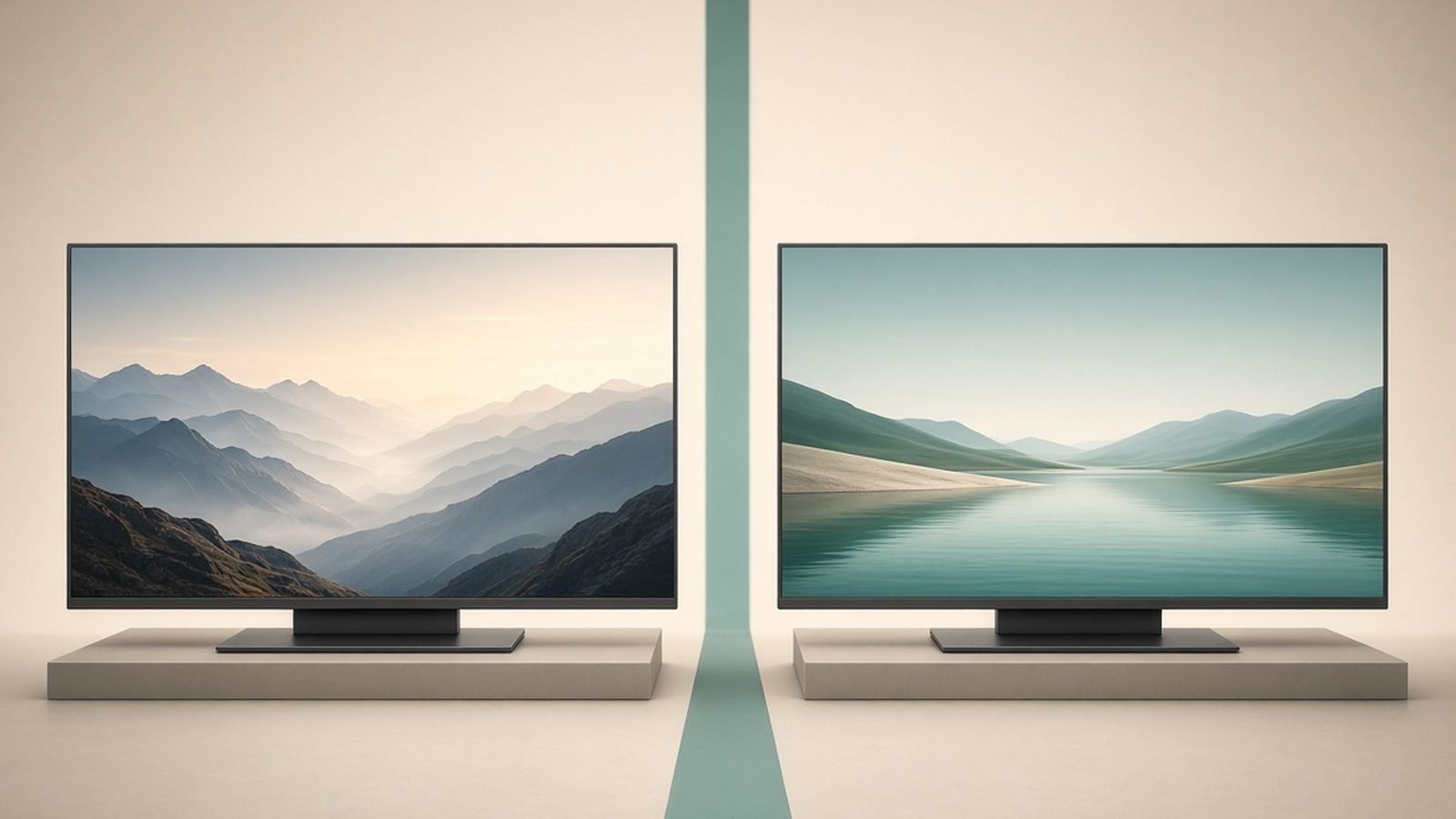
This comparison was built around two 65-inch flagships that landed a couple of hundred dollars apart, and what has moved since July is not the picture but the shelf. On 9 October 2026 TCL’s own US store listed the QM8K as unavailable in every size and offered the newer QM8L and QM9K in its place, while Hisense’s US store still lists the U8QG from 55 to 100 inches. So the Hisense U8QG vs TCL QM8K question now splits in two: the brightness-versus-blooming trade-off below still decides between these two panels if you can find both in stock, and the price section explains what TCL sells instead.
We’ve pulled together spec research and aggregated owner reports to cut through it. Here’s who each TV is really for.
Update, 9 October 2026: TCL’s US store (us.tcl.com) lists the QM8K as unavailable in 65, 75, 85 and 98-inch sizes; the 65-inch shows a $2,499.99 list price with no stock. The same store sells the QM8L (65-inch $1,079.99, 85-inch $2,149.99) and the QM9K (65-inch $999.99, 75-inch $1,799.99, 85-inch $1,999.99), both in stock. Newegg’s QM8K search returned only the 98-inch at $3,224.49 plus remotes and wall mounts. Hisense’s US product page for the 65U8QG lists 55, 65, 75, 85 and 100-inch sizes with a Where to Buy button and no price, and Newegg returned no U8QG TV listing, so the $899 on this page is the July 2026 check rather than a current price. In the UK, Currys, PriceSpy’s TV listings and TCL UK’s range page showed no C8K and no U8Q; Currys’ nearest listings on the day were the TCL C8L 65-inch at £1,899 and the Hisense U7S 65-inch at £999. The same day’s reads of TCL’s current range are on our best TVs of 2026 guide. We have not assessed the QM8L, QM9K, C8L or U7S, and the picks below are not re-ranked.
Quick verdict: who each TV suits
Buy the Hisense U8QG if you want the most brightness per dollar, watch a lot of daytime sport in a sunny room, and game on a 165Hz-capable PC. It’s the value champion.
Buy the TCL QM8K if you sit off to the side, care about clean dark-room contrast with minimal blooming, and want the more refined out-of-box picture. You pay more for polish.
Both are excellent. This isn’t a case of one being broken — it’s a genuine trade-off between raw punch (Hisense) and control (TCL).
| Spec (65-inch) | Hisense U8QG | TCL QM8K |
|---|---|---|
| US price (65-inch, 9 Oct 2026) | around $899 at the July 2026 check; Hisense US shows no price | unavailable at TCL US in every size ($2,499.99 list); QM8L successor $1,079.99 |
| UK name / price | U8Q — not found at Currys or on PriceSpy, 9 Oct 2026 | C8K — not in TCL UK’s range or at Currys; C8L listed at £1,899 |
| Panel | QD mini-LED VA | QD mini-LED, wide-angle layer |
| Peak brightness | Higher (class-leading) | Very high, slightly lower |
| Max refresh | 165Hz | 144Hz |
| VRR | FreesyncPremium Pro, G-Sync, HDMI 2.1 VRR | FreeSync Premium Pro, HDMI 2.1 VRR |
| HDMI 2.1 ports | 2 | 2 |
| Smart OS | Google TV | Google TV |
| Best for | Bright rooms, value, high-fps PC | Dark rooms, wide seating, tuning |
Prices and stock read 9 October 2026 from us.tcl.com (store feed), hisense-usa.com, newegg.com, currys.co.uk, pricespy.co.uk and tcl.com/uk: one store, one day, not an average.
Check price: Hisense U8QG (65-inch) Check price: TCL QM8K (65-inch)
Price and sizes (US + UK naming)
Naming trips people up, so let’s clear it first. In the US you’re comparing the Hisense U8QG and TCL QM8K. In the UK and Europe the near-equivalent models were sold as the Hisense U8Q and TCL C8K — so a search for “hisense u8q vs tcl c8k uk” is really this same fight. On 9 October 2026, though, neither name appeared at Currys or in PriceSpy’s TV listings, and TCL UK’s own range page listed the C8L, C7L and C7K with no C8K, so both may already have left UK shelves. Panels and tuning can differ slightly by region, but the character holds.
On price, the picture has changed since July. The 65-inch U8QG was around $899 at the July 2026 check; Hisense’s US store shows only a Where to Buy button and Newegg listed no U8QG TV on 9 October, so we cannot give a current US figure. The QM8K was about $1,098 in July; TCL’s US store now lists it as unavailable in every size, the 65-inch at a $2,499.99 list price with no stock. What TCL sells instead on the same day: the QM8L at $1,079.99 (65-inch, in stock; 85-inch $2,149.99) and the QM9K at $999.99 (65-inch; 75-inch $1,799.99, 85-inch $1,999.99). Both were among the strongest picks for the best mini-LED TV under $1,200 in July; that budget now buys the QM8L or QM9K, neither of which we have assessed. The July pound figures (U8Q around £1,199, C8K around £1,099) had no UK listing behind them on 9 October and are withdrawn; Currys’ nearest current listings were the TCL C8L 65-inch at £1,899 and the Hisense U7S 65-inch at £999, reduced from £1,499. Both lines still scale up if you want a wall-filler: Hisense lists the U8QG to 100 inches and TCL lists the QM8L and QM9K to 98.
US vs UK: the US buyer has direct successors on sale, TCL’s QM8L and QM9K, at or below the QM8K’s July price; the UK buyer has neither the U8Q nor the C8K to find, and the nearest listings are a step up (C8L at £1,899) or a step down (U7S at £999). None of those four replacements has been assessed here.
Brightness and backlight control head-to-head
This is the headline. In our research, the U8QG is the brighter panel — Hisense has chased the brightest mini-LED TV 2026 crown hard, and highlights genuinely pop harder in HDR, especially in a bright living room. For daytime sport and glary spaces, that extra punch is real.
The catch, based on owner reports, is discipline. The U8QG can show more blooming around bright objects on dark backgrounds, and its automatic brightness limiter (ABL) can dim full-white scenes more aggressively — think hockey rinks or bright UI menus that visibly dip.
The QM8K trades a little peak output for tighter local dimming. Its backlight control is the more refined of the two, so letterbox bars stay darker and haloing is better contained. If you watch films in a dim room, that control often matters more than the last few hundred nits.
Colour, upscaling and motion
Both use quantum-dot colour and cover a wide gamut, so saturated HDR looks vivid on either. Owner feedback gives the QM8K a slight edge in out-of-box accuracy — it tends to need less fiddling to look “right.” The U8QG is punchy and can look a touch more aggressive by default, though a few settings tweaks close the gap.
Upscaling of HD and streaming-compression cleanup is strong on both. For motion, each offers judder reduction and black-frame insertion; neither is flawless, but both handle 24p film and fast sport competently.
The real differentiator is viewing angle. The QM8K adds a wide-angle layer, so colour and contrast hold up better when you sit off-axis — a big deal for wide sofas or open-plan rooms. The U8QG’s VA panel is sharper dead-centre but fades faster as you move to the side.
Gaming: 165Hz vs 144Hz, VRR and input lag
For the u8qg or qm8k for gaming question, the U8QG has the spec-sheet lead. It supports up to 165Hz (vs the QM8K’s 144Hz) over HDMI 2.1, which PC players with the horsepower will appreciate. Both cover the essentials: two HDMI 2.1 ports, 4K/120, HDMI 2.1 VRR, AMD FreeSync Premium Pro and auto low-latency mode, plus a game dashboard.
In practice the difference between 144 and 165Hz is subtle, and console players capped at 120Hz won’t touch either ceiling. Input lag is low on both in Game mode based on aggregated reports. The tiebreakers: pick the U8QG for maximum PC frame rate and brightness in HDR games; pick the QM8K if you want cleaner dark-scene contrast and steadier off-angle image during couch co-op.
Smart TV: Google TV on both — what differs
Both run Google TV, so the app library, Google Assistant, Chromecast built-in and overall layout are nearly identical. Differences come down to hardware feel: menu responsiveness, how quickly settings apply, and remote design. Owner reports suggest both can feel occasionally sluggish after long uptime — an app-cache clear or reboot usually fixes it. If you already live in the Google ecosystem, neither TV forces a compromise here.
Reliability, firmware and quality control
Neither brand is bulletproof, and honesty matters. Across owner reports for both, the common themes are early-firmware quirks (occasional VRR flicker, HDR tone-mapping tweaks) that updates have generally improved, plus the usual panel-lottery risk of uniformity or backlight issues on any mini-LED. TCL’s tuning tends to arrive more settled out of the box; Hisense ships aggressive defaults that reward a quick calibration pass. Buy from a retailer with an easy return window so you can check your specific unit in the first two weeks.
Full spec comparison
| Feature | Hisense U8QG | TCL QM8K |
|---|---|---|
| Screen tech | QD mini-LED, VA | QD mini-LED, wide-angle |
| Sizes | 55–100” | 55–98” |
| Peak brightness | Class-leading | Very high |
| Local dimming | Many zones, brighter | Many zones, tighter control |
| Refresh rate | Up to 165Hz | Up to 144Hz |
| HDR formats | Dolby Vision, HDR10+, HLG | Dolby Vision, HDR10+, HLG |
| Gaming | 4K/120–165, VRR, ALLM | 4K/120–144, VRR, ALLM |
| Viewing angle | Narrower (VA) | Wider |
| Smart OS | Google TV | Google TV |
| US price (65”, 9 Oct 2026) | around $899 at the July 2026 check; no current price readable | unavailable at TCL US ($2,499.99 list); QM8L $1,079.99 / QM9K $999.99 in its place |
| UK model / price | U8Q — no listing found, 9 Oct 2026 | C8K — no listing found; TCL UK lists the C8L (£1,899 at Currys) |
Hisense U8QG — pros and cons
Pros: Highest brightness for the money; 165Hz for PC gaming; was the cheaper US model at the July 2026 check; excellent in bright rooms; still listed by Hisense US in five sizes. Cons: More visible blooming; aggressive ABL on full-white scenes; narrower viewing angle.
TCL QM8K — pros and cons
Pros: Tighter local dimming and less blooming; wide viewing angle; refined out-of-box picture. Cons: Cost more in the US at the July check; slightly lower peak nits; 144Hz ceiling vs 165Hz; unavailable in every size at TCL’s US store on 9 October 2026, with no UK C8K listing found.
The verdict
There’s no loser here. The Hisense U8QG is the value and brightness pick — get it for sunny rooms, sport and high-fps PC play, and accept a bit more blooming. The TCL QM8K is the connoisseur’s choice — get it for dark-room movies, wide seating and a cleaner default image, and accept the higher US price and slightly lower peak.
That verdict assumes you can buy both. On 9 October 2026 you could not order a QM8K from TCL’s US store, and the QM8L and QM9K that have replaced it are different TVs we have not assessed, so treat the TCL half of this page as a guide to the QM8K on clearance or second-hand rather than a new-purchase recommendation.
Want to save more? The step-down TCL QM7K Review: The $499 Mini-LED Sweet Spot delivers most of the QM8K experience for less. Curious how these stack against self-emissive panels? Read OLED vs Mini-LED TVs: Which Should You Buy in 2026?. For deeper single-model detail, see our Hisense U8QG Review: Flagship Brightness for $899, and for glare-heavy spaces our Best TVs for Bright Rooms 2026: Anti-Glare & High Nits guide. More picks live on the TVs & Displays.
FAQ
Is the Hisense U8QG or TCL QM8K brighter? The U8QG is the brighter panel and one of the brightest mini-LED TVs of 2026 in our research. It pushes higher HDR highlights and handles bright rooms better. The QM8K is still very bright but trades a little peak output for tighter, cleaner backlight control in dark scenes.
Which is better for gaming, U8QG or QM8K? For raw specs, the U8QG — it supports up to 165Hz versus the QM8K’s 144Hz, plus HDR games look punchier. Both have two HDMI 2.1 ports, VRR, ALLM and low input lag. Console players capped at 120Hz won’t notice the refresh gap, so it mostly matters for high-fps PC gaming.
What are the U8QG and QM8K called in the UK? They sold under different names: the Hisense U8QG is broadly the U8Q in the UK, and the TCL QM8K corresponded to the TCL C8K. On 9 October 2026 neither the U8Q nor the C8K was listed at Currys or on PriceSpy, and TCL UK’s range page showed the C8L, C7L and C7K instead, so UK readers may find both have left the shelves. Panels and tuning can vary slightly by region, but the overall character and this comparison still apply.
Which has less blooming? Based on owner reports, the TCL QM8K. Its local dimming is more disciplined, so haloing around bright objects and letterbox bars is better controlled. The U8QG hits higher peaks but can show more blooming, which is most noticeable in dark-room movie viewing.
Are they worth it over a cheaper mini-LED? If you value brightness and contrast, yes, provided you can still buy them: TCL’s US store listed the QM8K as unavailable in every size on 9 October 2026, while the U8QG remains on Hisense’s US site. If budget is tight, the TCL QM7K line gets you most of the way for less, and TCL’s current QM9K ($999.99 for the 65-inch) and QM8L ($1,079.99) now sit where the QM8K used to, though we have not assessed either.
Zen Tech Hub may earn a commission from links on this page, at no extra cost to you.