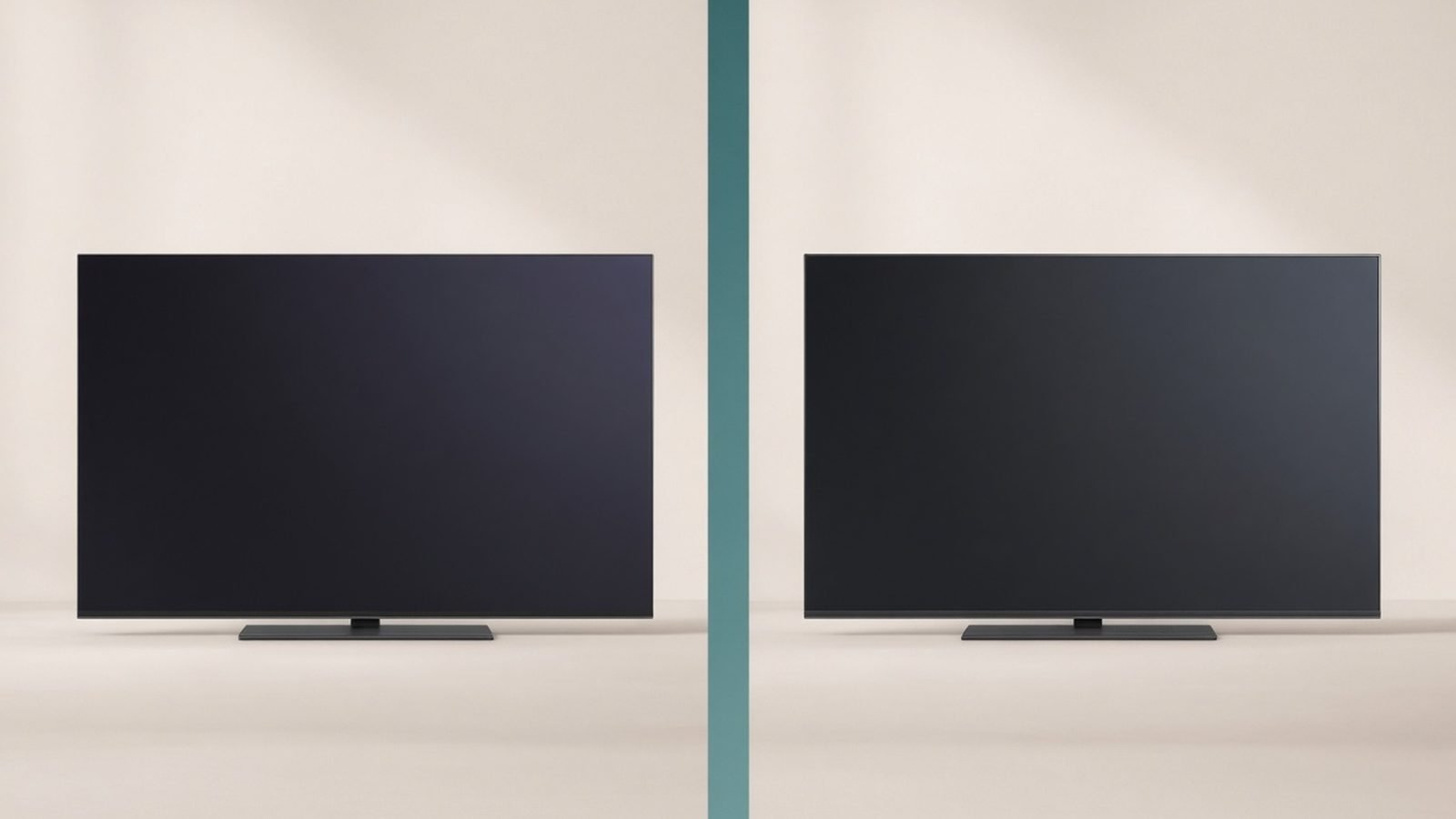
The LG C5 vs Samsung S90F decision is the single biggest mid-range OLED dilemma of 2025-26. Both sat at roughly $1,400-$1,500 for a 65-inch in US listings on 4 October 2026, both are stunning next to any LCD, and both are the TV most people should actually buy this year. But they take opposite routes to get there: LG leans on a mature, predictable WOLED evo panel with Dolby Vision, while Samsung chases raw QD-OLED colour and brightness — with one catch we’ll flag early, because it can quietly change which TV you’re really getting.
Here’s the short version before we dig in.
Quick verdict: who should buy which
Buy the LG C5 if you want the safe, no-surprises pick: Dolby Vision, four full-fat HDMI 2.1 ports, a consistent panel across every screen size, and a genuinely great smart platform. It’s the better all-rounder for movie fans and mixed-use living rooms.
Buy the Samsung S90F if you want the punchiest, most saturated image in a bright room and you play a lot of games — provided you confirm you’re getting the QD-OLED panel in your size and region. That’s the crux of the S90F panel lottery, and it’s the reason this isn’t a slam dunk.
Price and sizes compared (October 2026, US and UK)
Both TVs launched in 2025 at list prices well above what they sell for now ($2,699.99 for the 65-inch C5 at LG’s US store, $2,499.99 for the 65-inch S90F at Samsung’s). Prices as read on 4 October 2026:
| LG C5 (65”) | Samsung S90F (65”) | |
|---|---|---|
| US price (maker’s own store) | $1,499.99 (same at Newegg) | $1,399.99 (shown as out of stock) |
| Lowest UK listing (PriceSpy UK) | from £1,299 | from £1,339.99 |
| Sizes offered | 42, 48, 55, 65, 77, 83” | 42, 48, 55, 65, 77, 83” |
| Panel | WOLED evo (all sizes) | QD-OLED (varies by size/region) |
For most buyers hunting the best 65-inch OLED at around $1,500, these two are the shortlist. US vs UK: the order differs by country. In the US the S90F was the cheaper set by $100 at Samsung’s own store, but that store showed the 65-inch as out of stock on 4 October 2026, and Samsung’s US and UK sites now list S90H models alongside it, so check that the S90F is still obtainable in your size before planning around its price. In UK listings the C5 was the cheaper one, by about £40. Neither gap is large enough to decide the purchase; the panel and Dolby Vision differences below should. Prices do dip in sale periods: Tom’s Guide (Nick Pino, 12 March 2026) put the 65-inch C5’s lowest price at $1,246, during Black Friday, so if you’re not in a rush, set a price alert. LG also sells the smaller 42- and 48-inch C5 panels that Samsung’s QD-OLED line historically hasn’t matched on availability, which matters for desk or bedroom use.
Check price: LG C5 OLED (65-inch)
Check price: Samsung S90F OLED (65-inch)
Panel tech: WOLED evo vs QD-OLED (and the S90F panel lottery)
This is the heart of the WOLED vs QD-OLED 2026 debate.
The LG C5 uses LG Display’s WOLED evo panel with a white sub-pixel and a brightness-boosting layer. It’s a known quantity: the same fundamental tech across every size, tuned year over year for higher peak brightness and better near-black handling.
The Samsung S90F uses Samsung Display’s QD-OLED, which swaps colour filters for quantum dots. The upside is real — QD-OLED produces more saturated colour at high brightness and, in our research, tends to look more vivid on HDR highlights.
Now the catch. Based on owner reports and multiple outlet teardowns, the S90F does not ship with a QD-OLED panel in every size and region. Some sizes — and this got worse with the newer S90H generation — use a WOLED panel sourced from LG Display instead. Buyers have complained about “S90F missold as QD-OLED” when the box arrived with a WOLED panel. The 55- and 65-inch US units are the most reliably QD-OLED; smaller and some regional variants are where the lottery bites.
Practical advice: if QD-OLED colour is your reason for choosing the S90F, verify the panel before you commit — check the model code, retailer spec sheet, and recent owner reports for your exact size and country. With the LG C5, there’s no lottery. What you order is what you get.
Picture quality face-off: brightness, colour, HDR
On the LG C5 vs S90F brightness question, both hit similar real-world peaks, but they distribute it differently. The S90F’s QD-OLED panel tends to look brighter and more punchy on saturated HDR highlights and in daylight rooms, thanks to that colour-volume advantage. The C5 is no slouch — its WOLED evo panel is meaningfully brighter than older C-series sets — but on paper the QD-OLED holds a colour-at-brightness edge.
Colour is where QD-OLED earns its keep. Reds, greens and neon tones look fractionally richer on the S90F. The trade-off: QD-OLED can raise black levels slightly in a bright room (blacks tilt faintly purple/grey under strong ambient light), whereas WOLED holds a cleaner black. In a dim, controlled room the two are extremely close, and most viewers wouldn’t call a winner blind.
For HDR movies, the C5’s Dolby Vision support (more on that below) gives it a real content advantage on Netflix, Disney+ and 4K Blu-ray.
LG C5 pros - Consistent panel and picture across all sizes - Dolby Vision for better HDR movie playback - Clean blacks in bright rooms
LG C5 cons - Slightly less colour punch than QD-OLED - Highlights a touch less vivid on HDR demo material
Samsung S90F pros - QD-OLED colour volume and saturation - Excellent brightness in daylight rooms - Superb for vivid, high-impact HDR
Samsung S90F cons - No Dolby Vision - Panel type not guaranteed in every size/region - Blacks lift slightly under strong ambient light
Gaming: ports, refresh rates, latency
For the LG C5 vs S90F gaming matchup, this is close to a tie — both are elite. Each offers four HDMI 2.1 ports, 4K at up to 144Hz for PC, VRR (including AMD FreeSync and Nvidia G-Sync compatibility), ALLM, and very low input lag that lands around the 9-13ms range in Game Mode based on aggregated testing.
The C5 pairs this with LG’s Game Optimizer dashboard and, for movie-and-game households, Dolby Vision gaming on supported titles. The S90F counters with Samsung’s Gaming Hub and cloud-streaming apps built in, plus that extra QD-OLED colour pop that makes vibrant games look spectacular.
Bottom line: PS5, Xbox Series X and high-end PC players are well served either way. Pick on colour preference and Dolby Vision, not on gaming specs — the gap is negligible.
Smart platforms: webOS vs Tizen
LG runs webOS; Samsung runs Tizen. Both are fast, app-rich and, frankly, a bit ad-heavy on the home screen in 2026. webOS has a cleaner card-based layout and the Magic Remote’s point-and-click, which many owners love. Tizen’s strength is Samsung Gaming Hub and tight integration with Samsung’s ecosystem. Neither should decide your purchase — every major streaming app is present on both, and a cheap streaming stick papers over any gaps.
Dolby Vision vs HDR10+ — does it matter?
This is the clearest functional difference. The LG C5 supports Dolby Vision; the S90F Dolby Vision answer is simply no — Samsung backs HDR10+ instead and refuses to license Dolby Vision across its whole range.
Does it matter? Somewhat. Dolby Vision is the more widely supported dynamic-metadata format on Netflix, Disney+, Apple TV+ and 4K Blu-ray, and it can visibly improve tone mapping on tricky scenes. HDR10+ exists on Amazon Prime Video and some discs but has thinner support. Both TVs still play all HDR content via base HDR10 — you just lose the dynamic layer on the S90F for Dolby Vision titles. For committed movie fans, this nudges the LG C5 or Samsung S90F call toward LG.
Spec table
| Feature | LG C5 (65”) | Samsung S90F (65”) |
|---|---|---|
| Panel | WOLED evo | QD-OLED (size/region dependent) |
| Peak brightness | Very high | Very high, better colour volume |
| Dolby Vision | Yes | No (HDR10+ only) |
| HDR10+ | No | Yes |
| HDMI 2.1 ports | 4 | 4 |
| Max refresh | 4K 144Hz | 4K 144Hz |
| VRR | FreeSync + G-Sync compat. | FreeSync + G-Sync compat. |
| Smart OS | webOS | Tizen |
| Price, 4 Oct 2026 (US/UK) | $1,499.99 / from £1,299 | $1,399.99 / from £1,339.99 |
Final verdict
If you want one recommendation: the LG C5 is the safer buy for most people. Dolby Vision, a guaranteed panel in every size, clean blacks and a polished smart platform make it the low-regret choice — especially for movie-first living rooms.
Choose the Samsung S90F if colour saturation and daylight brightness top your list, you don’t care about Dolby Vision, and you can confirm the QD-OLED panel in your size and region. Get that confirmation and the S90F is arguably the more exciting image; skip it and you’re gambling.
For more on these sets, see our LG C5 OLED Review 2026: The Best All-Round TV? and the wider TVs & Displays. On a tighter budget? Check Best Budget OLED TVs 2026: Cheapest Ways Into OLED. Weighing the newer LG generation? Read LG C6 vs C5 OLED: Is the 2026 Upgrade Worth It?. And whichever you pick, our guide on OLED Burn-In in 2026: How to Prevent It (Real Data) is worth five minutes.
FAQ
Is the LG C5 or Samsung S90F brighter? In practice they peak similarly, but the S90F’s QD-OLED panel usually looks brighter and more vivid on saturated HDR highlights and in daylight rooms because of its higher colour volume. The C5 is bright too and holds cleaner blacks under strong ambient light. In a dim room the difference is small; in a sunny room the S90F edges ahead.
Does the Samsung S90F support Dolby Vision? No. The S90F does not support Dolby Vision — Samsung uses HDR10+ instead across its entire TV range. Both formats still fall back to standard HDR10, so all your HDR content plays. But for Netflix, Disney+ and 4K Blu-ray, which lean on Dolby Vision, the LG C5 has a real HDR advantage.
What is the S90F panel lottery? Samsung doesn’t fit QD-OLED panels in every S90F size and region; some units ship with WOLED panels sourced from LG Display instead. The 55- and 65-inch US models are the most reliably QD-OLED. If QD-OLED colour is your reason for buying, verify the panel for your exact size and country before ordering.
Which is better for gaming, the LG C5 or S90F? It’s essentially a tie. Both offer four HDMI 2.1 ports, 4K at up to 144Hz, VRR, ALLM and very low input lag. The C5 adds Dolby Vision gaming; the S90F adds Samsung Gaming Hub and extra QD-OLED colour pop. Choose on colour preference and Dolby Vision, not raw gaming specs.
Should I worry about OLED burn-in on either TV? For normal mixed viewing, no. Both use modern panel-protection features like pixel shifting and logo dimming. Burn-in risk rises with static content shown for many hours daily. Vary your content, keep a sensible brightness, and let the TV run its refresh cycles. See our burn-in prevention guide for the full routine.
Zen Tech Hub may earn a commission from links on this page, at no extra cost to you.