The Sonos Arc Ultra vs Samsung HW-Q990F debate is the defining premium soundbar question of 2026, and the two products couldn’t approach it more differently. Sonos sells you one beautifully engineered bar at around $999 / £899 and invites you to build outward. Samsung ships an entire 11.1.4-channel home theater — bar, wireless subwoofer, and two wireless rear speakers — in a single box for around $1,999 / £1,699, and frequently much less on sale.
That framing matters more than any spec sheet. In our research — combing through measurement-based reviews, spec documentation, and hundreds of owner reports across both ecosystems — the “right” answer flips completely depending on your room, your budget ceiling, and whether you care more about music or movie nights. Here’s the honest breakdown.
TL;DR: One Box vs the Full Package
Buy the Sonos Arc Ultra if you want the best-sounding single bar you can put under a TV, you stream a lot of music, you’re already in (or tempted by) the Sonos ecosystem, and you’d rather add a sub and surrounds later — or never.
Buy the Samsung HW-Q990F if you want a genuine, room-filling surround system on day one for the least money and effort. Nothing else at this price delivers real rear speakers, a serious subwoofer, and 11.1.4 channels of Dolby Atmos out of one box.
| Sonos Arc Ultra | Samsung HW-Q990F | |
|---|---|---|
| Price | ~$999 / £899 (bar only) | ~$1,999 / £1,699 (often ~$1,600 / £1,300) |
| Channels | 9.1.4 (single bar) | 11.1.4 (bar + sub + rears) |
| Sub included | No (Sub 4 is ~$799 / £699 extra) | Yes — wireless dual-driver sub |
| Rears included | No (Era 100/300 extra) | Yes — wireless, with up-firing drivers |
| Dolby Atmos | Yes | Yes |
| DTS:X | Yes (via eARC) | Yes |
| HDMI inputs | None — eARC only | 1 passthrough input (4K/120, VRR support) |
| Music streaming | Sonos app, AirPlay 2, Bluetooth, huge service support | Bluetooth, Wi-Fi, AirPlay 2, Spotify/Tidal Connect |
| Room correction | Trueplay (iOS; quick tune on Android) | SpaceFit Sound Pro (automatic) |
| Best with | Any TV | Samsung TVs (Q-Symphony, wireless Atmos) |
Check price: Sonos Arc Ultra Check price: Samsung HW-Q990F
Price Compared — Including the Sonos Sub and Surrounds Trap
On paper, the Arc Ultra looks like the bargain: around $999 / £899 against Samsung’s $1,999 / £1,699 list price. But that comparison is misleading in both directions, and this is where most Sonos vs Samsung soundbar comparisons go soft.
First, the Samsung side. The Q990F’s street price is the real price. Based on months of price tracking across US and UK retailers, it routinely sells for around $1,600 / £1,300, and it has dipped lower during major sales events. Nobody should pay full list for a Samsung flagship soundbar — they discount early and often.
Now the Sonos side, and what we call the parity trap. The Arc Ultra alone is a 9.1.4 bar with genuinely impressive bass for a single chassis — but it is still a single chassis. To match what’s in the Samsung box, you need:
| Sonos component | Approx. price |
|---|---|
| Arc Ultra | ~$999 / £899 |
| Sub 4 (wireless subwoofer) | ~$799 / £699 |
| 2x Era 100 surrounds | ~$398 / £358 |
| Total (Era 100 route) | ~$2,196 / £1,956 |
| Or 2x Era 300 surrounds (with up-firing Atmos drivers) | ~$898 / £798 |
| Total (Era 300 route) | ~$2,696 / £2,396 |
So the honest Arc Ultra with Sub vs Q990F price math looks like this: a full Sonos surround package costs roughly $2,200–2,700 / £1,950–2,400, versus a Samsung system you can regularly buy for around $1,600 / £1,300. That’s a gap of $600 to over $1,000 for broadly comparable channel counts — and the Sonos gap grows if you insist on the Era 300s, which you should for the best Atmos surround effect.
To be fair to Sonos, the full Era 300 package, once assembled, is an exceptional system that several respected measurement-focused outlets rate among the very best soundbar setups money can buy. But you’re paying a serious premium for it, and Sonos bundle discounts are modest and infrequent compared with Samsung’s aggressive sale pricing.
Check price: Sonos Sub 4 + Era 300 surrounds (bundle context)
The takeaway: if your endgame is a full surround package, Samsung wins the value fight decisively. If your endgame is one great bar, Sonos wins it just as decisively.
Design and Living-Room Footprint
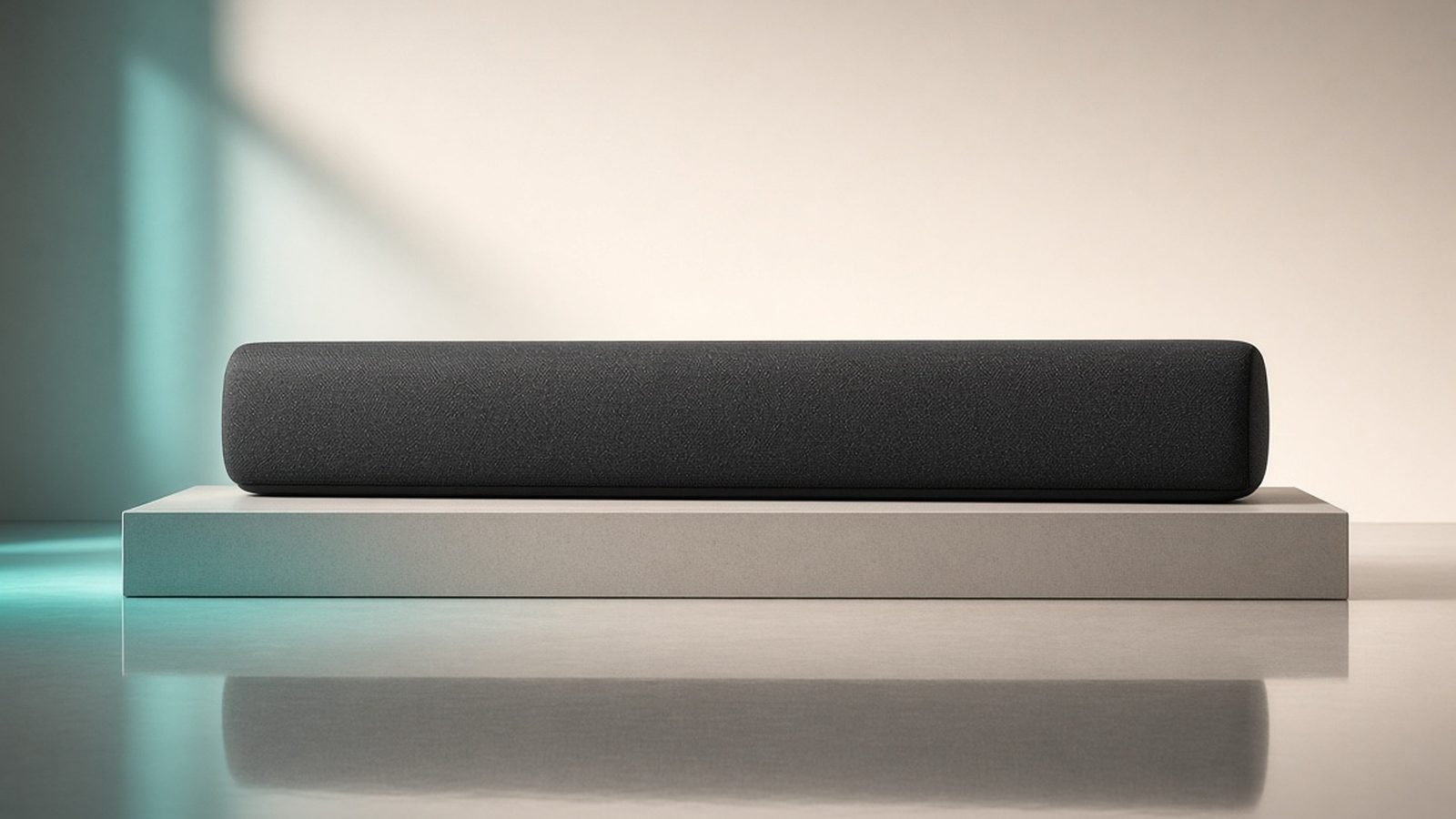
The Arc Ultra is the better-looking product, and it isn’t close. The curved, seamless grille in matte black or white reads as a design object rather than an appliance. At about 46.2 inches (117.3 cm) wide and a low 3-inch (7.5 cm) profile, it sits comfortably under 55-inch and larger TVs without blocking the screen or IR receiver on most stands, and it wall-mounts cleanly.
The Q990F’s bar is similar in width but visually busier — a fabric-and-metal box that owners consistently describe as “fine” rather than lovely. The bigger footprint question is everything else in the carton: a subwoofer that needs floor space and a power outlet, plus two rear speakers that each need placement behind your seating and their own outlets. They’re wireless for audio, not for power.
That’s four mains sockets and four placement decisions for Samsung versus one for Sonos. In a dedicated living room this is a non-issue. In a rental, a minimalist space, or a room where the sofa sits against the back wall, the Arc Ultra’s single-box footprint is a genuine practical advantage, not just an aesthetic one.
One Samsung note in its favor: the Q990F’s redesigned subwoofer is meaningfully more compact than the huge cube that shipped with earlier Q990 generations, which owners repeatedly flag as a welcome change.
Setup, Apps and Ecosystem — the Sonos App in 2026
Setup on both systems is quick: HDMI eARC cable to the TV, power, app walkthrough, room calibration. Samsung’s rears and sub pair automatically out of the box, and its SpaceFit calibration runs on its own. Sonos uses Trueplay, which delivers excellent results but still works best with an iPhone; Android users get a more basic quick-tune. If you’re new to any of this, our step-by-step guide covers the process for both brands. How to Set Up a Soundbar: HDMI ARC vs eARC vs Optical
The elephant in the room: the Sonos app. The disastrous 2024 redesign cost Sonos enormous goodwill, and no honest Sonos Arc Ultra review comparison can skip it. The good news, based on recent owner feedback and Sonos’s own steady update cadence since, is that the app in 2026 is in far better shape — core functions are back, stability complaints have fallen sharply, and new-device setup is largely painless again. The scar tissue is real, but the day-to-day experience has substantially recovered.
And when the app works, the Sonos ecosystem remains the best in consumer audio: one interface for dozens of streaming services, effortless multi-room grouping with any other Sonos speaker, and TV audio you can pipe to speakers in other rooms. If you already own Sonos gear — or plan a whole-home setup — this is a heavy thumb on the scale. Best Smart Speakers for Music in 2026: Echo, HomePod, Sonos
Samsung’s SmartThings app is competent and less essential; most owners set up once and rarely reopen it. The catch is that Samsung’s cleverest features — Q-Symphony (using your TV’s speakers alongside the bar) and wireless Dolby Atmos transmission from the TV — require a recent Samsung TV. With an LG, Sony, or TCL set, the Q990F is still excellent, but you’re leaving marquee features unused.
Dolby Atmos and Movie Performance Head-to-Head
This is the section that decides it for most movie lovers, so let’s be direct: in this Dolby Atmos soundbar comparison, the Samsung HW-Q990F produces the more convincing surround experience, and physics is the reason. No amount of psychoacoustic processing from a bar at the front of the room can equal actual speakers behind your head. Helicopters genuinely travel front to back. Rain falls around you, not just in front of you.
Reviewers who measure these systems consistently reach the same conclusion, and owner reports back it up: the Q990F’s 11.1.4 layout, with up-firing drivers in the rears as well as the bar, creates a dome of sound the Arc Ultra alone cannot match. The included sub also digs deeper than any single bar can, giving action scenes real physical weight.
What the Arc Ultra does better, per channel, is refinement. Its Sound Motion woofer technology extracts remarkable bass from a slim chassis — clearly the best low-end of any standalone bar in our research — and its dialogue clarity, center-image precision, and height effects from a single unit are class-leading. Owners repeatedly praise how wide and tall the Arc Ultra throws sound, and its speech-enhancement modes are genuinely useful at low late-night volumes rather than a gimmick.
Tonally, Sonos is the more neutral, natural-sounding system; Samsung runs more excitable, with a V-shaped, crowd-pleasing tuning that flatters blockbusters. Some owners find Samsung’s presentation slightly processed with dialogue-heavy drama, though its various EQ and Active Voice modes mostly tame this.
Verdict for movies: Q990F for spectacle and true surround immersion; Arc Ultra for the best single-bar performance and more refined tonality. Add the Sub 4 and Era 300s to the Arc Ultra and Sonos arguably takes the outright crown — at a price.
Music Performance
Flip the script for music. The Arc Ultra is one of the best music-playback soundbars ever made: balanced, detailed, spacious, with tight and tuneful bass for a standalone unit. Combined with the Sonos app’s direct, higher-quality streaming from virtually every service (plus AirPlay 2 and Bluetooth), it’s the obvious pick for anyone whose soundbar doubles as their main music system.
The Q990F is enjoyable rather than accurate with music. The sub can sound boomy on bass-heavy tracks until you spend time with the EQ, and the tuning that thrills in action movies can feel hyped with acoustic and vocal material. Samsung has improved here generation over generation, and Spotify Connect, Tidal Connect, and AirPlay 2 cover the streaming basics — but based on aggregated owner feedback, people who care about music consistently prefer the Sonos.
If music is 50% or more of your listening, that alone can settle the Samsung Q990F vs Sonos question in Sonos’s favor.
Gaming and Connectivity: HDMI Passthrough, eARC and VRR
Here’s the Arc Ultra’s most criticized omission: it has no HDMI inputs at all. One eARC port to the TV — that’s it. Every source (console, streaming box, Blu-ray player) must plug into your TV, which then passes audio back down eARC. With a modern TV that has enough HDMI 2.1 ports and reliable eARC, this works fine in practice. With an older TV, or one short on 2.1 ports for a PS5 and a Series X, it’s a genuine constraint. There’s also no DTS:X limitation anymore — the Arc Ultra supports it — but you remain dependent on your TV’s passthrough behavior.
The Q990F includes an HDMI passthrough input with 4K/120Hz and VRR support, so gamers can route a console through the bar and preserve next-gen features even on TVs with limited HDMI 2.1 sockets. It’s a single input — down from two on some earlier generations, which owners grumble about — but one is infinitely more than zero.
Add Samsung’s lower-latency game modes and the genuine advantage of rear speakers for positional audio in games, and the Q990F is the clear pick for gamers. Neither bar will disappoint on lip-sync or format support for typical streaming use; this section only matters if you have source devices and a port-limited TV.
Upgradability: Adding Subs and Rears Later
Sonos’s whole pitch is the staged upgrade path, and it’s a good one. Start with the Arc Ultra. Add a Sub 4 next year when the bonus lands. Add Era 100 or Era 300 surrounds after that — speakers that also work as standalone music speakers in other rooms if you ever rearrange. Everything pairs wirelessly and recalibrates via Trueplay. It’s the most flexible, least wasteful upgrade path in the industry.
Samsung offers essentially none of this in reverse. The Q990F is complete on day one, but you can’t meaningfully expand it, and its sub and rears only work with the bar they shipped with. You also can’t buy the Q990F bar solo at a proportionate price — you’re buying the package or nothing.
Two honest caveats on the Sonos path. First, as covered above, completing it costs more than buying the Samsung package outright. Second, “buy now, upgrade later” often becomes “buy now, never upgrade” — and an Arc Ultra alone, good as it is, will never out-immerse a Q990F with real rears. Be realistic about whether you’ll actually finish the system.
Which Should You Buy for Your Room Size and Budget?
Small to medium rooms, or a soundbar that’s also your hi-fi: Sonos Arc Ultra. In rooms under roughly 20 square meters, or where rear-speaker placement is impractical, the Arc Ultra’s virtual surround is convincing enough, its music performance is superb, and you avoid paying for spatial effects your room can’t support. It’s also the pick for anyone already running Sonos speakers elsewhere.
Sonos Arc Ultra — pros and cons
Pros
- Best-in-class sound from a single bar; exceptional dialogue and bass for the form factor
- Outstanding music performance and streaming ecosystem
- Elegant design, single-box simplicity, one power socket
- Clear upgrade path with Sub 4 and Era surrounds
Cons
- No HDMI inputs — eARC only, so your TV’s ports do all the work
- Sub and surrounds cost serious extra money; full parity beats Samsung’s price by $600+
- Trueplay calibration still favors iPhone owners
- App reputation still recovering, even if the 2026 reality is much improved
The Arc Ultra is our pick for most buyers at its price point — the best premium soundbar 2026 has to offer as a single-box purchase, and the foundation of an elite system if you complete it.
Bigger rooms, movie-first households, best value for a complete system: Samsung HW-Q990F. If you have space behind the sofa and a room over ~20 square meters, discrete rears and a real subwoofer beat any single bar, full stop. At its regular ~$1,600 / £1,300 street price, nothing matches the Q990F’s performance-per-dollar as an all-in-one soundbar vs full surround package decision — because it’s both.
Samsung HW-Q990F — pros and cons
Pros
- Complete 11.1.4 system with wireless sub and rears in one box — true surround on day one
- Deep, powerful bass and genuinely immersive Atmos
- HDMI passthrough with 4K/120 and VRR — the gamer’s choice
- Frequently and heavily discounted
Cons
- Music playback is good, not great; needs EQ attention
- Q-Symphony and wireless Atmos require a recent Samsung TV
- Four power sockets, four placement decisions
- Forgettable design; only one HDMI input
Building the full Sonos system anyway? Go Arc Ultra + Sub 4 + dual Era 300s (around $2,700 / £2,400 all-in) and you’ll own arguably the finest soundbar-based system on the market — with the multi-room bonus Samsung can’t answer.
If both budgets make your eyes water, there’s a smarter entry point than compromising on either flagship — see our budget picks. Best Soundbars Under $300 (£300) in 2026: Big TV Sound, Small Price And for everything else we’ve researched and ranked in audio, start at the hub. Audio
FAQ
Is the Sonos Arc Ultra worth it without the Sub?
Yes, more than any previous Sonos bar. Its Sound Motion woofer delivers genuinely deep, controlled bass for a standalone unit — owners consistently report they feel less urgency to add a sub than with the original Arc. That said, action movies still gain real weight from a Sub 4. For music and everyday TV, the bar alone satisfies; for a dedicated movie room, budget for the sub eventually.
Does the Samsung HW-Q990F work with non-Samsung TVs?
Yes. Core performance — 11.1.4 Atmos, DTS:X, the sub and rears, HDMI passthrough with 4K/120 and VRR — works with any TV that has HDMI eARC. What you lose without a recent Samsung TV are Q-Symphony (TV speakers playing alongside the bar) and wireless Dolby Atmos transmission. Those are nice extras, not essentials, so LG and Sony owners shouldn’t rule the Q990F out.
Which is better for music, Sonos or Samsung?
Sonos, clearly. The Arc Ultra offers more neutral, detailed, spacious playback and the best music-streaming software in the category, with direct support for virtually every service. The Q990F is fun but less accurate, with a bass-forward tuning that needs EQ work for critical listening. If your soundbar doubles as your main music system, the Sonos Arc Ultra vs Samsung HW-Q990F decision tilts firmly toward Sonos.
Can you add rear speakers to the Sonos Arc Ultra later?
Yes — this is a core Sonos strength. Any pair of matching Sonos speakers (Era 100 at ~$199 / £179 each, or Era 300 at ~$449 / £399 each with up-firing Atmos drivers) pairs wirelessly as surrounds, and a Sub 4 adds proper low end. Everything integrates through the Sonos app with Trueplay recalibration. Budget roughly $1,200–1,700 / £1,050–1,500 in additional spend for full parity with Samsung’s package.
Does the Arc Ultra have HDMI passthrough?
No. The Arc Ultra has a single HDMI eARC port and zero inputs, so every console and streaming device must connect to your TV, which passes audio back to the bar. With a modern TV offering multiple HDMI 2.1 ports this rarely matters, but gamers with older or port-limited TVs should favor the Q990F, which passes through 4K/120Hz with VRR.
Is the Q990F cheaper than a full Sonos surround setup?
Substantially. At its common street price of around $1,600 / £1,300, the complete Q990F package undercuts an equivalent Sonos system — Arc Ultra, Sub 4, and two Era 300s at roughly $2,700 / £2,400 — by more than $1,000 / £1,000. Even the cheaper Era 100 route costs around $2,200 / £1,950. If total cost for a full surround package is your deciding factor, Samsung wins comfortably.
Zen Tech Hub may earn a commission from links on this page, at no extra cost to you.