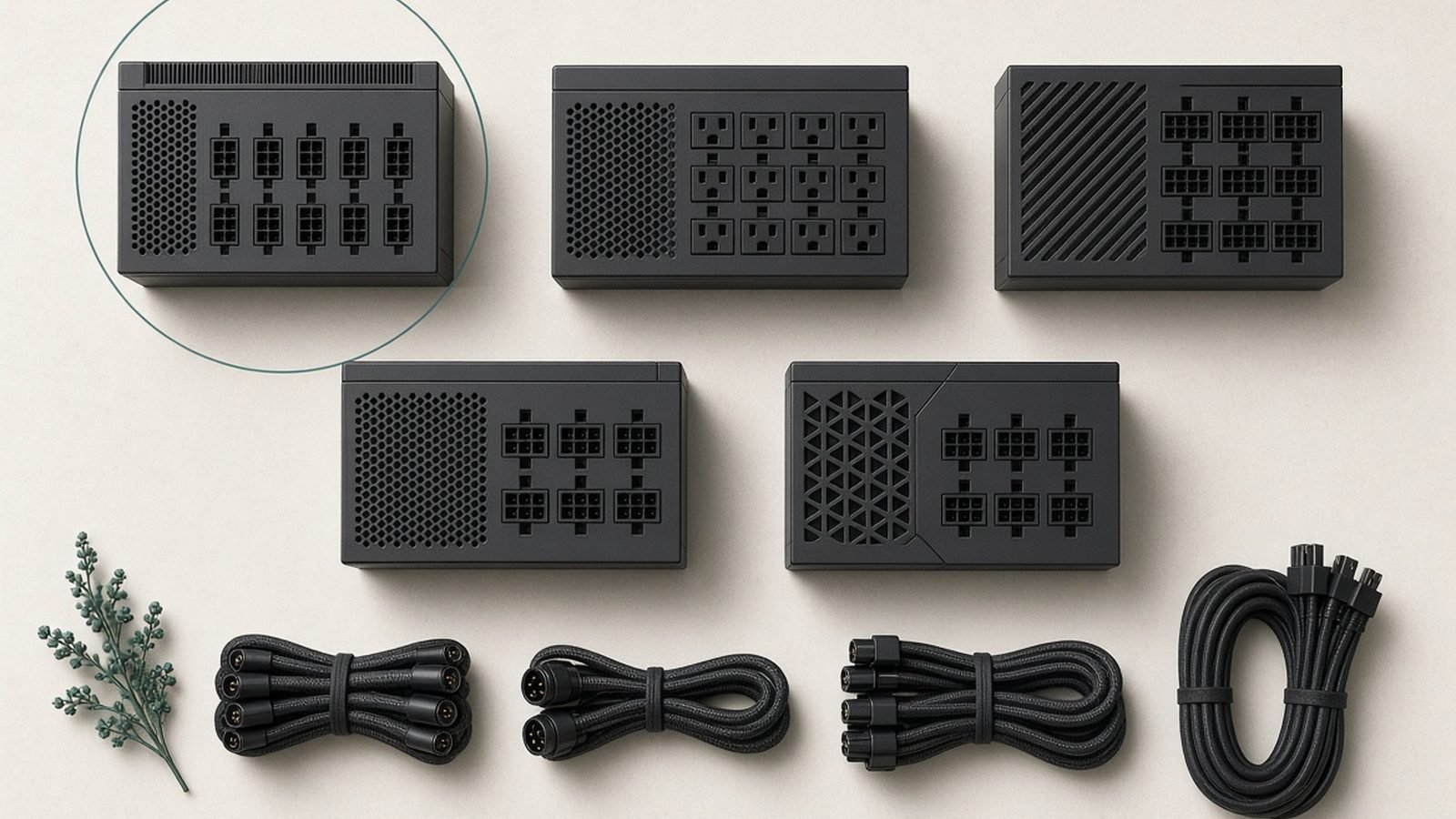
The best power supply for 2026 for most high-end builds is the Corsair RM1000x (ATX 3.1) — a fully modular, Cybenetics Gold unit with a native 12V-2x6 connector and enough headroom to feed today’s GPUs plus a future upgrade. It is quiet, reliable and sensibly priced for the wattage. If your build is more modest, the Corsair RM750e covers mid-range systems for less, and the Seasonic Prime TX-1600 is the unit to buy if you are running a power-hungry RTX 5090.
In 2026 wattage is only half the story. The unit must be a proper ATX 3.1 design with a native 12V-2x6 connector to absorb the sharp transient spikes modern GPUs throw out, or it can trip its protections mid-game. We have not bench-tested these ourselves; this guide draws on published spec sheets, third-party review data and aggregated owner feedback.
Best power supplies 2026 at a glance
| Pick | PSU | Best for | Efficiency | Price US/UK |
|---|---|---|---|---|
| Best overall | Corsair RM1000x (ATX 3.1) | High-end future-proof builds | Cybenetics Gold | ~$180 / £170 |
| Best value | Corsair RM750e (ATX 3.1) | Mid-range builds | Cybenetics Gold | ~$110 / £105 |
| Best quiet | be quiet! Pure Power 12 M 850W | Silent builds | 80+ Gold | ~$130 / £125 |
| Best for RTX 5090 | Seasonic Prime TX-1600 | Flagship / dual-purpose | 80+ Titanium | ~$500 / £470 |
| Best SFX | Corsair SF1000 (ATX 3.1) | Small-form-factor | 80+ Platinum | ~$200 / £190 |
| Best budget | MSI MAG A850GL | Value builds | 80+ Gold | ~$100 / £95 |
How we picked
We treated ATX 3.1 compliance with a native 12V-2x6 connector as the buying gate — for a 2026 build with an RTX 50 or Radeon RX 9000 GPU, it is non-negotiable. From there we weighed efficiency rating (80 Plus / Cybenetics Gold as the value sweet spot), transient response, cable quality and modularity, fan acoustics, warranty length, and aggregated owner reliability. We favoured units that get the fundamentals right over ones chasing headline features. Every pick clears the ATX 3.1 bar.
Why ATX 3.1 and 12V-2x6 matter
Two changes reshaped PSU buying. First, Nvidia’s RTX 50 and AMD’s RX 9000 cards pull brief, sharp power spikes that can far exceed their rated draw; a PSU that only meets the average load can shut the system down. Second, ATX 3.1 was written to handle those spikes, and the 12V-2x6 connector replaced the earlier 12VHPWR design behind the well-publicised melting-cable scares. A native 12V-2x6 socket on the PSU means no adapter clutter and a cleaner, safer connection.
So picking a PSU in 2026 is about transient headroom and connector safety as much as raw wattage. Every unit below is native ATX 3.1. For the wattage math tied to specific GPUs, our dedicated Best 850W Power Supply for Gaming PCs (2026) guide breaks it down tier by tier.
Best overall: Corsair RM1000x (ATX 3.1)
1000W · Cybenetics Gold · native 12V-2x6 · around $180 / £170
The RM1000x is the unit we would drop into most high-end builds. It is fully modular, Cybenetics Gold, and posts excellent transient handling in third-party reviews — exactly what an RTX 5080 demands. The 1000W rating gives real headroom: it comfortably runs today’s top single-GPU systems and leaves room to jump to a hungrier card later without shopping for a new PSU. Owner reports praise its quiet zero-RPM fan mode and long-run reliability.
This is the natural choice for a high-end single-GPU build and the safe pick if you might step up toward a 5090-class card down the line. It costs more than an 850W unit, and that extra wattage is more than a pure gaming build strictly needs — but the future-proofing and worry-free operation justify it for most enthusiasts.
Pros: native 12V-2x6, excellent transient performance, generous 1000W headroom, very quiet, long warranty and strong reliability.
Cons: pricier than 850W units, more wattage than a pure gaming build needs today.
Who it’s for: high-end builders who want future-proof headroom and a quiet, worry-free PSU for years.
Best value: Corsair RM750e (ATX 3.1)
750W · Cybenetics Gold · native 12V-2x6 · around $110 / £105
Not everyone needs four figures of wattage. For a build around an RTX 5070, RX 9070 or a mid-range Core Ultra chip, the RM750e does the job with headroom to spare at a price that makes it one of the best value ATX 3.1 units around. It is fully modular, Cybenetics Gold, quiet, and has the native connector — the fundamentals, done right, for less.
The catch is in the number. 750W leaves less room for a future GPU jump, so if there is any chance you will move to a 5080-class card, spend up for the RM1000x or an 850W unit instead. But for a mid-range 1440p system you plan to keep as-is, the RM750e saves real money without cutting an important corner.
Pros: excellent value, native ATX 3.1, Cybenetics Gold, quiet and fully modular.
Cons: 750W limits future GPU upgrade headroom, fewer cables than higher-wattage units.
Who it’s for: mid-range builders who want ATX 3.1 done right without paying for wattage they will not use.
Best quiet: be quiet! Pure Power 12 M 850W
850W · 80+ Gold · native 12V-2x6 · around $130 / £125
be quiet! built its name on acoustics, and the Pure Power 12 M lives up to it. This ATX 3.1, 80 Plus Gold, fully modular 850W unit undercuts the premium tier while staying genuinely quiet in owner reports. If your build is as much about a silent desk as it is about frame rates, this belongs on the shortlist — and 850W is the smart default for an RTX 5080 or RX 9070 XT.
The trade-offs are honest. The cables are stiffer than Corsair’s, which makes routing in a tight case fiddlier, and it ships with fewer connectors than pricier units, so heavily loaded multi-drive builds should count ports first. For a clean single-GPU gaming PC, none of that matters much.
Pros: genuinely quiet under load, native 12V-2x6, solid Gold efficiency below premium pricing, fully modular.
Cons: stiffer cables complicate tight builds, fewer connectors than premium rivals.
Who it’s for: quiet-build enthusiasts and value hunters who still want full ATX 3.1 compliance.
Best for RTX 5090: Seasonic Prime TX-1600
1600W · 80+ Titanium · native 12V-2x6 · around $500 / £470
A power-hungry RTX 5090 build — especially one paired with a top-tier CPU or aimed at heavy overclocking — deserves a bulletproof, high-wattage unit, and the Seasonic Prime TX-1600 is the flagship answer. It is 80 Plus Titanium, the highest efficiency tier, with superb build quality, near-silent operation and enormous headroom. This is a buy-once-cry-once PSU that will carry any single-GPU system for many years.
It is unapologetically expensive and overkill for anything below a 5090. Most people do not need 1600W or Titanium efficiency, and the price reflects that. But if you are running the most demanding hardware and want zero doubt about stability under transient spikes, nothing here is more reassuring. Pair it with the GPUs in our Best Graphics Cards 2026: GPUs for Every Budget roundup.
Pros: immense headroom, 80+ Titanium efficiency, exceptional build and reliability, near-silent, native 12V-2x6.
Cons: very expensive, wildly overkill for anything below a 5090, physically large.
Who it’s for: RTX 5090 owners and extreme builders who want the most robust, efficient PSU available.
Best SFX: Corsair SF1000 (ATX 3.1)
1000W SFX · 80+ Platinum · native 12V-2x6 · around $200 / £190
Small-form-factor builds need an SFX unit, and the SF1000 packs 1000W of ATX 3.1, 80 Plus Platinum power into the tiny SFX footprint. It has the native 12V-2x6 connector, so you can run a serious GPU in a compact ITX case, and its build quality and fan behaviour are excellent. For a high-performance small build, this is the standard-bearer.
The premium is real — SFX units cost more per watt than ATX, and this one is no exception. It also uses shorter cables suited to compact cases, which can be awkward in a larger chassis. But within its remit — powerful, compliant, compact — it is the unit to beat, and it makes a genuinely potent ITX build possible. Check compatibility with your Best PC Cases 2026: Airflow, Looks & Value pick before buying.
Pros: 1000W in an SFX footprint, native 12V-2x6, 80+ Platinum efficiency, excellent build quality.
Cons: expensive per watt, short cables suit only small cases, SFX premium over ATX.
Who it’s for: small-form-factor builders who want full-power, compliant power in a compact case.
Best budget: MSI MAG A850GL (ATX 3.1)
850W · 80+ Gold · native 12V-2x6 · around $100 / £95
If you want ATX 3.1 compliance without spending on a premium badge, the MSI MAG A850GL is a strong value pick. It is 850W, 80 Plus Gold, fully modular, and — crucially — ships with the native 12V-2x6 connector, so it clears the only non-negotiable bar for a modern GPU. For a value gaming build, it delivers the essentials at a keen price.
It is not as refined as the Corsair or Seasonic units — the internals and warranty are a step below the premium tier, and acoustics are good rather than class-leading. But nothing about it cuts a corner that matters for a mainstream single-GPU system, and the price leaves more budget for the GPU. A sensible foundation for a cost-conscious build; pair it with a value chip from our Best CPUs 2026: Gaming & Productivity Processors guide.
Pros: native 12V-2x6 at a low price, 850W Gold, fully modular, good value foundation.
Cons: shorter warranty and less refined internals than premium units, acoustics only good.
Who it’s for: value builders who want compliant, adequate 850W power without paying for a premium brand.
How to choose a power supply
ATX 3.1 with native 12V-2x6. This is the buying gate for any 2026 build with an RTX 50 or Radeon RX 9000 GPU. Confirm it on the box, not the fine print.
Right wattage, with headroom. A single-GPU gaming PC rarely pulls more than 500-600W in practice, but transient spikes and future upgrades justify buying a tier up. 750W suits mid-range, 850-1000W suits high-end, 1000W+ for a 5090.
Efficiency rating. 80 Plus or Cybenetics Gold is the value sweet spot — cool, quiet and low-waste. Platinum and Titanium cost more for marginal real-world gains, worthwhile mainly on flagship or SFX units.
Fully modular cables. Plug in only what you need for cleaner builds and better airflow — which matters in the ventilated cases we recommend in Best Airflow PC Cases in 2026: Top Picks Compared.
Warranty and fan mode. A 7-10 year warranty signals confidence; a zero-RPM or semi-passive fan keeps the unit silent at idle.
FAQ
What power supply do I need for an RTX 5080?
A quality 850W ATX 3.1 unit with a native 12V-2x6 connector is the comfortable recommendation for an RTX 5080 build paired with a strong CPU. That covers the card’s roughly 360W draw plus transient spikes with headroom to spare. If you might step up to a 5090-class card later, a 1000W unit like the Corsair RM1000x is the future-proof choice.
Do I really need ATX 3.1, or is ATX 3.0 fine?
ATX 3.0 works, but ATX 3.1 refined the connector into the safer 12V-2x6 standard and tightened transient specs. For a new 2026 build with an RTX 50 or RX 9000 GPU, a native ATX 3.1 unit is the version to buy — it avoids adapter clutter and reduces the risk of shutdowns from power spikes. Every pick in this guide meets that bar.
Is a higher-wattage PSU worth it for future-proofing?
Often, yes. A single-GPU system today rarely needs more than 850W, but buying 1000W lets you drop in a hungrier GPU in a couple of years without a new PSU. A quality Gold unit stays efficient even at partial load, so the main cost is the upfront price. For most high-end builders the headroom is worth the modest extra.
What is the difference between 80 Plus Gold, Platinum and Titanium?
They are efficiency tiers — how much wall power reaches your components rather than being lost as heat. Gold is the value sweet spot for gaming. Platinum and Titanium are more efficient and run cooler and quieter, but the real-world savings are small, so they mainly justify their premium on flagship, SFX or always-on systems where efficiency and heat matter more.
Can I reuse my old PSU with a new RTX 50 GPU?
Possibly, if it is a quality unit with enough wattage and the right connectors — but you will likely need a 12VHPWR-to-12V-2x6 adapter, and older designs can trip on transient spikes. For an RTX 5080 or above, a native ATX 3.1 unit is the safer choice, avoiding adapter clutter and the risk of mid-game shutdowns.
Do I need an SFX power supply for a small build?
Only if your case requires it. Many small-form-factor and ITX cases fit only the compact SFX form factor, in which case a unit like the Corsair SF1000 is the answer. Larger cases take standard ATX units, which are cheaper per watt. Always check your case’s PSU form-factor support before buying.
Zen Tech Hub may earn a commission from links on this page, at no extra cost to you.