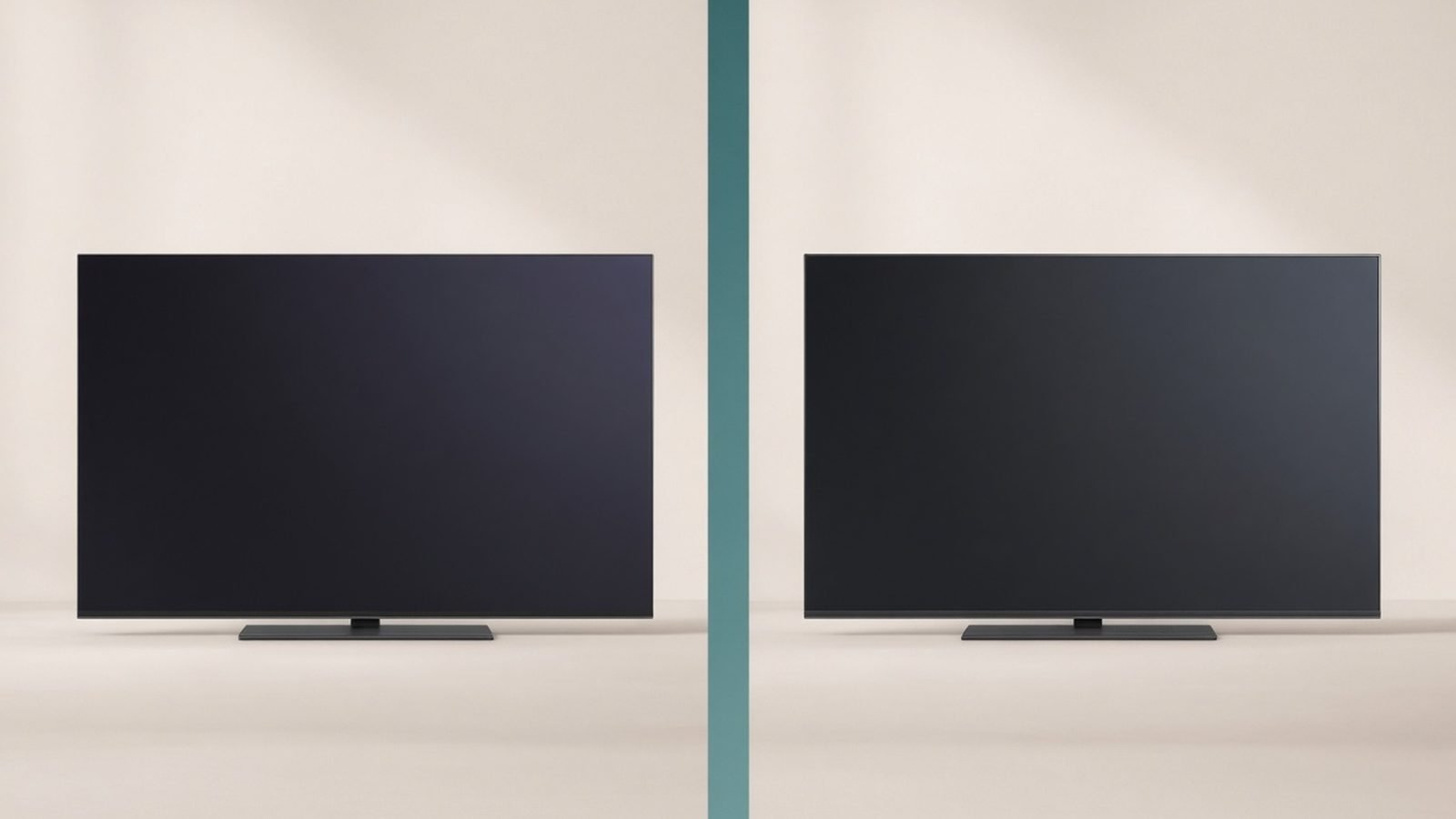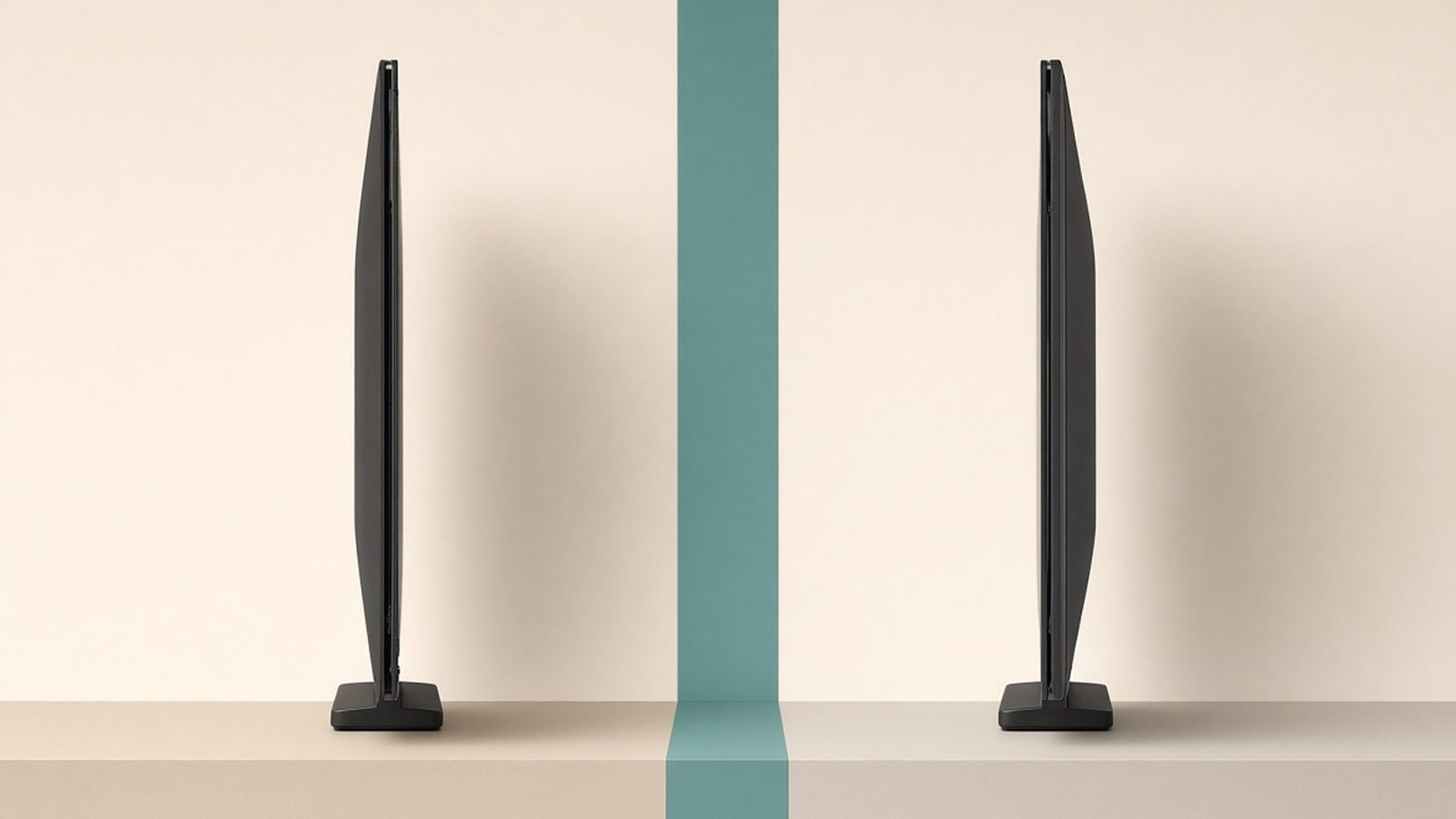
The OLED vs mini LED debate used to be simple: OLED for a dark home cinema, mini-LED for a bright living room. In 2026 the two technologies have collided head-on at overlapping prices, and the answer now hinges on your room and how you use the TV rather than on which panel is “better.” This guide breaks down the real trade-offs in plain English, covers what RGB mini-LED changes this year, and tells you exactly what to buy at $500, $1,000 and $2,000.
Update, 9 October 2026: the three reference sets below were re-read at their makers’ stores and at UK retailers. TCL’s US store no longer sells the QM8K in any size and lists the QM8L (65-inch $1,079.99) and QM9K ($999.99) in its place; LG’s US store lists every LG C5 size as out of stock ($1,499.99 list for 65 inches) with the 2026 C6 in stock at the same price; Hisense’s US product page shows no price for the U8QG, so its $899 remains the July 2026 check. In the UK neither the Hisense U8Q nor the TCL C8K appeared at Currys or on PriceSpy’s TV page — the nearest listings were the Hisense U7S at £999 and the TCL C8L at £1,899 — while the LG C5 was still listed from £1,479 on PriceSpy. The technology comparison below is unaffected; the named sets stay as the models this guide researched, with their successors named as listings only and not assessed. For ranked picks re-read at the same stores on the same day, see our best OLED TVs guide and best TVs of 2026 guide.
The one-paragraph answer
Buy an OLED if you watch in a dim or light-controlled room, care most about perfect black levels and contrast, and want the most cinematic image with the least effort. Buy a mini-LED if your room is bright, you watch a lot of daytime sport or news, you want a bigger screen for the money, or you simply want the most nits per dollar. At the mainstream 65-inch price where they overlapped in July 2026 — roughly $900 to $1,100 — both are excellent, and neither is a mistake. By 9 October 2026 that overlap had become a gap: LG’s in-stock C6 OLED listed at $1,499.99 while TCL’s current QM9K and QM8L mini-LEDs listed at $999.99 and $1,079.99 (US list prices at the makers’ stores), so mini-LED is now the cheaper way to 65 inches in the US.
How each technology works (plain English)
An OLED panel is made of millions of pixels that create their own light. Each pixel can switch fully off, which is why OLED produces true, inky black with no backlight bleed. There is no separate backlight at all.
A mini-LED TV is an LCD panel lit from behind by thousands of tiny LEDs grouped into dimming zones. More, smaller LEDs mean more zones, which means the backlight can brighten and darken smaller areas of the picture more precisely. Mini-LED is the high-end evolution of the LED-LCD panels most people already own.
This is also the answer to the common QLED vs OLED vs mini LED confusion. “QLED” just means an LCD TV with a quantum-dot colour layer for richer colour — it is not a rival panel type. Almost every modern mini-LED is also a QLED. So the real contest is self-lit OLED versus backlit mini-LED (QLED).
Contrast and black levels: OLED’s home turf
This is where OLED wins cleanly. Because every pixel switches off individually, OLED delivers perfect blacks and pixel-level contrast that mini-LED cannot fully match. Starfields, film credits and dark thrillers look flawless, with no halo or “blooming” around bright objects on a black background.
Mini-LED has closed the gap dramatically — a set with several thousand zones controls blooming well — but in our research the very best mini-LEDs still show faint halos in torture-test scenes that OLED simply never produces. If your favourite content is moody, cinematic and watched with the lights down, OLED is the more satisfying picture.
Brightness and bright rooms: mini-LED’s home turf
Flip the lights on and the story reverses. This is the crux of OLED vs mini LED for bright rooms: mini-LED panels push far higher peak and, crucially, full-screen brightness. A top 2026 mini-LED can hit several thousand nits on highlights, while even the best OLEDs top out lower, especially across a full white scene like a hockey rink or a bright UI.
For a sun-filled lounge, a kitchen TV or daytime sport, mini-LED’s brute-force brightness cuts through glare and makes HDR highlights genuinely pop. Based on owner reports, this is the single biggest reason bright-room buyers pick mini-LED and stay happy. If your room has big windows and no blinds, start with mini-LED. Our Best TVs for Bright Rooms 2026: Anti-Glare & High Nits guide goes deeper on this.
Gaming: response time, VRR and brightness combined
For OLED vs mini LED for gaming, both are now superb, with 4K/120Hz (or 144Hz+), VRR, ALLM and near-instant input lag on premium models.
OLED holds the edge on motion clarity and response time — pixels change state almost instantly, so fast motion looks cleaner with less blur, and its per-pixel contrast makes dark games look incredible. Mini-LED counters with sheer brightness, which makes HDR games dazzle in a lit room, and it sidesteps any worry about static HUDs over years of play. Competitive gamers who play in the dark lean OLED; those who game in bright rooms or leave a static HUD on screen for thousands of hours may prefer mini-LED.
Longevity, burn-in and value over 5 years
Burn-in is the OLED question everyone asks. Modern OLEDs include pixel-shifting, logo dimming and refresh cycles, and for normal mixed viewing burn-in is rare. The risk rises with the same static element — a news ticker, a game HUD, a channel logo — displayed at high brightness for enormous stretches. Our OLED Burn-In in 2026: How to Prevent It (Real Data) guide covers the habits that all but eliminate it.
There is effectively no mini LED burn in in the OLED sense, because an LCD panel has no organic pixels to wear unevenly. That makes mini-LED the lower-anxiety choice for a TV that runs one channel all day, a retail display, or a PC monitor with a fixed taskbar.
On value, mini-LED usually gives you a bigger, brighter screen for the money, and it ages predictably. OLED costs a little more for the same size but rewards you with the better dark-room image. Over five years, both are safe long-term buys.
RGB mini-LED: what’s new for 2026 and should you wait
The headline upgrade this year is RGB mini-LED. Here it is explained simply: instead of a single-colour (usually blue) backlight filtered into colours, RGB mini-LED uses individually controlled red, green and blue LEDs in the backlight itself. That means richer, more accurate colour at extreme brightness and wider colour volume — mini-LED chasing OLED’s colour purity while keeping its brightness advantage.
Should you wait? First-generation RGB mini-LED sets are premium-priced flagships in 2026. The proven mini-LEDs below already look outstanding, so there is no need to hold out unless you specifically want the newest colour tech and have the budget. Expect RGB mini-LED to trickle down to mainstream prices over the next couple of years.
Which to buy at each budget
Around $500: get a smart, brighter mini-LED
At this price OLED isn’t realistic at 65 inches, so a solid mini-LED or QLED is the value play. See Best 55-Inch TVs Under $500 in 2026 (Mini-LED for Less) for current picks that punch above their price.
Around $900–$1,100: the real OLED vs mini-LED fight
This is the tier where the two technologies go blow for blow, and where is OLED worth it over mini-LED actually gets a real answer — it depends on your room.
Hisense U8QG (65-inch) — $899 at the July 2026 check (Hisense’s US page shows no price and Newegg and Best Buy could not be read from here, so the figure is not re-dated); no UK U8Q listing was found at Currys or on PriceSpy on 9 October 2026, where the nearest Hisense mini-LED was the U7S 65-inch at £999, so the July £1,199 is withdrawn. Our reference bright-room mini-LED: it undercuts OLED on price yet beats it on nits, making it the standout for lounges and daytime sport.
Pros: Enormous brightness, huge value, strong HDR, great for bright rooms and sport.
Cons: Some blooming vs OLED in dark scenes; off-angle viewing softer than OLED.
Check price: Hisense U8QG (65-inch)
TCL QM8K (65-inch) — unavailable in every size at TCL’s US store on 9 October 2026 (65-inch list $2,499.99), where TCL now lists the QM8L at $1,079.99 and the QM9K at $999.99 for 65 inches instead, neither assessed here; in the UK the C8K is no longer on TCL’s range page and Currys returns the C8L at £1,899, so the July £1,099 is withdrawn. A premium mini-LED with a massive zone count, our reference point for the head-to-head budget tier and a direct OLED alternative while stock lasts.
Pros: Excellent contrast control for LCD, very bright, was superb value in the UK at its July 2026 price.
Cons: Still shows the occasional halo; heavier and bulkier than OLED.
Check price: TCL QM8K (65-inch)
LG C5 OLED (65-inch) — $1,499.99 list and out of stock in every size at LG’s US store on 9 October 2026, with the 2026 C6 in stock at the same price; from £1,479 on PriceSpy UK, where Currys now lists only the C6 at £1,899. The reference OLED at the price where the two techs collided in July: the best dark-room image and motion here, full stop.
Pros: Perfect blacks, pixel-level contrast, class-leading motion, brilliant for film and dark-room gaming.
Cons: Lower full-screen brightness than the mini-LEDs; slight burn-in caution with static content.
Check price: LG C5 OLED (65-inch)
For a closer look at the two mini-LEDs, see Hisense U8QG vs TCL QM8K: 2026 Mini-LED Battle; for OLED value picks, Best Budget OLED TVs 2026: Cheapest Ways Into OLED.
Around $2,000: flagship OLED or RGB mini-LED
At this tier you’re choosing a top-end OLED for the ultimate dark-room picture, or a first-gen RGB mini-LED for maximum brightness and colour. Match it to your room, not the spec sheet.
Comparison table
| Factor | OLED (LG C5) | Mini-LED (Hisense U8QG / TCL QM8K) |
|---|---|---|
| Black levels & contrast | Perfect, pixel-level | Very good, occasional bloom |
| Peak / full-screen brightness | High / moderate | Very high / high |
| Best room | Dark or light-controlled | Bright, sunny |
| Gaming | Best motion & dark-scene contrast | Best HDR brightness, no burn-in worry |
| Burn-in risk | Low but non-zero | Effectively none |
| Value for size | Slight premium | More screen per dollar |
Verdict
There is no universal winner in OLED vs mini LED — there’s a winner for your room. Watch in the dark and love film? The LG C5 OLED is the one to beat. Bright room, lots of sport, want the most screen and nits per dollar? The Hisense U8QG and TCL QM8K are the smarter buys — though on 9 October 2026 TCL US listed the QM8L and QM9K in the QM8K’s place and no UK listing for either set was found, so read the dated update above before ordering. Pick the technology that matches how you actually watch, and you’ll be delighted either way. Back to the TVs & Displays for more.
FAQ
Is OLED worth it over mini-LED? If you watch mostly in a dim or light-controlled room and care about perfect blacks, cinematic contrast and the cleanest motion, yes — OLED is worth the small premium. If your room is bright or you want a bigger, punchier screen for the money, mini-LED is the better value and you won’t feel short-changed.
Which is better, mini-LED or OLED, for a bright living room? Mini-LED. Its far higher peak and full-screen brightness cuts through glare and sunlight, so HDR highlights still pop with the curtains open. OLED can look a little muted in a very bright room, though a good one still performs well with some light control.
Does mini-LED get burn-in like OLED? No. Mini-LED uses an LCD panel with no organic, self-lit pixels, so there’s effectively no mini-LED burn-in. That makes it the low-worry pick for a TV showing static news tickers, sports scores or a fixed game HUD for thousands of hours.
What is RGB mini-LED and should I wait for it? RGB mini-LED uses separately controlled red, green and blue backlight LEDs for richer, more accurate colour at high brightness. It’s excellent but currently confined to pricey 2026 flagships. Unless you want the newest colour tech and have the budget, today’s proven mini-LEDs are a smarter buy.
Is QLED the same as mini-LED? Not quite. QLED just means an LCD TV with a quantum-dot colour layer, while mini-LED describes the tiny-LED backlight. Most mini-LEDs are also QLEDs. In a QLED vs OLED vs mini-LED comparison, the real contest is self-lit OLED versus backlit mini-LED.
Zen Tech Hub may earn a commission from links on this page, at no extra cost to you.