If one wall brick is powering your laptop, phone, earbuds and a tablet from a nest of separate chargers, the Anker Prime 250W Charging Station is the single device that replaces the pile. This Anker Prime 250W review covers the six-port desktop charger that has become the default recommendation for cluttered home-office desks in 2026 — and it earns that spot, with two clear caveats.
The short verdict: the Anker Prime 250W is the best desktop charging station most people can buy at around $170 / £150, thanks to 250W of shared output across four USB-C and two USB-A ports and a genuinely useful smart display. It is not the cheapest way to hit 250W, and its per-port power drops sharply once you plug in three or four hungry devices — so read the allocation section before you assume it’ll fast-charge everything at once.
Who should buy it: anyone running a laptop plus three or more devices from one desk who wants tidy cabling and live power readouts. Who shouldn’t: single-laptop users (a 100W brick is cheaper) and travellers (this is a stay-at-home unit).
Around $170 / £150 · 6 ports (4×USB-C, 2×USB-A) · 250W total · smart colour display · GaN
Check price: Anker Prime Charging Station (250W, 6 Ports)
Anker Prime 250W at a glance
| Detail | |
|---|---|
| Total output | 250W shared across all ports |
| Ports | 4× USB-C, 2× USB-A |
| Single-port max | 140W (USB-C, PD 3.1) |
| Display | Colour LCD with per-port wattage |
| Tech | GaN, Anker Prime power allocation |
| App | Anker companion app (power history, port control) |
| Price | around $170 / £150 |
| Best for | Multi-device desks, one-cable laptop charging |
Pros
- 140W single-port output fast-charges a 16-inch MacBook Pro
- Smart display shows live per-port wattage — genuinely useful, not a gimmick
- Six ports handle an entire desk from one wall outlet
- Excellent Anker build quality and support record
- App adds power history and per-port control
Cons
- 250W is shared, not per-port — four devices split it fast
- Costs more than assembling separate chargers
- Desktop-only; too big and heavy to travel with
- No cables in the box beyond the mains lead
- Overkill if you only ever charge one laptop
Design and build
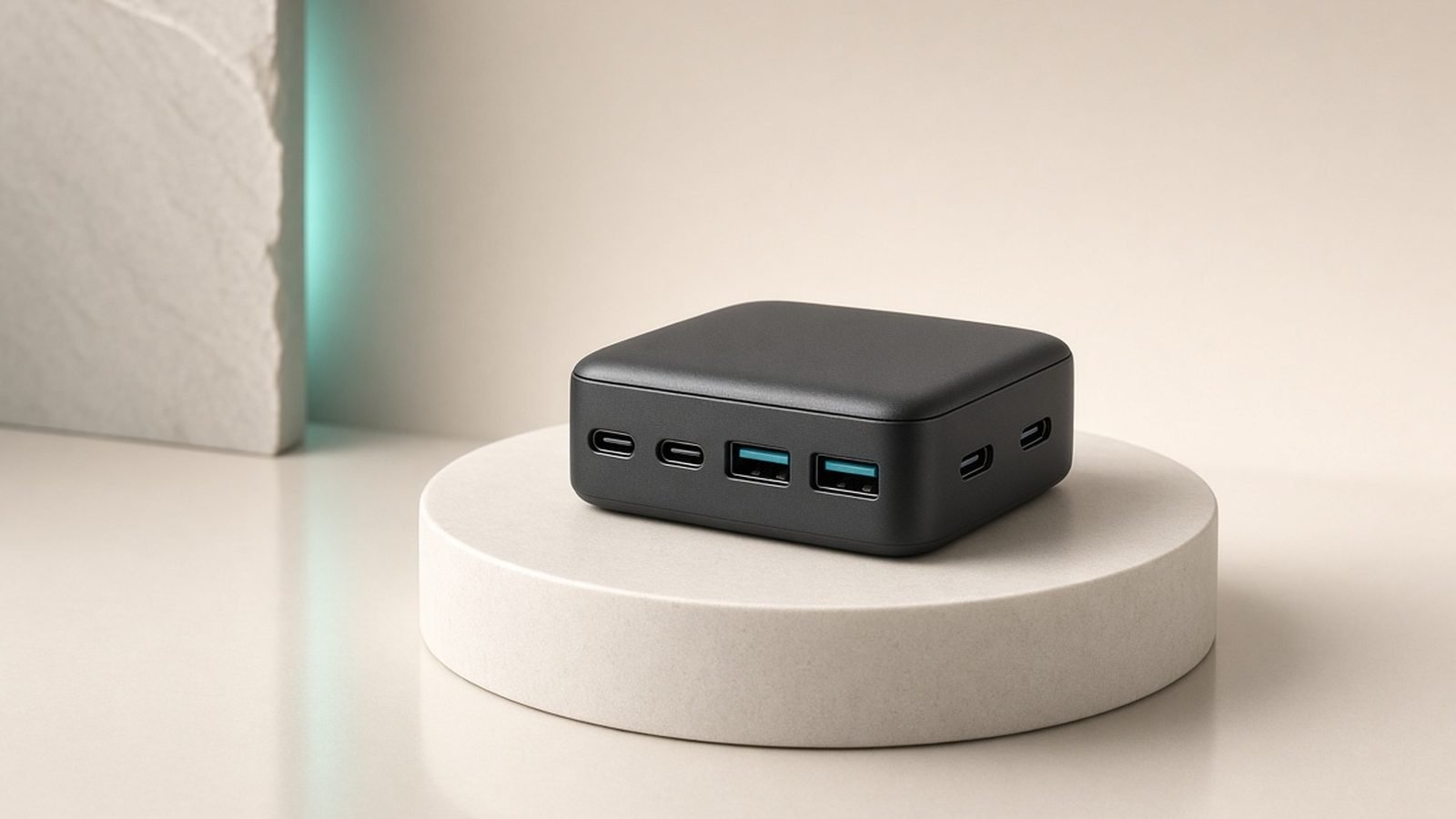
The Prime 250W is a dense, upright brick roughly the size of a small hardback, finished in Anker’s usual matte grey with a glossy display panel on the front. It weighs enough (around 570g) to stay put when you tug a cable, and the ports run along the top edge — four USB-C, two USB-A — angled so cables fall neatly behind the desk rather than sticking straight up.
The star feature is the colour LCD. It cycles through total draw, per-port wattage and temperature, and unlike the monochrome readouts on cheaper units it’s legible across a desk. In daily use it’s the difference between guessing why your laptop is charging slowly and simply seeing that port one is negotiating 90W while ports two and three eat the rest. Based on aggregated owner reports, the display is the single most-praised feature and the main reason buyers pick this over a screenless UGREEN Nexode desktop unit.
Build quality is what you expect from the Prime line: tight tolerances, no coil whine on most units, and a mains cable that detaches for tidy transport. The US model ships with a fixed cable; the UK version uses a standard kettle-style lead. One practical note — this thing is a desk fixture, not a bag charger. At this size and weight, treat it as permanent infrastructure.
Performance and power allocation
Here’s the part that decides whether you’ll be happy. The 250W is a shared budget, not a guarantee per port. Plug in one device and a single USB-C port delivers up to 140W over PD 3.1 — enough to charge a 16-inch MacBook Pro at full speed, or run a gaming handheld and a phone with headroom. That single-port ceiling is genuinely excellent and matches the best dedicated laptop bricks.
Add devices and Anker’s allocation logic kicks in. Based on published specs and owner reports, a typical loaded scenario — laptop plus phone plus tablet plus earbuds — sees the laptop port step down to around 100W while the others draw what they need. That’s still fast for everything involved, because phones and tablets rarely pull more than 30–45W. The failure case is niche but real: two power-hungry USB-C laptops at once will each get roughly 100W-class output rather than 140W, so a household charging two 16-inch MacBook Pros simultaneously won’t max both.
For fast phone charging, the Prime supports USB Power Delivery and PPS, so Samsung Super Fast Charging 2.0 (up to 45W) and iPhone full-speed PD both work. You’ll need decent cables to see peak speeds — the box doesn’t include any, so budget for good ones from our Best USB-C Cables 2026: Fast Charging & Data Ranked guide, and make sure at least one is a 140W-rated cable if you want top laptop speed.
Thermals are well managed. Under a full four-device load the unit runs warm to the touch but never hot in aggregated feedback, and there’s no fan, so it’s silent. GaN internals keep it far smaller than a legacy 250W supply would be.
The app and smart features
The Anker companion app pairs over Bluetooth and adds a layer most chargers don’t have: a running history of what each port has delivered, the ability to prioritise a specific port (handy when you want the laptop to always win the power split), and firmware updates. It’s not essential — the charger works fully standalone — but it turns the Prime into something you can actually reason about. For anyone who has ever wondered why a device charges slowly on a multi-port hub, seeing the numbers is quietly satisfying.
The trade-off is that app-connected chargers ask you to trust another account and another background connection. If that’s not for you, ignore the app entirely; nothing on the charger depends on it.
Value: is 250W worth it?
At around $170 / £150, the Prime 250W is not cheap, and honesty demands the obvious point: you can hit 250W of total charging for less by buying two separate bricks. What you’re paying for is consolidation — one wall outlet, one device, one display — plus Anker’s build and support.
That maths works best for genuinely multi-device desks. If you regularly charge a laptop and three or more accessories, the tidiness and the single-outlet footprint justify the premium. If you charge one laptop and occasionally a phone, you’re overspending; a 100W GaN brick from our Best GaN Chargers 2026: 30W to 160W Compared & Ranked roundup does that job for a third of the price. And if you need power on the move rather than on a desk, a battery from our Best Power Banks for Laptops in 2026: 100W+ Picks Compared guide is the smarter purchase.
The closest rival is UGREEN’s Nexode desktop line, which offers similar wattage for less money but usually without the colour display. We break that rivalry down fully in Anker vs Ugreen Chargers 2026: Which Brand Is Better?.
Verdict
The Anker Prime 250W Charging Station is the desk charger to beat in 2026. It combines a class-leading 140W single-port ceiling, six ports, silent GaN thermals and the best power display on the market into one tidy unit. The two things to internalise before buying: the 250W is shared, so a full load splits it, and the price only makes sense if you’re actually charging several devices at once.
For the multi-device home office it’s designed for, nothing else offers this blend of power, visibility and build. Recommended — with the shared-power caveat firmly in mind.
FAQ
Can the Anker Prime 250W charge a MacBook Pro at full speed?
Yes. A single USB-C port delivers up to 140W over PD 3.1, which is the full fast-charge rate for a 16-inch MacBook Pro and more than enough for the 14-inch model. The caveat is load: if you’re simultaneously charging several other power-hungry devices, the laptop port can step down to around 100W as the 250W total is shared out. For full 140W you’ll also need a 140W-rated USB-C cable, which isn’t included.
Is the 250W per port or shared across all ports?
Shared. The 250W is a total budget the charger allocates across whatever you plug in. One device can take up to 140W; add more and Anker’s power logic divides the remaining wattage. Phones, tablets and earbuds draw little, so a laptop plus accessories works well, but two demanding USB-C laptops at once will each get roughly 100W-class output rather than 140W apiece.
Does the Anker Prime 250W come with cables?
No — only the mains lead. You supply your own USB-C and USB-A cables, and to hit the full 140W laptop speed you need a 140W-rated USB-C cable specifically. Many owners already own suitable cables, but budget for at least one high-wattage cable if you don’t. Our cable guide covers what to look for.
Is it worth it over separate chargers?
Only if you charge multiple devices from one spot. Two individual GaN bricks can match 250W of total output for less money. The Prime’s value is consolidation — one outlet, one unit, a live display and app control — which pays off on a busy desk but is wasted if you only ever charge a single laptop.
How does it compare to the UGREEN Nexode desktop chargers?
UGREEN’s Nexode desktop line typically offers comparable wattage for less money, usually without a colour display. Anker counters with the smart screen, app and marginally more graceful power allocation. If live per-port readouts matter to you, the Prime justifies its premium; if you just want reliable watts, UGREEN is the value pick. Our full Anker vs Ugreen Chargers 2026: Which Brand Is Better? comparison covers it in detail.
Does it support Samsung and iPhone fast charging?
Yes. The Prime supports USB Power Delivery and PPS, so iPhones charge at full PD speed and Samsung Galaxy phones get Super Fast Charging 2.0 up to 45W on supported models. Pixels, iPads and USB-C laptops are all covered. Use a good USB-C cable to see peak speeds.
Zen Tech Hub may earn a commission from links on this page, at no extra cost to you.