Western Digital, usually just “WD,” is the other half of the hard-drive duopoly and, for many buyers, the slightly more trusted name on reliability. Its color-coded system — Blue for desktops, Red for NAS, Black for performance, Gold for enterprise, Purple for surveillance — makes it unusually easy to pick the right drive, and its WD Black SN-series SSDs are among the best performance drives you can buy. The verdict: WD is a genuinely good, safe-default storage brand, especially for NAS and everyday use. The caveat is that the color labels hide important details (not every “Red” is the same technology), and WD’s 2020 SMR scandal proved the brand isn’t above cutting corners quietly.
For most people, WD is an easy recommendation: buy WD Red Plus/Pro for a NAS, WD Black for a fast gaming SSD, and WD Blue for value. Just read the exact model spec, not only the color. Here’s the full picture.
Company overview
Western Digital is an American company, headquartered in San Jose, California, and founded in 1970 — making it even older than Seagate. It is publicly traded and independent. Over the decades it absorbed several legendary storage names: it bought HGST (the old Hitachi/IBM drive division, itself widely regarded as the most reliable HDD maker of its era), and in 2016 it acquired SanDisk, giving it a major flash-memory and NAND manufacturing arm.
An important 2025–2026 development: Western Digital spun SanDisk back out as a separate public company, splitting the group into a hard-drive/HDD-focused Western Digital and a flash-focused SanDisk. In practice WD still sells SSDs under the WD Black, WD Blue and WD Red SSD names, but the flash-memory business and the SanDisk consumer brand are now organizationally distinct. WD’s reputation among enthusiasts is strong, buoyed largely by inheriting HGST’s reliability pedigree and by the excellent WD Black SSD line.
What Western Digital makes
WD’s lineup is organized by its famous color system:
- WD Blue — mainstream desktop HDDs and value SATA/NVMe SSDs.
- WD Red / Red Plus / Red Pro — NAS-specific hard drives for multi-bay enclosures, plus WD Red SSDs for caching.
- WD Black — performance line: high-end NVMe SSDs (SN770, SN850X, SN8100-class) and gaming-oriented drives, including PS5-ready heatsink versions.
- WD Gold — enterprise and data-center HDDs.
- WD Purple — surveillance/CCTV drives built for constant write workloads.
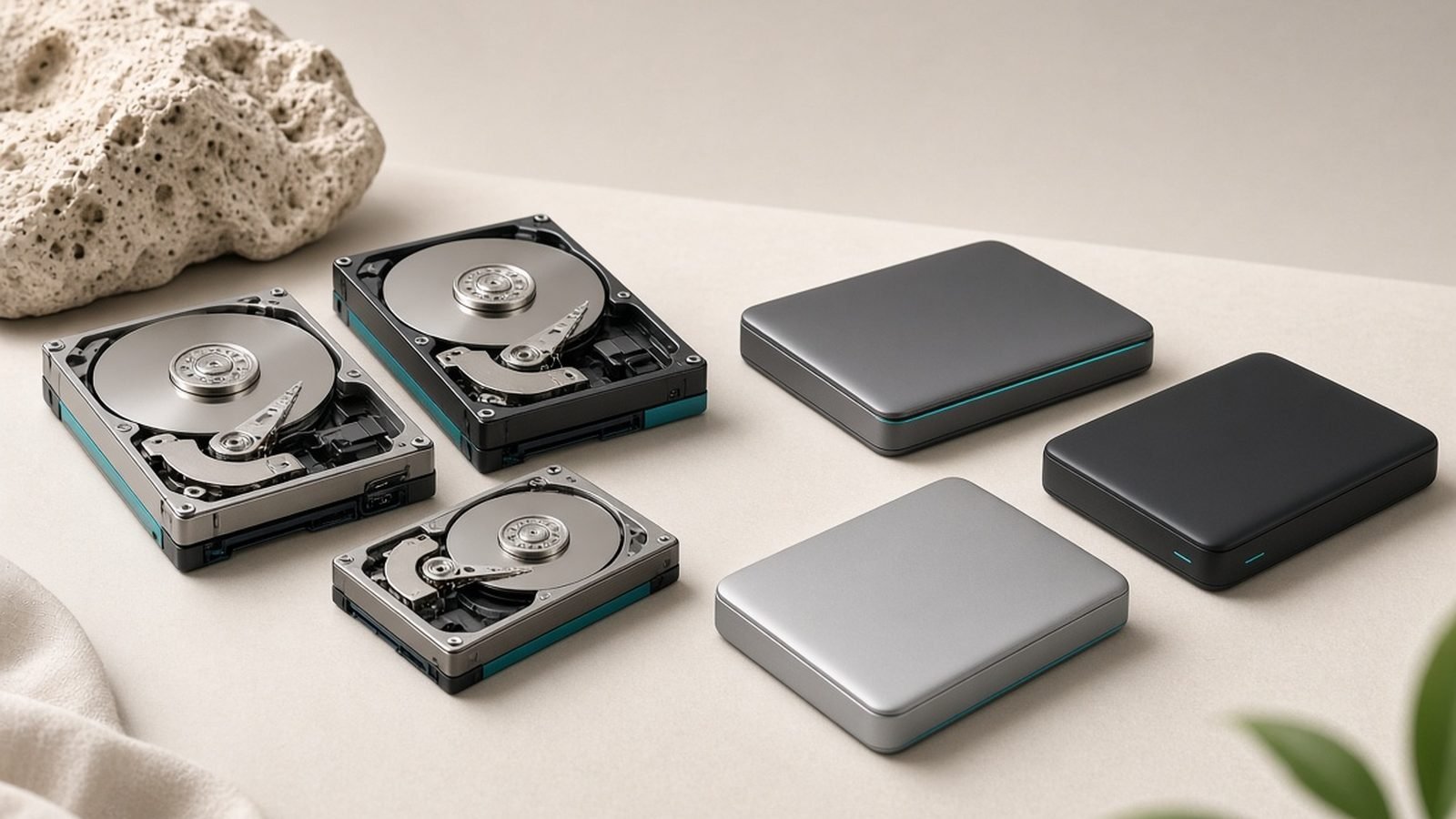
- WD Elements & My Passport / My Book — external portable and desktop backup drives (HDD and SSD).
- Ultrastar — the enterprise data-center line inherited from HGST, still among the most respected drives in server rooms.
Standout Western Digital products in 2026
- WD Red Plus / Red Pro (up to 24TB+) — the default NAS drive for many home and small-business builders, using conventional CMR recording and rated for multi-bay use. Pair it with the right enclosure using our Best NAS Drives for Home 2026: Backup & Media Picks Ranked guide.
- WD Black SN850X / SN8100-class NVMe SSD — one of the best gaming and creator SSDs available, with strong sustained speeds and a PS5-compatible heatsink variant. It’s a regular feature in our Best SSDs 2026: NVMe & SATA Drives Compared & Ranked roundup.
- WD Blue SN5000 NVMe — the sensible-value SSD for a laptop or budget PC build, trading peak speed for a better price.
- WD Gold / Ultrastar enterprise HDDs — the drives homelab and server builders reach for when reliability and workload rating matter more than price.
- WD My Passport / Elements portable drives — cheap, dependable external backup. If you want faster portable solid-state storage, compare picks in Best SSDs 2026: NVMe & SATA Drives Compared & Ranked.
- WD Purple — the go-to for anyone running an always-recording CCTV/NVR setup.
Strengths
- A reputation for reliability. WD, and especially its inherited HGST/Ultrastar drives, consistently rank among the most reliable in large-scale field data. For many buyers this is the reason to choose WD over the competition.
- The color system makes buying easy. Matching a drive to its job — Red for NAS, Black for speed, Purple for surveillance — is more intuitive than most rivals’ naming.
- Class-leading performance SSDs. WD Black NVMe drives are genuinely top-tier for gaming and content creation, not also-rans.
- Vertical integration on flash. Even post-split, WD’s long relationship with SanDisk/Kioxia NAND means its SSDs are built on strong, proven memory.
- Deep enterprise pedigree. The Ultrastar line gives WD credibility and supply that flows down into its consumer NAS and Gold drives.
Weaknesses & criticisms
- The 2020 SMR scandal. WD quietly shipped slower shingled-magnetic-recording drives inside some WD Red NAS models without disclosure, causing failed RAID rebuilds and real data-integrity scares. It led to lawsuits and a lasting trust dent. WD now labels CMR vs SMR more clearly, but the episode is why you must still check the exact model.
- Color labels hide the details. “WD Red” alone isn’t enough — Red (SMR) vs Red Plus/Pro (CMR) matters enormously for NAS. The simplicity of the system can mislead as much as it helps.
- Premium pricing on flagships. WD Black SSDs and Red Pro drives often cost more than equivalent Seagate or third-party options; you pay for the reputation.
- The SanDisk split adds confusion. With SanDisk spun out, buyers can be unsure which brand to look for on portable SSDs and memory cards, since the product lines overlap in the market.
- Occasional external-drive frustrations. Some My Passport/My Book units use hardware encryption or bundled software that complicates recovery or reuse.
Reliability & support
Reliability is Western Digital’s strongest suit. In the large multi-year fleet statistics that backup companies publish, WD and HGST/Ultrastar drives frequently post among the lowest failure rates in the industry — a big part of why the brand is trusted for NAS and enterprise. That said, the SMR affair is a reminder that reputation doesn’t guarantee every model is what it appears, so buying the CMR-confirmed Red Plus or Red Pro for a NAS is important.
Warranties follow the tiers: WD Blue drives typically get two to three years, WD Red Plus and Black five years, and Red Pro/Gold/Ultrastar five years with higher workload ratings. WD Black SSDs carry five-year warranties with generous endurance (TBW) ratings, and WD’s firmware and Dashboard software for SSDs are actively maintained — a real advantage over hard-drive-only brands. Customer service is about average for the sector: competent for standard RMAs, with the usual variability on complex cases.
Who should buy Western Digital
Buy WD if you want a safe-default, reliability-first storage brand. WD Red Plus/Pro is one of the best mainstream choices for a home or small-business NAS, WD Black is a top pick for a fast gaming or creator SSD, and WD Blue covers value builds. The clear color system makes it the easiest brand to shop if you’re not a storage nerd.
Look elsewhere if you’re chasing the absolute lowest price per terabyte on huge drives — Seagate’s Exos line often undercuts WD Gold — or if you want the cheapest performance SSD, where Crucial and others frequently beat WD Black on value. As always, confirm CMR vs SMR before building an array.
FAQ
Is Western Digital a good brand?
Yes. Western Digital is one of the most trusted storage brands, with a strong reliability reputation (bolstered by its HGST/Ultrastar heritage), an easy-to-navigate color-coded lineup, and excellent WD Black SSDs. Its main black mark is the 2020 SMR labeling scandal, which taught buyers to check exact models.
Is Western Digital reliable?
Very — WD and its Ultrastar/HGST drives regularly rank among the lowest-failure drives in large field studies. Reliability is arguably its biggest selling point, though the SMR episode shows you should still verify a specific model is CMR for NAS use.
Where is Western Digital from and who owns it?
WD is an American company founded in 1970 and headquartered in San Jose, California. It is publicly traded and independent. It formerly owned SanDisk, which it spun back out as a separate public company in the 2025–2026 period.
Western Digital vs Seagate — which is more reliable?
Both are reliable when you buy the right model, but WD (especially Ultrastar/HGST) has a slight edge in reputation and field-failure data. Seagate often wins on price for the largest drives. For a typical NAS, either WD Red Plus or Seagate IronWolf is a sound choice.
What’s the difference between WD Red and WD Red Plus?
The base WD Red used slower SMR recording and is best avoided for RAID; WD Red Plus and Red Pro use CMR and are built for multi-bay NAS with higher workload ratings. For any NAS array, choose Red Plus or Red Pro, not plain Red.
Is WD Black a good SSD?
Yes — WD Black NVMe drives (like the SN850X and newer SN8100-class) are among the best performance SSDs for gaming and creative work, with strong sustained speeds, long warranties and PS5-ready heatsink options. You pay a premium, but the drives earn it.
Zen Tech Hub may earn a commission from links on this page, at no extra cost to you.