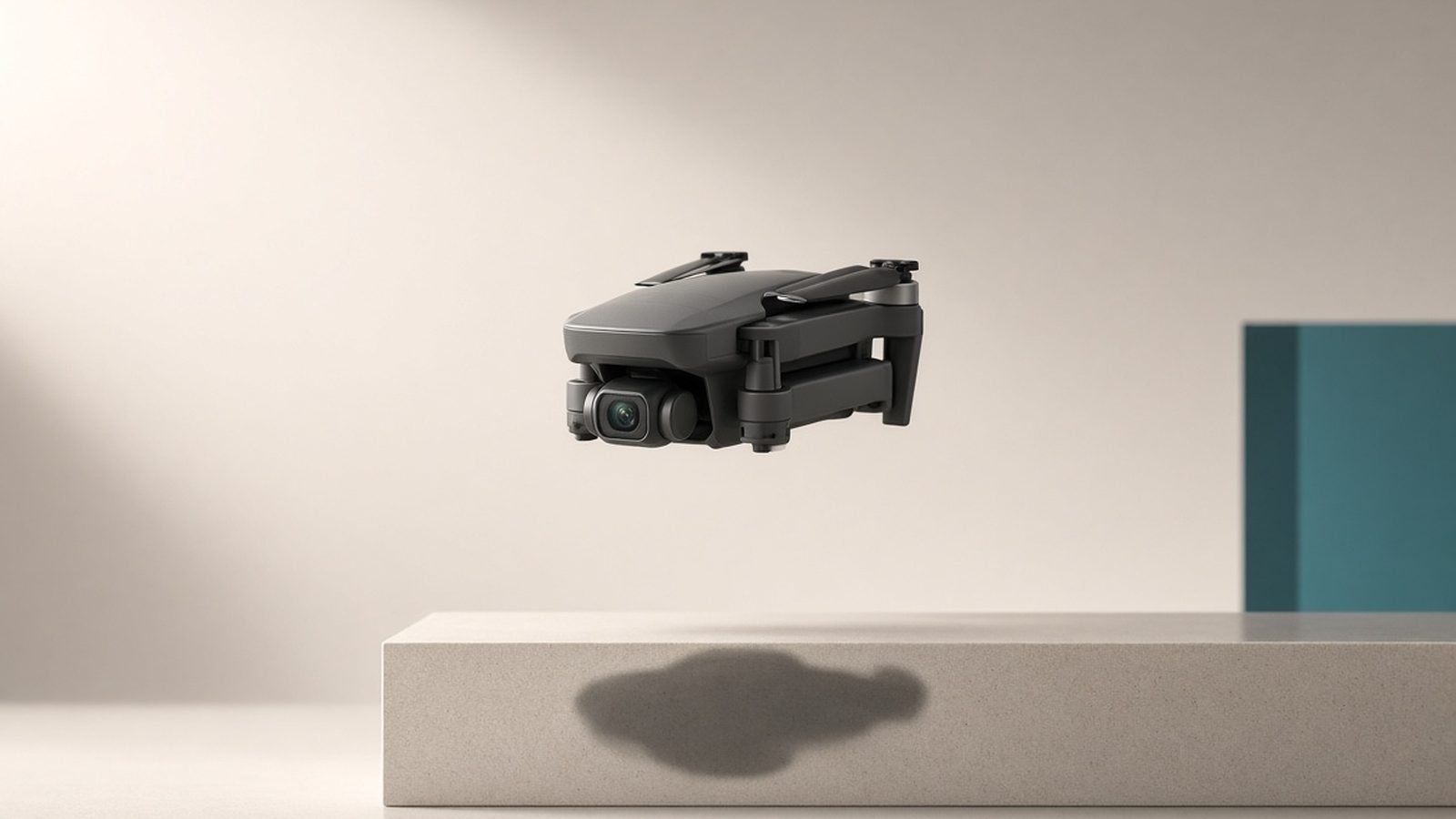
Guides to a first DJI drone usually hang everything on one number: 250 grams. The line matters, but for less than it is often given credit for. In the US it decides whether the drone has to be registered with the FAA. In the UK it does not decide whether you sit a test — the CAA requires a Flyer ID from 100 grams, which takes in every drone on this page. What the featherweights still give a first-time pilot is a lower price, a smaller thing to crash and, in the US, one less form, and that is why most of our picks remain under 250g.
DJI still dominates the beginner space because the flight software is forgiving, the obstacle sensing genuinely prevents crashes, and the video looks good straight off the memory card. Below we rank four models — from a palm-launch toy-killer that DJI’s UK store sells for £119 to a serious 1-inch step-up — and tell you exactly who each one is for.
Which DJI Drone Is Right for a Beginner?
Most new pilots want three things: something that won’t drop out of the sky, something that stays on the right side of the law, and a camera that makes clips worth posting. Here’s the short version.
| Drone | Best for | Weight | Price (UK / US) | FAA registration (US)? |
|---|---|---|---|---|
| DJI Mini 5 Pro | Best overall beginner-to-serious | 249g | £689 / around $799 | No |
| DJI Neo | Cheapest first / backup flyer | 135g | £119 (was £145) / around $199 | No |
| DJI Flip | Friendliest selfie / palm drone | Sub-250g | £295 (RC-N3) or £439 (RC 2) / around $439 | No |
| DJI Air 3S | Best image quality step-up | Over 250g | £959 / around $1,099 | Yes |
Pound prices are from DJI’s UK store on 2 October 2026; dollar figures are from our July 2026 check and were not re-verified for this update. If you only remember one thing: three of these four are under 250g, which in the US means no FAA registration for recreational flying. It does not excuse you from the free test in either country. For the wider rules on where and how you can fly, see our guide: Do You Need a License to Fly a Drone? (US & UK 2026).
How We Ranked Them
We don’t run a drone lab, so we won’t pretend to. Our rankings combine close spec analysis, DJI’s published figures, and aggregated owner feedback from forums, retailer reviews and creator communities. Where we say a drone struggles in wind or nails subject tracking, that reflects patterns in owner reports, not invented benchmark numbers.
We weighted four things heavily for beginners: legal simplicity (the sub-250g advantage), crash resistance and obstacle sensing, ease of the first flight, and real-world image quality. Price mattered too — this is the category where people are most likely to over-buy. We looked hard at value under the psychological $500 / £500 line, since the best drone under 500 for a nervous first-timer is often smarter than a flagship.
Best Overall: DJI Mini 5 Pro
The Mini 5 Pro is the drone we’d hand almost any beginner who can stretch to it. It packs a 1-inch sensor — the size that separates genuinely good aerial footage from phone-in-the-sky mush — into a body that still comes in under 250g. That combination barely existed a couple of years ago.
Crucially for new pilots, it adds omnidirectional obstacle sensing, so the drone can “see” and stop in every direction, not just forwards. Owner reports consistently credit this with saving first flights that would otherwise have ended in a tree. Battery life is long enough that you’re not landing in a panic every eight minutes, and the return-to-home function is reliable.
The catch is cost. DJI’s UK store lists the drone with the RC-N3 controller at £689, and the Fly More combos — extra batteries, a nicer controller, a bag — run from £869 to £1,039 (2 October 2026). Our July 2026 check put the US price at around $799, but DroneDJ reported on 17 September 2025 that DJI would not sell the Mini 5 Pro through its own US online store, which leaves American buyers with third-party sellers; we could not re-verify a US price for this update. It’s the most future-proof pick here, but it’s also the one you’re most likely to over-spend on.
Pros - Sub-250g, so no FAA registration for recreational flying in the US - Large 1-inch sensor for the class - Omnidirectional obstacle sensing - Long battery life and dependable return-to-home
Cons - Easily the priciest sub-250g option - Fly More combos add meaningful cost - More capability than a casual flyer needs
Who it’s for: the beginner who knows they’ll stick with it and wants to buy once. Read our full DJI Mini 5 Pro Review 2026: The Beginner Drone to Beat before you commit.
Best First / Budget Drone: DJI Neo
DJI’s UK store lists the Neo at £119, reduced from £145, on 2 October 2026 (it was around $199 at our July 2026 US check). That makes it the cheapest drone in this guide and the easiest entry point in the range. It weighs just 135g, launches from the palm of your hand, and can fly preset shots — orbits, follow, spotlight — without you touching a controller at all. For social clips and getting comfortable with the idea of a flying camera, nothing here is less intimidating.
It’s also the best “second drone” in the whole line-up. Experienced Mini and Air owners keep a Neo in the bag for tight indoor spaces and grab-and-go moments where they’d never risk a pricier aircraft.
Be honest about the trade-offs, though. The small sensor can’t match the Mini 5 Pro or Air 3S in low light, and owner reports repeatedly flag limited range and poor wind resistance. On a breezy day near the coast, the Neo gets pushed around. Treat it as a fun, low-stakes learning tool and a capable social-clip machine rather than a serious photography drone.
Pros - Cheapest drone in this guide, a true impulse-buy entry point - 135g palm-launch, no controller needed to start - Brilliant backup / indoor flyer - Fun automated shot modes
Cons - Small sensor, weak in low light - Limited range and wind resistance - Not built for serious stills or cinematics
Who it’s for: absolute beginners on a budget, kids-with-supervision, and existing pilots who want a throwaway backup. Wondering how it stacks up against the Mini? Our take on the dji neo vs mini question is simple — the Neo is for fun and firsts, the Mini for footage you’ll keep.
Best Selfie / Palm Drone: DJI Flip
The Flip is the drone we’d recommend to the most nervous beginner of all. It’s a sub-250g folding design wrapped in full propeller guards, so the spinning bits are enclosed — a big deal if you’re flying near people, launching from your hand, or just terrified of chewing up a finger. Subject tracking is genuinely good, making it the friendliest drone here for hands-free selfie video and vlog-style follow shots.
DJI’s UK store lists the Flip at £295 with the RC-N3 controller and £439 with the RC 2 (2 October 2026; it was around $439 at our July 2026 US check). That slots it neatly between the Neo and the Mini 5 Pro, and it stays under the 250g FAA registration line. For a lot of casual creators, this is the sweet spot: safer and more capable than the Neo, far less money and less intimidating than a Pro.
The compromise is the camera. The Flip uses a fixed, lower-resolution sensor than the Mini 5 Pro, so it can’t touch the Pro’s detail or dynamic range. Footage is more than good enough for social and family memories, but it won’t satisfy anyone chasing print-quality stills. This is a drone with a camera for beginners, not a camera drone for perfectionists.
Pros - Full propeller guards — safest for palm launch and flying near people - Sub-250g, so no FAA registration in the US - Excellent subject tracking for selfies and vlogs - Approachable price under the £500 mark
Cons - Fixed, lower-res sensor vs Mini 5 Pro - Guards add bulk and cut a little flight efficiency - Limited manual creative control
Who it’s for: content creators who want to be in the shot, and anyone who prioritises safety and simplicity over ultimate image quality.
Best Step-Up: DJI Air 3S
If you’re pretty sure your interest in drones is going to become a hobby rather than a phase, the Air 3S is the one to grow into. It runs a dual-camera 1-inch system — a wide and a medium telephoto — giving you two genuinely useful focal lengths without swapping anything. Range is superb, the obstacle avoidance is among the best DJI makes, and the image quality is the strongest on this list.
The reason it’s the “step-up” and not our overall pick is weight. The Air 3S is over 250g, which in the US means FAA registration — and, the FAA notes, a drone that needs a registration number also has to broadcast Remote ID. In the UK it needs the same Flyer ID and Operator ID as the lighter camera drones here. None of that is a dealbreaker, but it is friction a first-timer might not want on day one.
At £959 on DJI’s UK store (2 October 2026; around $1,099 at our July 2026 US check), it’s also a real investment. Buy it if you value image quality above all and don’t mind the paperwork. Otherwise, start smaller.
Pros - Best-in-class image quality here, dual 1-inch cameras - Outstanding range and obstacle avoidance - Two focal lengths for creative flexibility
Cons - Over 250g — FAA registration and Remote ID apply in the US - Most expensive option by a wide margin - Overkill for casual first flights
Who it’s for: committed beginners with a bigger budget who want a drone they won’t outgrow. See exactly how it compares in our DJI Mini 5 Pro vs Air 3S: Which Drone Should You Buy? breakdown.
The Verdict
For most people, the DJI Mini 5 Pro is the best DJI drone for beginners in 2026 — it’s the rare pick that’s easy to start on but good enough that you won’t replace it in a year, all while staying under the 250g line for FAA registration. If money is tight, the DJI Neo is the cheapest way in and a fantastic backup. Nervous about safety or want to star in your own clips? The DJI Flip is the friendliest. And if image quality trumps everything and you’ll accept the paperwork, the DJI Air 3S is the step-up.
Update, 2 October 2026: DJI’s UK store now also lists a DJI Neo 2 (151g) at £209, alongside the original Neo at £119. We have not assessed the Neo 2 for this guide, so it is named here as availability context, not as a recommendation. This update also corrects the licence advice throughout: the earlier version said sub-250g drones skip the test in both countries, which is not what the FAA and CAA rules say.
Do You Need a Licence to Fly?
Short answer: not a “licence,” but there is a test in both countries. In the US, the FAA says recreational flyers are required by law to take TRUST — free and online — and carry proof when flying, whatever the drone weighs. You must also register the drone if it weighs 250 grams (0.55 lb) or more, and a drone that needs registration also has to broadcast Remote ID (FAA recreational flyers page, last updated 18 March 2026). In the UK, the CAA requires a Flyer ID for any drone of 100g or more, and an Operator ID as well if that drone has a camera or weighs 250g or more — which covers all four drones here. The Flyer ID test is free and the ID lasts five years; the Operator ID costs £12.34 a year and the operator must be 18 or over (CAA registration pages, read 2 October 2026).
So the sub-250g advantage is real but narrower than it is often described: it removes FAA registration in the US, and it changes nothing about the UK test. For the wider rules on where and how you can fly, see our guide: Do You Need a License to Fly a Drone? (US & UK 2026).
Accessories and Safety Kit
Whichever you buy, budget a little extra for the essentials. A Fly More style bundle with two or three spare batteries is the single best add-on — one battery is never enough. Add a set of ND filters for smoother, cinematic footage in bright light, a fast microSD card rated for 4K, and a small hard case so props don’t get bent in a bag. Landing pads help on grass or sand, and a spare set of propellers costs almost nothing versus a grounded flight.
New to the sticks entirely? Walk through your first take-off with our How to Fly a Drone for Beginners: Step-by-Step tutorial before you head outside.
FAQ
What is the best DJI drone for a complete beginner? For most complete beginners, the DJI Flip or DJI Neo is the gentlest start — both are sub-250g or lightweight, safe to launch by hand, and simple to fly. If budget allows and you want footage you’ll keep, the Mini 5 Pro is the smarter long-term buy despite the higher price.
What’s the cheapest DJI drone? Of the drones in this guide, the DJI Neo: DJI’s UK store lists it at £119 (reduced from £145) on 2 October 2026, and it was around $199 at our July 2026 US check. Its 135g weight and palm-launch design make it a genuine entry point, though the small sensor and limited wind resistance mean it’s best treated as a fun first flyer or a backup rather than a serious camera drone.
Neo vs Mini — which should I buy? The dji neo vs mini choice is about ambition. The Neo is cheaper, lighter and pure fun, ideal for social clips and learning. The Mini 5 Pro costs far more but adds a 1-inch sensor, omnidirectional obstacle sensing and long battery life. Buy the Neo to dip in; buy the Mini to commit.
Do I need to register a beginner drone? It depends on weight and country. In the US, a recreational drone of 250g or more needs FAA registration; lighter ones don’t, though every recreational flyer still takes the free TRUST test. In the UK, any drone of 100g or more needs a free Flyer ID, and one with a camera also needs an Operator ID (£12.34 a year) — so all four drones here need both.
Is a drone under 500 dollars good enough? Yes. The best drone under 500 for beginners — the DJI Flip or Neo — flies well, shoots sharp social-ready video, and stays under the 250g FAA registration line. You only need to spend more if you want a larger 1-inch sensor for low light and print-quality stills, which is where the Mini 5 Pro and Air 3S come in.
Ready to explore more gear? Head back to our Cameras & Creator Gear for reviews, comparisons and buying guides across cameras and drones.
Zen Tech Hub may earn a commission from links on this page, at no extra cost to you.