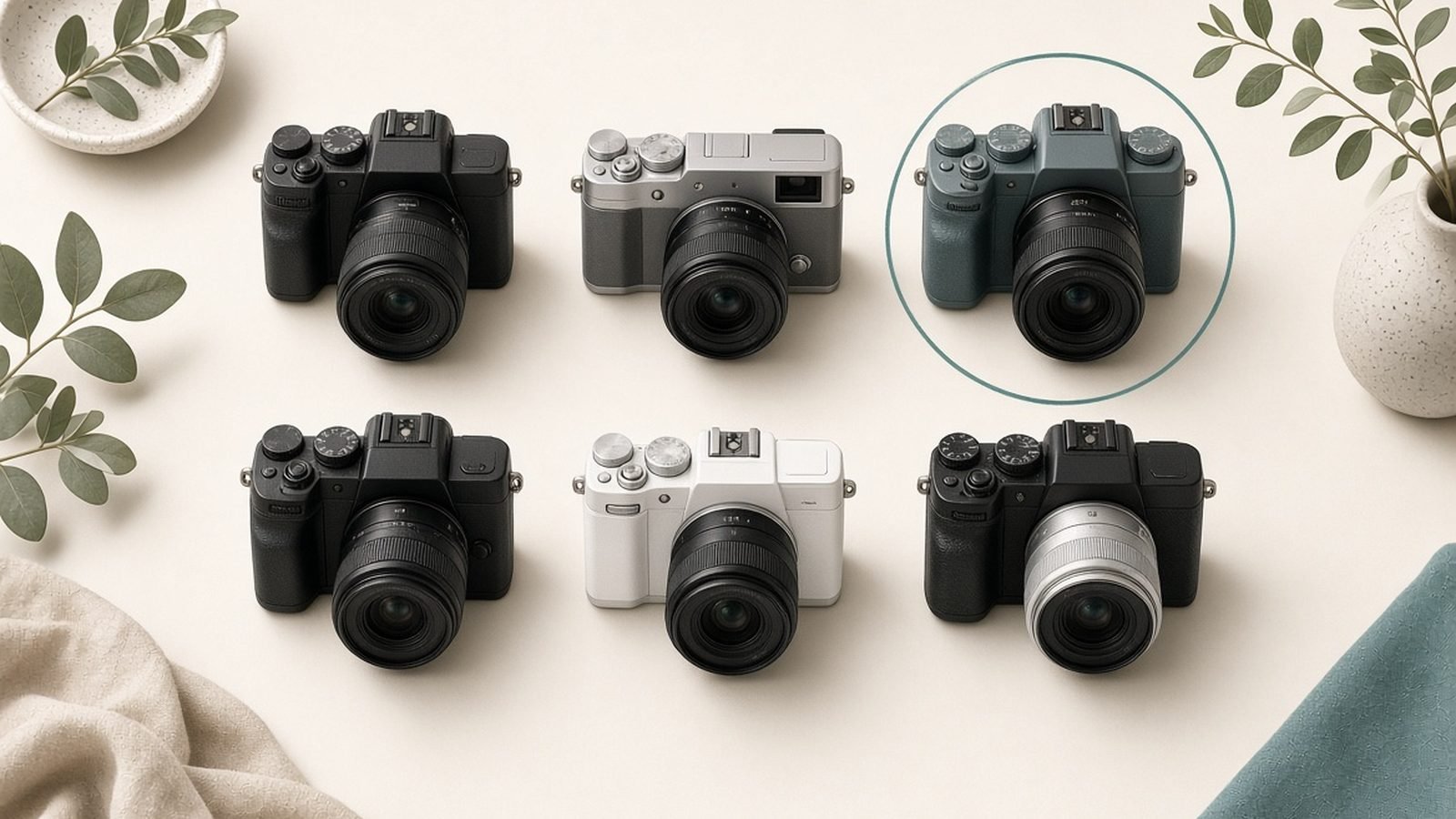
If you want the best camera for beginners in 2026, the short answer is the Canon EOS R50. It pairs genuinely simple menus, reliable autofocus and a tiny body with the most beginner-friendly interface in its class, and it costs around $679 / £689 with a kit lens. Most people learning photography or starting a YouTube channel will be happy with it for years.
That said, “beginner” covers a lot of ground. If video is your main goal, a Sony ZV camera makes more sense. If you care about how the camera looks and how photos feel straight out of the box, Fujifilm and Nikon have compelling answers. Below are six cameras we would confidently hand to a first-timer, each with a clear job.
Best beginner cameras at a glance
| Pick | Camera | Best for | Price (US / UK) |
|---|---|---|---|
| Best overall | Canon EOS R50 | Easiest all-rounder for photos + video | ~$679 / £689 |
| Best for video | Sony ZV-E10 II | Vlogging and YouTube | ~$999 / £909 |
| Best for style | Fujifilm X-M5 | Great JPEGs, film looks | ~$799 / £799 |
| Best retro design | Nikon Z fc | Classic dials, learning exposure | ~$959 / £999 |
| Best budget | Canon EOS R100 | Cheapest way into a real camera | ~$479 / £549 |
| Simplest compact | Sony ZV-1F | Point-and-shoot creators | ~$499 / £519 |
Prices move around, especially on kit bundles and during sales, so treat these as a snapshot rather than a promise.
How we picked
We are an editorial team, not a lab, and we will not pretend otherwise. These picks come from close reading of manufacturer specs, cross-checking US and UK retail pricing, and aggregating a year of owner feedback and creator reviews. When we say a camera has weak battery life or a fiddly kit lens, that reflects consistent patterns in owner reports, not a number we made up.
For beginners we weighted four things above all: how quickly you can get a good shot without reading the manual, autofocus reliability, size and weight (a camera you leave at home teaches you nothing), and room to grow into better lenses. Every camera here clears that bar.
Best overall: Canon EOS R50
24MP APS-C sensor · 4K/30p video · Dual Pixel autofocus · around $679 / £689 with 18-45mm kit lens.
The EOS R50 is the camera we recommend to most first-timers because Canon has spent years refining the friendliest interface in the business. The guided menu explains what each setting does in plain English, the touchscreen works the way a phone user expects, and Scene Intelligent Auto genuinely gets exposure and focus right most of the time. You can grow into manual controls at your own pace.
Underneath the simplicity is a capable camera. The 24MP APS-C sensor produces clean, punchy photos, and Canon’s Dual Pixel autofocus with subject detection tracks people, animals and vehicles reliably, including eye detection that holds focus while your subject moves. For a beginner camera, the hit rate is excellent.
The trade-offs are real but minor at this level. The little body has no in-body stabilization, the kit lens is slow in low light, and 4K/30p comes with a mild crop. Battery life is modest, so a spare is worth buying. None of that will hold back someone learning the craft.
Pros:
- Easiest menus and guided interface of any camera here
- Reliable subject-detection autofocus with eye tracking
- Small, light and quick to pick up
Cons:
- No in-body stabilization
- Kit lens struggles in low light
- Short battery life; buy a spare
Who it’s for: Anyone who wants one small camera for photos and casual video and values a gentle learning curve over raw specs.
Best for video: Sony ZV-E10 II
26MP APS-C sensor · 4K up to 60p · class-leading autofocus · around $999 / £909 body.
If your real goal is a YouTube channel or vlog, the ZV-E10 II is the beginner-friendly choice that will not hold you back. It keeps the flip-out screen, one-touch Background Defocus button and Product Showcase mode that made the ZV line popular, then adds a much larger battery, a sharper 26MP sensor and 4K up to 60p.
Its trump card is Sony’s autofocus. Eye detection locks on and stays locked as you move around the frame, which is exactly what a solo creator needs: set it, step into the shot, and trust the focus. The built-in directional mic with its bundled windshield is usable on its own, and there is a proper 3.5mm mic input for when you upgrade.
The honest catch is the lack of in-body stabilization, so handheld walking footage benefits from a stabilized wide lens or a small gimbal. Rolling shutter also shows on fast pans. For seated talking-head content, product reviews and everyday vlogs, neither issue matters much. Read the full Sony A7 V Review 2026: The All-Rounder Full-Frame if you later want to see where Sony’s full-frame line goes.
Pros:
- Best-in-class autofocus for solo creators
- Flexible 4K up to 60p and 10-bit color options
- Big battery and a real mic input
Cons:
- No in-body stabilization
- Rolling shutter on quick pans
- Kit lens is the weakest part of the package
Who it’s for: New creators who care more about video, autofocus and audio than about pure photography.
If audio is a priority, pair it with a desktop mic from our Best USB Microphones in 2026 for Streaming and Podcasting guide, and see our Best Vlogging Cameras 2026: Creators' Picks roundup for creator-first alternatives.
Best for style: Fujifilm X-M5
26MP APS-C sensor · 6.2K/30p and 4K video · Film Simulation dial · around $799 / £799 with kit.
The X-M5 is the beginner camera for people who want their photos to look finished the moment they leave the camera. Fujifilm’s Film Simulations bake in tasteful color and contrast, so JPEGs have character without any editing, and the dedicated Film Simulation dial makes trying looks fun rather than menu-diving. For a lot of beginners, that immediate payoff is what keeps them shooting.
It is more capable than its retro charm suggests. The 26MP sensor is sharp, video punches well above its price with 6.2K/30p capture and 4K options, and the compact body is easy to carry every day. Fujifilm’s X-mount lens range is deep and includes many affordable, characterful primes to grow into.
The compromises: there is no viewfinder, so you compose on the rear screen, and there is no in-body stabilization. Autofocus, while much improved, still trails Canon and Sony a little for fast action. For street, travel, everyday and creative photography, the X-M5 is a joy.
Pros:
- Gorgeous straight-out-of-camera JPEGs via Film Simulations
- Strong video for the price, including 6.2K
- Small, stylish and genuinely fun to use
Cons:
- No electronic viewfinder
- No in-body stabilization
- Autofocus trails the best for fast action
Who it’s for: Beginners who want photos with personality and minimal editing, and who do not need a viewfinder.
Best retro design: Nikon Z fc
20.9MP APS-C sensor · 4K/30p · tactile dials · around $959 / £999 with kit.
The Z fc wins hearts with its 1980s SLR looks, but the clever part for a beginner is the physical dials. Shutter speed, ISO and exposure compensation each get their own knob, so you can see and feel how the exposure triangle works instead of hunting through menus. It is one of the most enjoyable ways to actually learn manual photography.
Beyond the styling, this is a solid 20.9MP APS-C camera with dependable Nikon color, a fully articulating touchscreen for selfies and vlogging, and access to Nikon’s Z lens system plus a huge back catalog of F-mount glass via an adapter. It feels special in a way plastic beginner bodies do not.
The downsides are worth knowing. Resolution is a touch lower than rivals, there is no in-body stabilization, and the retro grip is shallow, so larger lenses feel front-heavy. The Z fc is as much about the experience of shooting as the specs, and for many people that is exactly the point.
Pros:
- Tactile dials that teach exposure naturally
- Beautiful retro build with a flip screen
- Reliable Nikon color and lens ecosystem
Cons:
- Lower resolution than some rivals
- No in-body stabilization
- Shallow grip; less comfortable with big lenses
Who it’s for: Beginners who want to learn manual controls hands-on and love a camera with character.
Best budget: Canon EOS R100
24MP APS-C sensor · 4K/24p (cropped) · around $479 / £549 with kit.
If the goal is simply to spend as little as possible while still getting a real interchangeable-lens camera, the EOS R100 is the answer. It shares Canon’s approachable interface and a good 24MP sensor with pricier models, comes in at well under $500 / £550 with a lens, and gives you a genuine upgrade path into the RF lens system.
You are clearly buying at a price, though. Autofocus is older and less sticky than the R50’s, the screen is fixed rather than flip-out (a real limitation for vlogging), and 4K is heavily cropped and less useful. For still photography and casual family video, it delivers far more than a phone at a rock-bottom entry price.
Pros:
- Cheapest way into a proper Canon mirrorless system
- Good 24MP photos and familiar, simple menus
- Very light and pocketable with a pancake lens
Cons:
- Older, less capable autofocus
- Fixed screen; awkward for vlogging
- Cropped, limited 4K
Who it’s for: Absolute beginners on a tight budget who mainly shoot photos and want room to grow.
Simplest compact: Sony ZV-1F
1-inch sensor · fixed 20mm-equivalent lens · 4K/30p · around $499 / £519.
Not everyone wants to think about lenses. The ZV-1F is a fixed-lens compact built for creators who want to pull it out, flip the screen and record. The wide 20mm-equivalent view is made for arm’s-length selfie video, the one-inch sensor beats any phone in low light, and the same Background Defocus and Product Showcase tricks from Sony’s bigger ZV cameras are here.
The limits are the flip side of that simplicity: the lens does not zoom, autofocus is good but not Sony’s very latest, and stills are secondary to video. As a grab-and-go vlogging camera for someone who never wants to change a lens, it is hard to beat at the price.
Pros:
- True point-and-shoot simplicity for video
- One-inch sensor outperforms phones in low light
- Flip screen and creator-friendly modes built in
Cons:
- Fixed wide lens with no zoom
- Photos are a secondary strength
- No hot shoe for larger accessories
Who it’s for: Creators who want the easiest possible vlogging camera and never plan to buy extra lenses.
How to choose your first camera
Start with what you shoot. If it is mostly video and talking to camera, prioritize a flip screen, good autofocus and a mic input — the ZV-E10 II or ZV-1F. If it is mostly photos, the R50, X-M5 and Z fc are all excellent.
Think about size and habit. The best beginner camera is the one you actually carry. Smaller bodies like the X-M5 and R50 get used far more than bulky ones that stay in a drawer.
Weigh the learning experience. Physical dials, as on the Nikon Z fc, teach exposure faster than menus. Guided interfaces, as on the Canon R50, remove friction while you learn. Both are valid paths.
Finally, budget for the system, not just the body. Every camera here uses interchangeable lenses (except the fixed-lens ZV-1F), and your next lens will improve your photos more than a new body would. Factor one affordable prime into your plans. For a wider view of where these bodies sit, see our Best Mirrorless Cameras 2026: Full-Frame & APS-C guide.
FAQ
What is the best camera for beginners in 2026?
For most people it is the Canon EOS R50. It combines the friendliest menus, reliable autofocus and a small body at around $679 / £689 with a kit lens. If your focus is video, the Sony ZV-E10 II is the better beginner buy; if you want characterful photos with no editing, the Fujifilm X-M5 is our pick.
Should a beginner buy a mirrorless camera or a DSLR in 2026?
Mirrorless, in nearly all cases. New lenses, autofocus development and camera bodies are almost entirely focused on mirrorless systems now, so you get better tracking, lighter bodies and a longer upgrade path. DSLRs still take great photos, but you would be buying into a system that is winding down.
Is a beginner camera worth it over a smartphone?
Yes, if you want to learn photography or make better video. A dedicated camera gives you a larger sensor for cleaner low-light shots, real background blur, interchangeable lenses and proper controls. For quick snaps a phone is fine, but a camera rewards you as your skills grow in a way a phone cannot.
How much should a beginner spend on their first camera?
You can start a real camera system for under $500 / £550 with the Canon EOS R100, and around $679 / £689 gets you the far more capable R50 kit. Spending $800–$1,000 buys stronger video and autofocus. We would not push a first-timer past $1,000 until they know what they enjoy shooting.
Do I need extra lenses to start?
No. The kit lens bundled with most of these cameras is a fine place to learn. Once you know what you like, a single affordable prime lens (for sharper images and background blur) is usually the best next purchase and will improve your photos more than upgrading the camera body.
Which beginner camera is best for YouTube?
The Sony ZV-E10 II for interchangeable-lens flexibility, or the Sony ZV-1F if you want the simplest possible setup. Both have flip-out screens, strong autofocus and creator-focused features. Pair either with a good microphone and you have a complete starter kit for talking-head videos.
Zen Tech Hub may earn a commission from links on this page, at no extra cost to you.