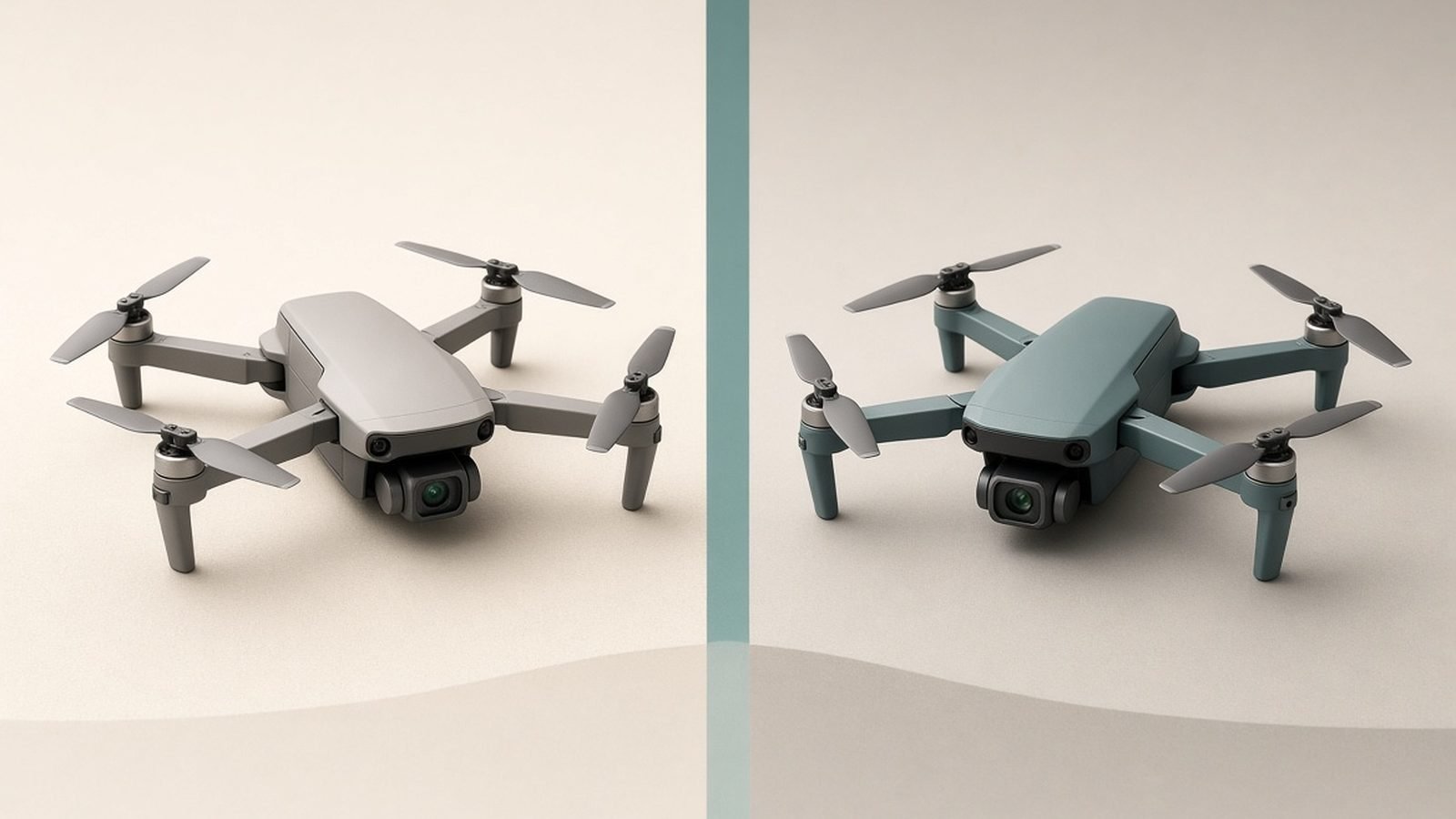
The DJI Mini 5 Pro vs Air 3S decision is one of the cleanest in DJI’s whole lineup, and also one of the most misunderstood. On paper the Air 3S looks like the obvious “better” drone: bigger, dual cameras, longer range. But the Mini 5 Pro slips in under 250g, and that single number changes how, where and whether you’re even allowed to fly. This is not really a camera contest. It’s a portability-versus-capability call, and the right answer depends almost entirely on how you plan to fly.
Below we break down price, size, image quality, flight time and the legal weight rules for both US and UK pilots, so you can stop second-guessing and buy the one that actually fits your life.
Quick Verdict
Buy the Mini 5 Pro if you value travel, simplicity and lighter legal obligations. Its sub-250g weight means no FAA registration for recreational flying in the US, and a body that disappears into a jacket pocket. It’s the better everyday and travel drone.
Buy the Air 3S if image quality and reach come first. The dual-camera 1-inch system, longer effective range and stronger wind resistance make it the more capable creative tool, as long as you accept the FAA registration that comes with a heavier drone in the US.
If you’re new to drones entirely, also read our Best DJI Drone for Beginners in 2026 guide before you commit.
Price and Combos
| DJI Mini 5 Pro | DJI Air 3S | |
|---|---|---|
| Starting price | around $799 / £689 | around $1,099 / £959 |
| Weight | Under 250g | Around 724g |
| Camera | Single 1-inch, 50MP | Dual: 1-inch wide + 70mm tele |
| Max flight time | ~36 min | ~45 min |
| Transmission | DJI O4 | DJI O4 |
| Wind resistance | Moderate | Strong (higher class) |
| Obstacle sensing | Omnidirectional + LiDAR | Omnidirectional + forward LiDAR |
| Legal (sub-250g perks) | Yes | No |
Both drones follow DJI’s usual tiered combos. Expect a bare “base” kit with one battery, then Fly More combos that add two extra batteries, a charging hub and a carry bag for roughly $300 to $400 / £280 to £360 more. For most buyers the Fly More combo is the honest purchase, because a single battery on either drone runs out fast once you factor in flying to your subject and back.
Size, Weight and Portability
This is the heart of the sub 250g vs air drone debate. The Mini 5 Pro folds down to something you can genuinely carry every day. It fits in a coat pocket or the side of a small camera bag, and you’ll actually bring it out because packing it costs you nothing.
The Air 3S is not huge, but at roughly 724g it’s a deliberate “I’m going out to fly” object. It needs a dedicated slot in your bag, and you feel it on a long hike.
Weight also drives the law, and this is where the Mini 5 Pro’s advantage becomes concrete:
In the UK, the weight difference does not separate these two on paperwork. The CAA requires a Flyer ID for any drone of 100g or more and an Operator ID as well if it has a camera or weighs 250g or more, so the Mini 5 Pro and the Air 3S both need both: the Flyer ID test is free and online, and the Operator ID costs £12.34 a year (CAA registration pages, read 2 October 2026).
In the US, all drones flown recreationally must be registered with the FAA if over 250g. The Mini 5 Pro sits right under that line for its lighter recreational category, while the Air 3S must be registered and marked.
The Air 3S is over 250g, so FAA registration applies in the US, and the FAA notes that a drone needing a registration number also has to broadcast Remote ID. For the full breakdown, see Do You Need a License to Fly a Drone? (US & UK 2026).
Best DJI drone for travel? For most people it’s the Mini 5 Pro, and it isn’t close. Lighter bag, fewer forms, fewer countries where you’re caught out at the border.
Camera and Image Quality
Here the Air 3S earns its price. The air 3s vs mini 5 pro camera gap comes down to that second lens.
The Mini 5 Pro uses a single 1-inch sensor with a 50MP still capability and 4K video at high frame rates. For a sub-250g drone this is genuinely excellent, and in good light most viewers won’t be able to tell its footage apart from a bigger drone. It also supports true vertical shooting, which is a real advantage if social content is your priority.
The Air 3S pairs a 1-inch wide-angle sensor with a second medium-telephoto camera (around 70mm equivalent). That tele lens is the difference maker: it gives you real optical reach for compression, portraits of landscapes, and safer distance from your subject, without the mush of a digital crop. Based on owner reports, the second camera is the feature people say they’d miss most if they downgraded.
DJI Mini 5 Pro
Pros - Class-leading image quality for a sub-250g drone - True vertical shooting for social content - Lightweight, travel-friendly, lighter legal load
Cons - Single camera, no optical telephoto - Less capable in strong wind - Shorter effective range than the Air 3S
DJI Air 3S
Pros - Dual-camera system with a genuine telephoto lens - Longer range and stronger wind resistance - More headroom for serious photography and video
Cons - Over 250g, so FAA registration and Remote ID apply in the US - Heavier and bulkier to carry - Meaningfully more expensive once you add a combo
If photography specifically is your driver, our DJI Mini 5 Pro Review 2026: The Beginner Drone to Beat digs deeper into the Mini’s image pipeline, but for a pure dji drone for photography pick, the Air 3S’s two focal lengths give you more to work with.
Flight Time and Range
The Air 3S leads on stamina, with a rated flight time of around 45 minutes versus roughly 36 for the Mini 5 Pro. Real-world numbers are always lower once you account for wind, cold and flying home with margin, but the ranking holds: the Air 3S simply stays up longer.
Both drones use DJI’s O4 transmission, so line-of-sight video feed is strong on each. In practice, though, the Air 3S holds a cleaner signal at distance and pushes further before quality degrades. Combined with better wind resistance, it’s the drone you want for coastal, mountain or open-water flying where conditions turn quickly.
The Mini 5 Pro is no slouch and its O4 link is reliable, but its lighter body gets shoved around more in gusts. Based on owner reports, that’s the most common frustration Mini pilots mention, not image quality.
Obstacle Avoidance and Safety
Both drones are well specified here, which is part of why this dji drone comparison 2026 feels so close. Each offers omnidirectional obstacle sensing plus LiDAR to help with low-light and night flying, and both run DJI’s mature return-to-home and automatic braking systems.
In our research the practical difference is small. The Air 3S’s sensing suite is tuned for confident flight at higher speeds and greater distances, which suits its role as the longer-range drone. The Mini 5 Pro’s system is impressive for the size and more than enough for the closer, more casual flying most owners do with it. Neither should be treated as a licence to fly carelessly, but both are among the safer drones you can buy.
Which Drone Should You Buy?
Strip away the spec sheet and the decision is really about that 250g line.
Choose the DJI Mini 5 Pro if you’re a traveller, a casual creator, or anyone who wants the least friction. It’s lighter to carry, lighter on paperwork, and its single 1-inch camera is good enough that you’ll rarely feel short-changed. This is the best DJI drone for travel for the vast majority of people, and the one you’ll actually take with you.
Choose the DJI Air 3S if you’re a keen photographer or videographer who wants the telephoto lens, longer range and stronger wind performance, and you’re comfortable registering your drone with the FAA if you fly in the US. It’s the more capable creative tool, full stop.
Still torn between mini 5 pro or air 3s? Default to the Mini 5 Pro unless you can name a specific reason you need the tele lens or the extra range. Most people can’t, and the lighter drone makes them happier.
Explore more guides on our Cameras & Creator Gear.
FAQ
Is the DJI Mini 5 Pro really exempt from the theory test? No. In the UK the CAA requires a Flyer ID — a free online theory test — for any drone of 100g or more, and an Operator ID as well for one with a camera, so the 249g Mini 5 Pro needs both, exactly as the Air 3S does. In the US every recreational flyer takes the free TRUST test; what the Mini 5 Pro avoids there is FAA registration, which starts at 250g. Always confirm current rules for your country before you fly.
Does the Air 3S take noticeably better photos than the Mini 5 Pro? In good light the gap on the shared 1-inch wide camera is small. The real difference is the Air 3S’s second telephoto lens, which gives optical reach the Mini simply can’t match. If you want compression and framing options, the Air 3S wins. If you mostly shoot wide, the Mini is very close.
Which is better for windy coastal or mountain flying? The Air 3S. Its heavier body and higher wind-resistance rating hold position better in gusts, and its longer range gives more confidence over open water. Based on owner reports, wind is the Mini 5 Pro’s main weakness, though it remains flyable in moderate conditions with sensible margins.
Is the Mini 5 Pro good enough for professional work? For social content, travel films, real estate and much commercial video, yes. Its 1-inch sensor and vertical shooting cover a lot of paid work. Serious photographers who need telephoto reach or maximum flexibility will still prefer the Air 3S, but plenty of pros happily use a Mini as their carry-everywhere drone.
Are the Fly More combos worth it? For nearly everyone, yes. A single battery on either drone disappears quickly once you fly to your subject and back with a safe reserve. The extra batteries, charging hub and bag in the Fly More combo turn both drones from a frustrating one-flight tool into a proper day-out kit.
Zen Tech Hub may earn a commission from links on this page, at no extra cost to you.