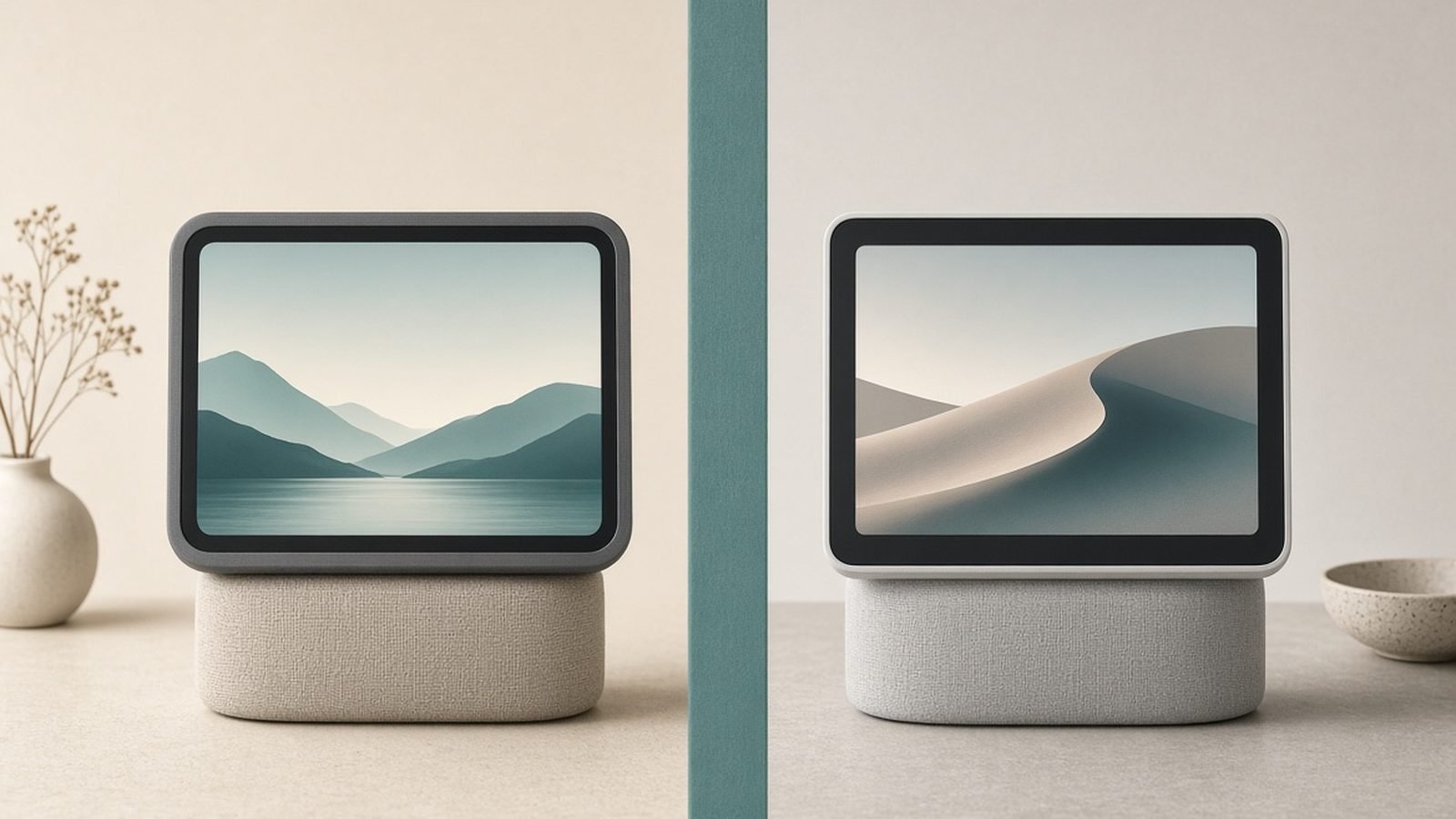
The Echo Show 8 vs Nest Hub question used to be a genuine coin flip. In 2026, it isn’t. Amazon shipped a substantially redesigned Echo Show 8 (4th Gen) in late 2025 — new chip, Omnisense presence detection, a full local smart home hub and Alexa+ — while Google is still selling the same Nest Hub (2nd Gen) it launched in 2021, with no successor in sight.
That doesn’t make the Nest Hub worthless. It’s cheap, camera-free and still a lovely bedside device. But if you’re choosing a smart display to actually run your home for the next five years, the honest answer has changed.
Quick answer
Buy the Echo Show 8 (4th Gen) if you want the best all-round smart display in 2026: better screen, far better speakers, built-in Thread/Matter/Zigbee hub duties, and Alexa+ actively improving month by month. It costs around $180 / £160, and drops to roughly $125 in sales.
Buy the Nest Hub (2nd Gen) only if you’re deep in Google’s ecosystem, you refuse to put a camera in the room (it doesn’t have one), or you want a bedside display with sleep tracking for around $100 / £85 — often nearer $60 on sale. Just go in knowing you’re buying five-year-old hardware from a company that has visibly deprioritised smart displays.
Specs and price face-off
| Amazon Echo Show 8 (4th Gen) | Google Nest Hub (2nd Gen) | |
|---|---|---|
| Released | Late 2025 | March 2021 |
| Screen | 8.7-inch HD touchscreen | 7-inch, 1024 x 600 touchscreen |
| Speakers | Stereo front-facing drivers + custom woofer, spatial audio | Single full-range driver |
| Camera | 13MP with auto-framing (no physical shutter) | None |
| Presence/sensors | Omnisense suite (radar, ultrasound, camera, audio) | Soli radar (sleep sensing, gestures) |
| Smart home radios | Wi-Fi 6E, Thread, Zigbee, Matter controller, Bluetooth | Wi-Fi ac, Thread, Matter controller, Bluetooth |
| Assistant | Alexa, with Alexa+ rolling out | Google Assistant; Gemini for Home rollout ongoing and uneven |
| Video calling | Yes (Alexa calling, Zoom) | Audio only (no camera) |
| Price | Around $180 / £160 (frequent $125-ish deals) | Around $100 / £85 (often $60 or less on sale) |
Two things jump out. First, the Echo Show 8 is a 2025-generation device competing with 2021 hardware — the gap in silicon, radios and audio is exactly as large as those dates suggest. Second, the Nest Hub’s one structural advantage is the thing it lacks: a camera. For plenty of bedrooms, that’s decisive.
Displays, speakers and design compared
The 4th-gen Echo Show 8 moved to a cleaner design than the chunky fabric wedge of old: a rounded display that appears to float above a smaller speaker base. The 8.7-inch panel is bigger, brighter and noticeably sharper than the Nest Hub’s ageing 7-inch, 1024 x 600 screen, which looks soft in 2026 — fine for glanceable cards and photos, less fine for recipe videos across the kitchen.
Audio is not a close contest. The Echo Show 8 pairs stereo front-facing drivers with a dedicated woofer and spatial audio processing, and in our research it’s consistently rated among the best-sounding smart displays ever made — genuinely good enough to be your kitchen speaker. The Nest Hub’s single small driver is fine for podcasts, radio and sleep sounds, and that’s the ceiling. Based on hundreds of owner reports, music on the Nest Hub is the single most common complaint after sluggishness.
Google’s counterpunch is aesthetic and practical: the Nest Hub is smaller, lighter and easier to tuck onto a nightstand or a crowded shelf, and its ambient light sensor still does an excellent job matching photo frames to room lighting. If the display is going to spend 95% of its life as a digital photo frame, the Nest Hub remains quietly excellent at that job.
Alexa+ vs Google Assistant and Gemini on screens
This is where 2026 buyers need the most guidance, because both companies are mid-transition.
Amazon’s Alexa+ — the generative-AI rebuild of Alexa — is designed around exactly this class of device, and the 4th-gen Echo Show 8 is one of its flagship homes. Owners report much more natural conversation, multi-step requests (“dim the lights, lock up and play something mellow”), and usefully summarised camera feeds and calendars on screen. Alexa+ is free with Prime (otherwise a monthly fee), and the rollout has been gradual: US customers broadly have it, UK availability has been expanding through 2026. Buy the Show 8 and you’re buying into a platform Amazon is visibly investing in.
Google’s story is messier. Gemini for Home began replacing Assistant on Nest speakers and displays in late 2025, but the rollout to the 2021 Nest Hub has been slow and uneven, and in our research owner sentiment is mixed — some love the smarter conversations, others report regressions in basic commands that classic Assistant nailed for years. Google Assistant remains the better assistant for pure knowledge questions and Google-service integration (Calendar, Photos, YouTube, YouTube Music), and the Nest Hub is still the only one of the two with native YouTube on screen. But you’re betting on Google continuing to care about a hardware line it hasn’t refreshed in five years.
On the classic alexa vs google assistant smart display question — Alexa for shopping, routines, timers-with-names and device breadth; Google for questions, Photos and YouTube — the fundamentals still hold. What’s changed is momentum, and it’s all Amazon’s.
Smart home control: Thread, Matter and Zigbee hub duties
If you want the best smart display for smart home control, this section settles it.
The Echo Show 8 (4th Gen) is a complete smart home hub in one box: Zigbee radio, Thread border router, Matter controller and Wi-Fi 6E. That means older Zigbee sensors and bulbs connect directly with no extra bridge, new Matter-over-Thread devices get a strong local connection, and many routines run locally, so lights respond even when your internet doesn’t. If you’re new to Matter, our explainer covers what actually works today What Is Matter? The Smart Home Standard Explained (2026).
Then there’s Omnisense, the headline of the echo show 8 omnisense marketing push. It fuses radar, ultrasound, camera and audio so the display knows when someone enters the room — and can trigger routines from presence alone, not just voice. Walk into the kitchen at 7am and the lights, radio and coffee-machine smart plug come on without a word. Paired with energy-monitoring plugs, that’s real automation, not gimmickry Best Smart Plugs With Energy Monitoring in 2026.
The Nest Hub 2 is a Thread border router and Matter controller too — Google deserves credit for enabling that on 2021 hardware — but there’s no Zigbee, so a Hue bridge or equivalent stays on your network for older gear (see our Hue alternatives guide Best Philips Hue Alternatives in 2026: Cheaper Smart Bulbs). Google Home’s app has improved enormously, and its Automations editor is arguably nicer than Alexa’s. But the Nest Hub’s slower chip shows: based on aggregated owner reports, touch responsiveness and device-control latency are the most-cited frustrations with the 2nd Gen in 2026.
Winner: Echo Show 8, comfortably. One box, three radios, local control, presence sensing.
Privacy: cameras, mics and sensor data
The Nest Hub’s best feature is the camera it doesn’t have. If a display is going in a bedroom or a bathroom-adjacent hallway, “no camera, full stop” beats any shutter or kill switch. Its Soli radar handles sleep sensing and gesture control without ever recording an image, and mic mute is a physical switch.
The Echo Show 8 has a 13MP camera and — a genuine regression Amazon deserves criticism for — the 4th-gen model dropped the physical camera shutter its predecessors had. You get a mic/camera electronic kill switch, but privacy-conscious buyers reasonably preferred a sliding cover. Omnisense also means the device is, by design, always sensing the room; Amazon lets you disable individual sensors, but the default posture is “aware.”
Both companies process voice in the cloud (with growing local processing), both let you review and delete recordings, and both have had trust wobbles over the years. But if your question is “which one goes in the bedroom?”, the camera-free Nest Hub wins this section outright.
Kitchen, bedside and desk: which fits where?
Kitchen: the Echo Show 8 is the better smart display for kitchen duty and it isn’t close. Bigger, brighter screen for recipes, vastly better speakers over extractor-fan noise, video calls while cooking, and Omnisense triggering your morning scene when you shuffle in. The Nest Hub counters with native YouTube for recipe videos — worth something — but the small dim screen and thin audio undermine it.
Bedside: the Nest Hub 2 was practically designed for the nightstand. No camera, free Soli-based sleep sensing (Google folded it into the free tier after retiring the Fitbit Premium requirement for basics), sunrise alarms, and a screen that dims beautifully at night. The Echo Show 8 works fine as an alarm clock, but a camera pointed at your bed with no physical shutter is a hard sell; Amazon’s smaller Echo Show 5 is the better Alexa bedside pick.
Desk: Echo Show 8 for video calls (auto-framing 13MP camera, Zoom support) and music while you work; Nest Hub if you just want a glanceable calendar-and-Photos companion that stays out of your meetings.
The elephant in the room: Google’s neglected display lineup
Here’s the context every echo show vs nest hub comparison in 2026 needs to state plainly: Amazon iterated, Google stagnated.
Since the Nest Hub 2 launched in March 2021, Amazon has shipped multiple generations of the Show 5, Show 8, the Show 10, the Show 15, the wall-mountable Echo Hub, a redesigned Show 8 and a new Show 11 — plus the Alexa+ platform to run on them. Google in the same window: discontinued the Nest Hub Max (with Assistant features being wound down on it), shipped no new Nest display, and pushed its screen ambitions toward Pixel Tablet and TV instead. Long-rumoured Gemini-era Google displays have yet to materialise as of mid-2026.
Google still updates the Nest Hub 2 and is rolling Gemini toward it, so this isn’t abandonware. But when one product line gets annual investment and the other gets maintenance, the five-year buying decision writes itself. If Google ships a genuinely new display later this year, we’ll revisit this verdict — that’s the honest caveat.
Alternatives worth considering
Amazon Echo Hub — for serious smart home builders
Around $180 / £170, the Echo Hub is not a media device — it’s a wall-mountable, always-on control panel with a dashboard-first interface, Thread, Zigbee and Matter. If your home has 30+ devices and you want a family-friendly control surface by the front door, it’s the best dedicated panel at the price. Weak speaker, so it complements rather than replaces a Show 8. Browse more hub options in our smart home hub guide Smart Home.
Echo Show 5 (3rd Gen) — the bedside Alexa
Around $90 / £90 and frequently near half that, the Show 5 is the right Alexa answer to the Nest Hub’s nightstand dominance: compact, has a physical camera shutter (unlike its bigger sibling), and does alarms, sunrise wake-ups and quick controls well. Screen and sound are basic — treat it as a smart alarm clock, not a kitchen display.
Check price: Amazon Echo Show 5 (3rd Gen)
An iPad or cheap Android tablet
A tablet on a stand gives you real apps, real YouTube and real browsing. But it lacks far-field mics, always-on ambient displays, hub radios and multi-user voice — and it walks off its stand within a week in most households. Tablets make great secondary dashboards, poor primary smart displays.
Echo Show 8 (4th Gen): pros and cons
Pros
- Best-in-class audio for a smart display, with spatial processing
- Full hub: Thread border router, Zigbee, Matter, Wi-Fi 6E, local routines
- Omnisense presence sensing enables genuinely hands-free automation
- Alexa+ is improving fast and is free with Prime
- Sharp 8.7-inch screen, 13MP auto-framing camera for calls
Cons
- No physical camera shutter — a real step backwards
- No native YouTube; browser workaround is clunky
- Alexa+ rollout still uneven outside the US
- Amazon’s interface pushes shopping and suggestions harder than Google’s
Check price: Amazon Echo Show 8 (4th Gen)
Google Nest Hub (2nd Gen): pros and cons
Pros
- No camera — the easy bedroom recommendation
- Free Soli sleep sensing, sunrise alarms, superb ambient photo frame
- Native YouTube and deep Google Calendar/Photos integration
- Thread border router and Matter support despite its age
- Cheap, and regularly heavily discounted
Cons
- 2021 chip: owners widely report lag in touch and device control
- Weak single speaker; soft, dim 7-inch screen
- Gemini for Home rollout has been slow and mixed on this hardware
- No successor announced — an ageing platform bet
Check price: Google Nest Hub (2nd Gen) Check price: Google Nest Hub (2nd Gen)
FAQ
Is the Nest Hub 2nd Gen still worth it in 2026?
Yes — narrowly, and only at sale prices. At $60 or less it’s still the best camera-free bedside display, with free sleep sensing and an excellent photo frame. At full price, its 2021 chip, weak speaker and Google’s stalled display roadmap make the Echo Show 8 the smarter long-term buy for most rooms.
Does the Echo Show 8 (4th Gen) have a camera shutter?
No. Unlike the 2nd and 3rd generation models, the 4th-gen Echo Show 8 dropped the physical sliding shutter. You can disable the camera and mics with an electronic kill switch, and turn off individual Omnisense sensors in settings, but there’s no physical cover — worth knowing before putting one in a bedroom.
Can the Echo Show 8 or Nest Hub work with Matter?
Both are Matter controllers with Thread border routers, so both control Matter-over-Wi-Fi and Matter-over-Thread devices. The Echo Show 8 adds a Zigbee radio, letting older sensors and bulbs connect without a separate bridge. In practice the Show 8 is the more complete single-box hub for a mixed-protocol smart home.
Which is better for a kitchen: Echo Show 8 or Nest Hub?
The Echo Show 8. Its larger, brighter 8.7-inch screen is easier to read across a kitchen, its stereo-plus-woofer audio survives extractor-fan noise, and it handles video calls while you cook. The Nest Hub’s trump card is native YouTube for recipe videos, but its small screen and thin speaker hold it back.
Will the Nest Hub get Gemini?
Google has been rolling Gemini for Home out to existing Nest speakers and displays since late 2025, including the Nest Hub 2, with early access tied to the Google Home app’s public preview. The rollout has been gradual and owner feedback mixed, so treat Gemini as a likely upgrade — not a guaranteed transformation — on this 2021 hardware.
Is Alexa+ free on the Echo Show 8?
Alexa+ is included with Amazon Prime at no extra cost; without Prime it’s a standalone monthly subscription (around $19.99/month in the US). Classic Alexa remains free either way. Availability is broad in the US and has been expanding in the UK through 2026, so check current rollout status for your region before buying on that basis.
Verdict: which should you buy?
For most people in 2026, the Echo Show 8 (4th Gen) wins the echo show 8 vs nest hub contest decisively. It’s the better screen, a dramatically better speaker, a complete Thread/Matter/Zigbee hub, and the front door to Alexa+ — current hardware on an ascending platform, for around $180 / £160 and often much less.
The Nest Hub (2nd Gen) keeps two clear wins: it’s the only camera-free option, and at sale prices it’s an unbeatable bedside and photo-frame device for Google households. Buy it for the nightstand with eyes open about its age.
And if you’re building a display-heavy smart home with dozens of devices, add the wall-mounted Echo Hub as your control panel and let the Show 8 handle the kitchen.
Zen Tech Hub may earn a commission from links on this page, at no extra cost to you.