Philips Hue makes the most polished smart lighting on the market — and in 2026, the most expensive by an even wider margin than usual. In June, Signify raised the US price of the new Hue Bridge Pro from $99 to around $140, a roughly 40% jump blamed on tariffs, and it wasn’t alone: several Hue bulbs and fixtures crept up at the same time. If you’ve been searching for Philips Hue alternatives, this is the year the maths finally tips in your favour.
Here’s the twist: the best cheap alternative to Hue might be Hue itself. The new Hue Essential range delivers the core Hue experience at roughly half the classic price. But Govee, Nanoleaf, WiZ and LIFX all undercut even that — and thanks to Matter, mixing brands is no longer the compatibility minefield it was in 2024.
In our research for this guide, we compared published specs, firmware update histories and hundreds of owner reports across US and UK retailers to find the smart bulbs that genuinely rival Hue — and to be honest about where they fall short.
Philips Hue Alternatives at a Glance
| Product | Best for | Price (approx.) | Hub needed? | Matter support |
|---|---|---|---|---|
| Govee colour bulbs + M1 strip | Best overall alternative | ~$15 / £12 (bulb); ~$60 / £50 (M1 strip) | No (Wi-Fi) | Yes, on newer gear |
| Nanoleaf Essentials A19/E27 | Best no-hub Matter bulb | ~$20 / £18 | No (Thread border router helps) | Yes (Matter over Thread) |
| WiZ Colour A19/E27 | Best dirt-cheap option | ~$13 / £10 | No (Wi-Fi) | Yes |
| LIFX Colour | Best colour accuracy | ~$35 / £30 | No (Wi-Fi) | Yes |
| Hue Essential colour bulb | Best “Hue but cheaper” | ~$25 / £20 | No (Bluetooth) or Bridge | Via Bridge |
| Hue Bridge Pro | Power users staying with Hue | ~$140 / £90 | Is the hub | Yes |
Why People Are Looking Beyond Hue in 2026
Three things are pushing long-time fans to shop around.
Price. A single classic Hue colour bulb still costs around $50 / £45. The Bridge Pro’s June 2026 US price hike — from its $99 launch price to roughly $140 — made headlines because it landed barely nine months after the hub debuted. UK pricing has held steadier at around £90, but nobody would call it cheap.
The account requirement. Since late 2025, Hue has required a Hue account for app access. It’s a minor friction for most people, but for a product line whose pitch was “it just works, locally, forever”, it stung — and owner forums lit up accordingly.
The competition got good. Matter has matured to the point where a Govee strip, a Nanoleaf bulb and an IKEA sensor can sit in one Apple Home or Google Home setup and mostly behave. The Hue tax no longer buys you the only good ecosystem — just the most polished one. New to the standard? Start here: What Is Matter? The Smart Home Standard Explained (2026).
Hue’s Own Budget Answer: The Hue Essential Range
Best for: Hue loyalists who want the app and reliability without the classic price
Signify saw the exodus coming. The Hue Essential line, launched alongside the Bridge Pro, is effectively Hue undercutting itself: a colour-capable A19/E27 bulb for around $25 / £20 — half the price of a classic Hue colour bulb.
What do you give up in the hue essential vs hue classic comparison? Brightness, mainly. Essential bulbs top out lower than the 1,100-lumen classics, and they miss the entertainment-sync features that make Hue special for TV and gaming. Based on owner reports since launch, colour quality is very close to classic Hue at typical dimmed levels.
Essential bulbs run over Bluetooth out of the box, or join a Bridge for the full experience: scenes, schedules, away-from-home control and rock-solid Zigbee reliability.
Pros
- Genuine Hue colour science and app polish at half the classic price
- Works hub-free over Bluetooth, upgrades gracefully to a Bridge
- Same long firmware-support track record as the rest of the Hue line
Cons
- Dimmer than classic Hue bulbs
- No entertainment/sync support
- Still pricier than every non-Hue bulb in this guide
Check price: Philips Hue Essential A19/E27 colour bulb
Verdict: if you already own a Bridge or you’re wedded to the Hue app, Essential bulbs are the obvious way to expand cheaply. If you’re starting from zero, keep reading — your money goes further elsewhere.
Best Overall Alternative: Govee
Best for: most people — especially anyone who wants light strips, ambient effects and TV backlighting
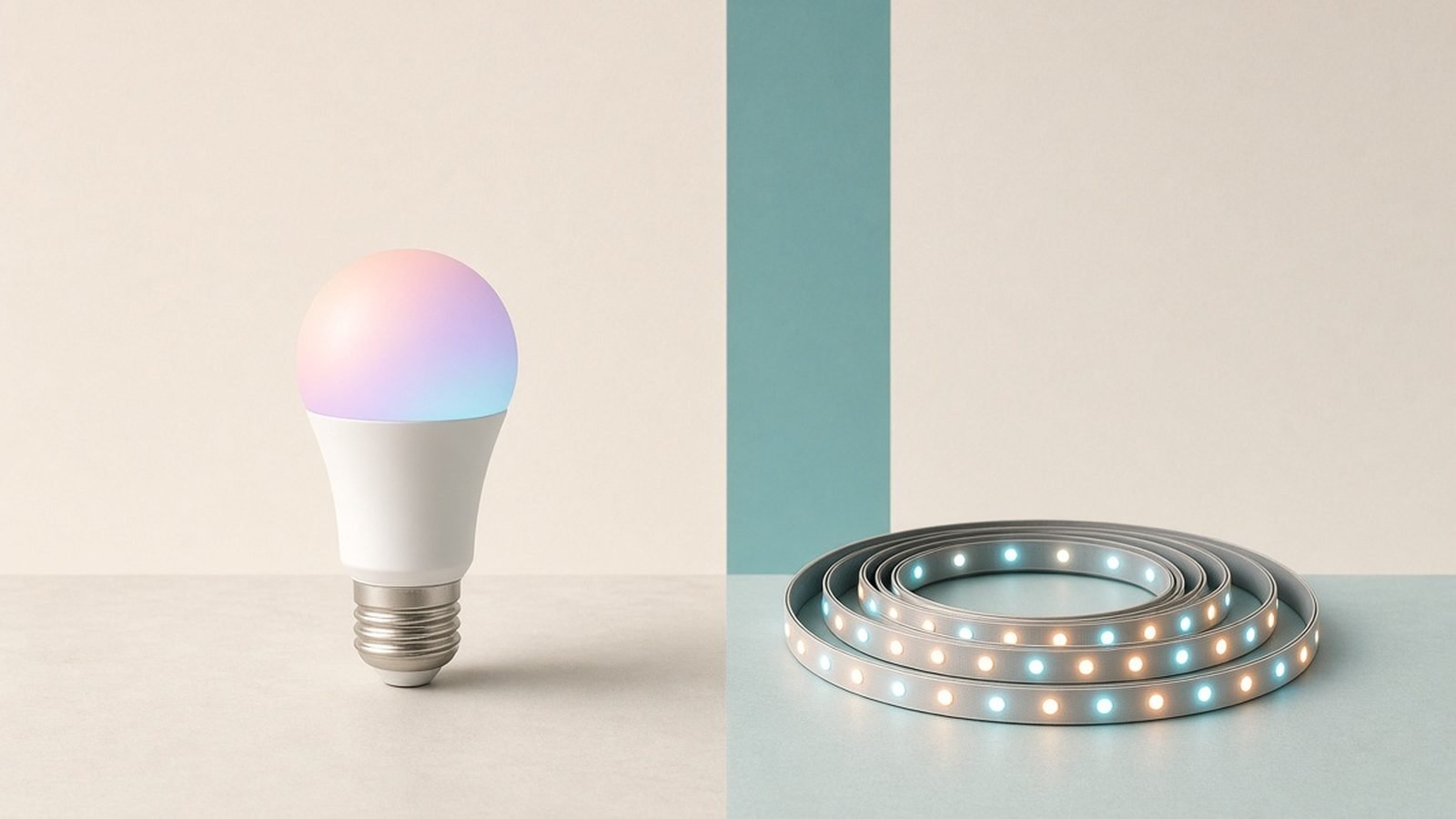
If we had to hand someone a single brand to replace Hue room-for-room, it would be Govee. Colour bulbs run around $15 / £12, and the flagship M1 LED strip — with individually addressable segments that Hue’s standard Lightstrip still can’t match at anywhere near the price — costs about $60 / £50.
The govee vs hue question really comes down to what you value. Hue wins on colour consistency across a room, app polish and Zigbee reliability. Govee wins on effects (its scene library is enormous), strip lighting value, and sheer range — floor lamps, curtain lights, outdoor permanent lights, TV backlight kits with camera-based colour matching. Newer Govee gear supports Matter, so you can fold it into Apple Home, Google Home or Alexa alongside other brands.
The trade-offs are real. The Govee Home app is busy to the point of chaotic — part controller, part social feed, part storefront. And based on hundreds of owner reports, colour consistency between different Govee product lines lags Hue: two “red” scenes on a bulb and a strip may not quite agree. For a party wall or a gaming den, nobody cares. For subtle whole-home white-light scenes, Hue still does it better.
Pros
- Outstanding value, especially strips and ambient fixtures
- Best-in-class effects and scene library
- Matter support on newer devices; works with all major voice assistants
- Huge product range Hue simply doesn’t offer
Cons
- Cluttered, upsell-heavy app
- Colour matching across product lines is below Hue’s standard
- Older Wi-Fi-only gear can be sluggish on congested networks
Check price: Govee LED Strip Light M1 Check price: Govee colour bulbs
Verdict: the best cheaper alternative to Philips Hue for most homes. Buy the M1 strip first — it’s the product that makes Hue owners question their life choices.
Best No-Hub Matter Bulbs: Nanoleaf Essentials
Best for: Apple Home and Google Home users who want smart bulbs without a hub — done properly
Most “smart bulbs without hub” options mean Wi-Fi, which gets messy past a couple of dozen devices. The Nanoleaf Essentials A19 (around $20 / £18) takes the smarter route: Matter over Thread. Bulbs form their own low-power mesh network that doesn’t touch your Wi-Fi, and every mains-powered Thread device strengthens the mesh.
The nanoleaf essentials matter bulb has quietly become the default recommendation in Apple Home circles, and in our research the reasons hold up: pairing straight into Apple Home or Google Home with no Nanoleaf account required, vivid saturated colours that punch above the price, and up to 1,100 lumens — matching classic Hue bulbs that cost twice as much.
The caveat is infrastructure. Thread bulbs are only as reliable as your border router. With a HomePod, Apple TV 4K, or recent Nest hub in the house, owners report Hue-grade responsiveness. Without one, you’re on Bluetooth fallback, which is noticeably slower and shorter-ranged. Early Essentials firmware had a rocky reputation; reports since mid-2025 are far more positive, but Nanoleaf’s software track record is still a tier below Signify’s.
Pros
- Matter over Thread: no hub, no Wi-Fi congestion, local control
- Bright (up to 1,100 lm) with excellent colours for the price
- No account needed when paired directly with Apple/Google Home
Cons
- Wants a Thread border router for best reliability
- Nanoleaf’s app and firmware polish trail Hue
- Fewer shapes and fittings than Hue or Govee
Check price: Nanoleaf Essentials A19 (Matter/Thread)
Verdict: the best budget smart bulbs for anyone already holding a HomePod or Nest device. Skip if you have no border router and no plans to get one.
Best Dirt-Cheap: WiZ
Best for: filling a whole house with colour bulbs on the smallest possible budget
Here’s the industry’s worst-kept secret: WiZ is owned by Signify, the same company behind Hue. It’s the budget brand Hue runs so that your money leaves the room but not the building — and at around $13 / £10 for a full-colour A19/E27 bulb, it’s the cheapest credible option in this guide.
Any honest wiz smart bulbs review lands in the same place. The good: simple Wi-Fi setup with no hub, Matter support, a clean app with solid scheduling and rhythms, and SpaceSense — a genuinely clever feature that uses Wi-Fi signal disturbance between bulbs to detect motion in a room, no sensor hardware required. Owner reports on SpaceSense are mixed on sensitivity (pets trigger it; sometimes ceiling fans do too), but as a free bonus on a $13 bulb, it’s hard to grumble.
The compromises: colour vibrancy and dimming smoothness are a clear step below Hue and LIFX, especially in deep blues and low-end dimming. And because every bulb is a Wi-Fi client, big installs can strain budget routers — beyond 25–30 devices, owners on cheaper ISP hardware report dropouts.
Pros
- Absurdly cheap; regularly discounted below list price
- No hub, Matter support, decent app
- SpaceSense motion detection costs nothing extra
Cons
- Colour quality and dimming below Hue/LIFX standard
- Large installs can congest household Wi-Fi
- Plastic-feeling hardware; shorter warranty than Hue
Check price: WiZ Colour A19/E27
Verdict: the price-per-socket champion. Light six rooms with WiZ for the cost of two classic Hue bulbs and spend the savings on a decent thermostat — see our picks: Best Smart Thermostats UK 2026: tado vs Hive vs Nest.
Best for Colour Accuracy Purists: LIFX
Best for: people who left Hue over price but refuse to compromise on light quality
LIFX has spent a decade as the enthusiast’s answer to “are Philips Hue lights worth it?” Its colour bulbs (around $35 / £30) are the brightest and most saturated in this class, and features like Polychrome Technology — multiple colour zones inside a single bulb — do things no Hue bulb can.
No hub is required; LIFX runs over Wi-Fi with Matter support on current models, and the app rewards tinkerers with per-zone painting and effects. Based on long-running owner feedback, the flip side is consistency: LIFX’s reliability reputation has had rough patches across its changes of ownership, and at $35 a bulb you’re drifting back toward Hue Essential money.
Pros
- Best-in-class brightness and colour saturation
- Multi-zone colours in a single bulb
- No hub; Matter on current models
Cons
- Pricier than every non-Hue rival here
- Reliability history is patchier than Hue’s
- Wi-Fi-only, so the usual congestion limits apply
Check price: LIFX Colour A19/E27
Verdict: the connoisseur’s pick. Two or three LIFX bulbs in the rooms where light quality matters, WiZ everywhere else, is a killer combination.
When Hue Is Still Worth It
Let’s be fair to the incumbent, because sometimes the answer to “are Philips Hue lights worth it?” is still yes.
Entertainment sync. Nothing else matches the Hue Sync ecosystem — the HDMI sync box, gradient strips and play bars reacting to your TV in real time. Govee’s camera-based TV kits are 80% as good for 40% of the money, but the last 20% is visible.
Scale and reliability. The Bridge Pro handles 150+ lights on its own Zigbee network, immune to Wi-Fi congestion, with MotionAware turning bulbs themselves into motion sensors. If you’re automating a large home, that engineering is what the money buys. Price-hike sting aside, no rival hub does more.
Longevity. Signify still ships updates to bulbs sold a decade ago. In our research, no competitor comes close to that support record.
If you’re deep in Hue and staying, pair it with a decent display for control — we compare the options in Echo Show 8 vs Google Nest Hub (2026): Best Smart Display.
Check price: Philips Hue Bridge Pro
Mixing Ecosystems with Matter: What Works in 2026
The old advice was “pick one brand and stick to it”. Matter has mostly retired that. A mixed 2026 setup — Nanoleaf bulbs, a Govee strip, WiZ in the hallway — works day-to-day from Apple Home or Google Home, with on/off, dimming and colour behaving consistently.
What still doesn’t transfer through Matter: brand-specific magic. Govee’s music-reactive scenes, WiZ’s SpaceSense and Hue’s entertainment sync all live in their native apps only. Our rule of thumb: buy on Matter for control, but pick each brand for the exclusive feature you’ll actually use. Smart plugs follow the same logic — see Best Smart Plugs With Energy Monitoring in 2026.
Cost Comparison: Lighting a 3-Bed Home on Each System
Assume 15 colour bulbs (living room, kitchen, three bedrooms, hall) plus one light strip. Approximate street prices, July 2026:
| System | 15 colour bulbs | 1 light strip | Hub | Total |
|---|---|---|---|---|
| Hue Classic + Bridge Pro | ~$750 / £675 | ~$90 / £80 | ~$140 / £90 | ~$980 / £845 |
| Hue Essential + Bridge Pro | ~$375 / £300 | ~$90 / £80 | ~$140 / £90 | ~$605 / £470 |
| LIFX | ~$525 / £450 | ~$70 / £60 | — | ~$595 / £510 |
| Nanoleaf Essentials | ~$300 / £270 | ~$50 / £45 | — | ~$350 / £315 |
| Govee | ~$225 / £180 | ~$60 / £50 | — | ~$285 / £230 |
| WiZ | ~$195 / £150 | ~$35 / £30 | — | ~$230 / £180 |
The spread is stark: a full WiZ home costs less than a quarter of a classic Hue setup, and even Hue’s own Essential range saves you nearly $400 / £375 over classic bulbs.
FAQ
What is the best cheap alternative to Philips Hue?
Govee is the best all-round cheaper alternative to Philips Hue in 2026. Colour bulbs cost around $15 / £12 against roughly $50 / £45 for classic Hue, its light strips beat Hue’s on features and price, and newer devices support Matter. WiZ is cheaper still at around $13 / £10 a bulb, but Govee’s colour quality and product range justify the small premium.
Do smart bulbs work without a hub?
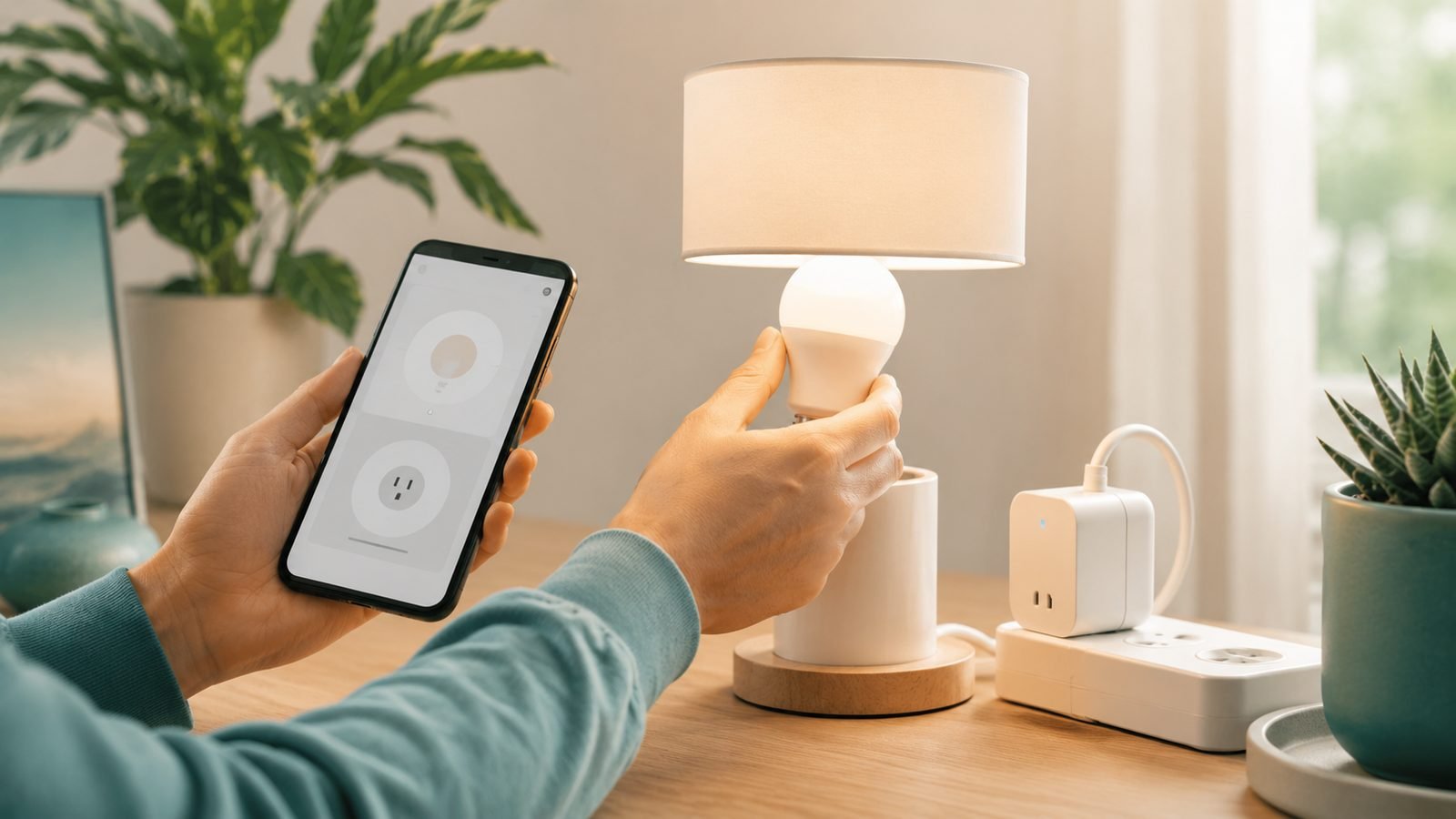
Yes. Every non-Hue pick in this guide — Govee, WiZ and LIFX over Wi-Fi, Nanoleaf Essentials over Matter-and-Thread — works without a dedicated hub. Wi-Fi bulbs can congest budget routers past roughly 25–30 devices, while Thread bulbs need a border router (HomePod, Apple TV 4K or recent Nest hub) for best reliability. Even Hue’s Essential bulbs work hub-free over Bluetooth.
Is Govee as good as Philips Hue?
Not quite, but it’s closer than the price gap suggests. Hue wins on colour consistency, app polish, Zigbee reliability at scale and entertainment sync. Govee wins on price, effects and product variety — especially addressable light strips, where the M1 outclasses Hue’s standard strip for a fraction of the cost. For most rooms, most people won’t miss the difference.
What’s the difference between Hue Essential and Hue Classic bulbs?
Hue Essential bulbs cost about half as much (~$25 / £20 vs ~$50 / £45) but are dimmer than the 1,100-lumen classic bulbs and don’t support Hue’s entertainment sync features. Both use the same app, work with the Hue Bridge, and share Hue’s colour science. Essential is the better buy unless you need maximum brightness or TV sync.
Why did the Hue Bridge Pro get more expensive?
Signify raised the US price of the Bridge Pro from its $99 launch price to around $140 in June 2026, citing tariff-related costs, with several bulbs and fixtures rising at the same time. UK pricing stayed close to £90. The hike is a big reason searches for Philips Hue alternatives spiked this summer.
Are WiZ bulbs made by Philips?
Effectively, yes. WiZ is owned by Signify, the company that makes Philips Hue. WiZ is the budget Wi-Fi brand: no hub, Matter support and very low prices, but simpler hardware and colour quality a step below Hue. Buying WiZ gets you Signify’s firmware support record at a third of the price.
Verdict: Which Philips Hue Alternative Should You Buy?
- Most people: start with Govee — bulbs at ~$15 / £12 and the M1 strip deliver 90% of the experience for 30% of the money.
- Apple Home or Google Home households: Nanoleaf Essentials for hub-free Matter-over-Thread bulbs that stay off your Wi-Fi.
- Tightest budget: WiZ, and don’t look back — a whole home for ~$230 / £180.
- Light-quality obsessives: LIFX in the rooms you live in, cheaper bulbs elsewhere.
- Already own a Bridge: expand with Hue Essential bulbs and ignore the rest of this article.
The real story of 2026 is that the Hue premium is now a choice, not a requirement. Between the Essential range’s price cut and Matter’s maturity, there’s never been a better time to build smart lighting your way. For more of our smart home coverage, head to the hub: Smart Home.
Zen Tech Hub may earn a commission from links on this page, at no extra cost to you.