Two engineering decisions explain most of AMD’s standing with PC builders in 2026. The first is 3D V-Cache: the extra stacked cache on Ryzen X3D processors lifts gaming frame rates far enough to make the top X3D chip the fastest mainstream gaming CPU available. The second is the long-lived AM5 socket, which lets you drop in a faster processor later without buying a new motherboard. Graphics is a closer call: Radeon cards are the value choice, strong in raster performance and generous with video memory, while Nvidia keeps the edge in ray tracing and FSR still sits a step behind DLSS. Verdict: buy AMD Ryzen for gaming and mixed-use desktops with confidence, and buy Radeon if value and raster performance matter more to you than best-in-class ray tracing and upscaling.
AMD’s comeback over the last several years is one of tech’s better stories: from underdog to setting the gaming-CPU standard. This profile covers where that leadership is real and where Nvidia and Intel still have the edge.
Company overview
Advanced Micro Devices (AMD) was founded in 1969 and is headquartered in Santa Clara, California. For decades it was the scrappy alternative to Intel in CPUs; its 2006 acquisition of ATI added the Radeon graphics business. AMD’s fortunes transformed with the 2017 launch of the Zen architecture, which restored its competitiveness against Intel, and with subsequent Zen generations it took the gaming-performance lead. Under CEO Lisa Su, AMD also grew a substantial data-center and semi-custom business.
Like Nvidia, AMD is fabless — it designs chips and outsources manufacturing (largely to TSMC). AMD is unusual in supplying both leading-edge CPUs and GPUs, plus the semi-custom silicon inside the PlayStation 5 and Xbox Series consoles, and the chips in many handheld gaming PCs. That console and handheld presence quietly makes AMD one of the most widely used gaming-silicon brands in the world.
What AMD makes
AMD’s consumer and enthusiast portfolio:
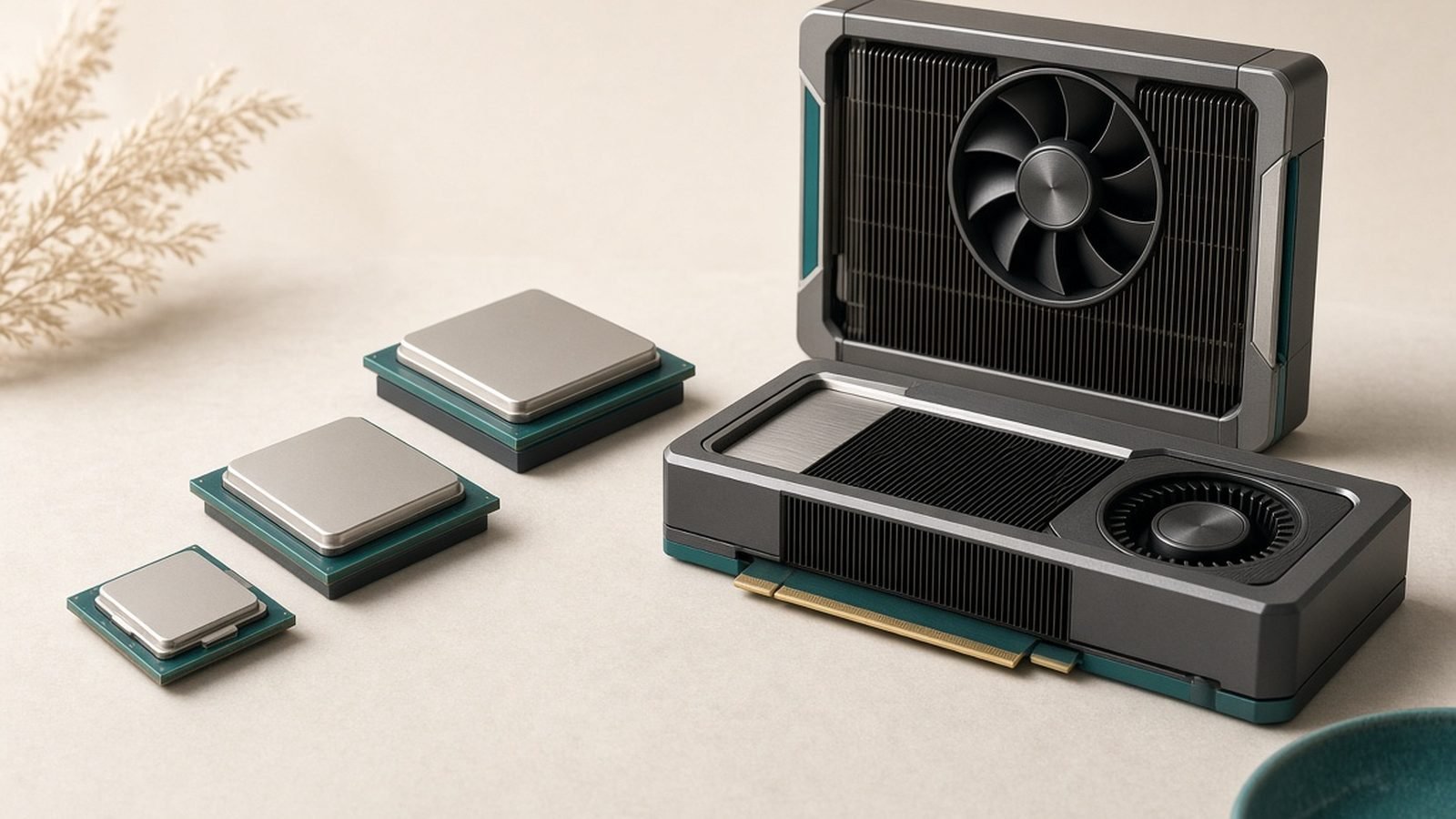
- Ryzen desktop CPUs: The mainstream and enthusiast processor line, including the gaming-focused X3D models with stacked 3D V-Cache. Built on the AM5 socket.
- Ryzen mobile and Ryzen AI laptop chips: Efficient laptop processors, increasingly with on-chip AI (NPU) acceleration.
- Radeon graphics cards: The RX gaming GPU line, competing on value and raster performance, with FSR upscaling.
- Ryzen Threadripper: High-end desktop/workstation CPUs with very high core counts for creators and professionals.
- Semi-custom console and handheld silicon: The APUs inside PlayStation 5, Xbox Series X/S, and popular handheld gaming PCs.
- Software: The Adrenalin driver suite, FSR (FidelityFX Super Resolution) upscaling and frame generation, and tuning tools like Ryzen Master.
- Data-center CPUs and AI accelerators (EPYC, Instinct): Not consumer products, but a growing part of the business.
Standout products in 2026
Ryzen X3D gaming CPUs. AMD’s 3D V-Cache processors are the standout: the extra cache dramatically boosts gaming frame rates, making the top X3D chip the fastest mainstream gaming CPU available. These are the default recommendation for high-refresh gaming builds and headline our Best CPUs 2026: Gaming & Productivity Processors guide. If you are torn between platforms, our head-to-head AMD vs Intel 2026: Which CPU Should You Buy? breaks down exactly who should pick which.
Ryzen 9000 (Zen 5) and the AM5 platform. Beyond the X3D halo parts, the broader Ryzen 9000 range covers gaming and productivity well, and AM5’s long-lived socket means you can drop in a faster chip later without a new motherboard — a real ownership advantage over frequently-changing sockets.
Radeon RX GPUs. AMD’s current Radeon cards target strong 1440p and 4K raster performance and typically include generous VRAM for the money, which helps longevity. They trail Nvidia in ray tracing and in upscaling maturity (FSR is improving but still generally a step behind DLSS), but they are frequent value picks in Best Graphics Cards 2026: GPUs for Every Budget. Pair one with a high-refresh display from Best Gaming Monitors 2026: OLED, 4K & High Refresh.
Ryzen AI laptop chips. For thin-and-light laptops, AMD’s efficient mobile processors deliver strong battery life and, increasingly, NPU acceleration for on-device AI features.
For most people, the single best AMD purchase is a Ryzen X3D CPU — it is where the brand’s lead is clearest.
Strengths
Best-in-class gaming CPUs. The X3D chips lead gaming performance, often by meaningful margins in CPU-bound titles, while running efficiently.
Platform longevity. AM5’s long socket support lets you upgrade the CPU across multiple generations, lowering the long-term cost of ownership.
Value across the stack. Ryzen CPUs and Radeon GPUs frequently deliver more cores, cache, or VRAM per dollar than direct rivals, which appeals to budget-conscious builders.
Strong multi-threaded and creator performance. Higher-core Ryzen and Threadripper parts are excellent for rendering, compiling, and heavy multitasking.
Ubiquity in gaming. Powering the major consoles and many handhelds gives AMD huge real-world reach and developer familiarity with its architecture.
Weaknesses & criticisms
Radeon trails in ray tracing and upscaling. In ray-traced games and image reconstruction, Nvidia remains ahead; FSR has closed some of the gap but is still generally behind DLSS in stability and adoption. Compare in our Nvidia Brand Profile 2026: GeForce RTX GPUs & AI profile.
Software polish gaps. AMD’s Adrenalin suite is feature-rich, but the brand has periodically faced driver-stability complaints, and its creator/AI software ecosystem is less mature than Nvidia’s CUDA world.
Early-platform teething and pricing. New AM5 launches have at times carried high motherboard and memory costs, and early Zen generations sometimes needed BIOS updates to reach full performance.
Mixed idle efficiency on some desktop chips. While gaming efficiency is strong, some Ryzen desktop CPUs draw comparatively high power at idle due to their chiplet design.
Less mindshare in prebuilt and OEM systems. Intel and Nvidia still dominate many prebuilt and business machines, so AMD options can be harder to find off the shelf.
Reliability & support
AMD’s hardware is generally reliable, and Ryzen CPUs in particular have a solid track record. Retail (“boxed”) CPUs typically carry a three-year warranty, which is reassuring for a core component. The most common historical complaint has been software rather than silicon — occasional Radeon driver issues — though AMD has improved stability and updates the Adrenalin suite regularly.
For Radeon graphics cards, note the same board-partner dynamic as Nvidia: most retail cards are built by partners (ASUS, Sapphire, PowerColor, XFX and others), so cooler quality and warranty terms vary by brand and model. AMD supports its platforms with long BIOS/AGESA update tails, which is part of what makes AM5 a good long-term bet. Driver and chipset software updates are frequent. Overall, AMD offers dependable core hardware; the main things to research are specific Radeon partner-card quality and your motherboard’s BIOS update history.
Who should buy
Buy AMD Ryzen if you are building or upgrading a gaming or mixed-use desktop and want the best gaming performance and a platform you can upgrade for years — an X3D chip on AM5 is the enthusiast sweet spot. Buy Radeon if you prioritize raster performance and VRAM per dollar and don’t mind trailing in ray tracing and upscaling. AMD laptop chips are a strong pick for battery life.
Lean Intel instead if you want the best all-core productivity efficiency or need widely available prebuilt/business machines (see Intel Brand Profile 2026: Core CPUs & Arc GPUs), and lean Nvidia for graphics if ray tracing, DLSS, or creator/AI software are priorities (see Nvidia Brand Profile 2026: GeForce RTX GPUs & AI). Our current rankings live in Best CPUs 2026: Gaming & Productivity Processors and Best Graphics Cards 2026: GPUs for Every Budget.
FAQ
Is AMD a good brand?
Yes. AMD makes the best gaming CPUs in 2026 and competitive, value-oriented graphics cards, and it powers the major consoles. Its main relative weaknesses are Radeon ray tracing and some software polish versus Nvidia.
Is AMD or Intel better for gaming?
AMD leads gaming CPU performance in 2026 thanks to its X3D chips, and AM5 offers longer upgrade support. Intel is very competitive on all-core productivity and efficiency. Our AMD vs Intel 2026: Which CPU Should You Buy? comparison covers who should pick which.
Are Radeon GPUs worth it over Nvidia?
If you want more raster performance and VRAM for the money and can live with weaker ray tracing and a less mature upscaler (FSR vs DLSS), yes. If ray tracing, DLSS, or creator/AI software matter most, Nvidia is the safer pick. Compare in Best Graphics Cards 2026: GPUs for Every Budget.
What is 3D V-Cache (X3D)?
It is AMD’s technique of stacking extra L3 cache on the CPU. That large cache dramatically improves performance in many games, which is why X3D chips top gaming charts. For pure productivity, non-X3D or Intel parts can be equally good.
How long will an AM5 motherboard last?
AMD has committed to supporting the AM5 socket across multiple CPU generations, so an AM5 board bought today should accept faster Ryzen chips for years — a key reason AMD builds are cost-effective over time.
Do AMD CPUs come with a cooler?
Some lower and mid-tier Ryzen chips include a stock cooler, but higher-end and X3D models often do not, expecting you to add your own. Budget for a quality air or liquid cooler with performance parts.
Zen Tech Hub may earn a commission from links on this page, at no extra cost to you.